

I’ve used a lot of smart wearables over the years and honestly, most of them feel like a coach that judges your sleep. When I wore the Hume band for the first time, I thought it would be another fitness tracker that would simply tell me to move more and sleep better. Instead, it tried to tell me about my emotions, which I found interesting and a little strange.

While the looks are comparable to WHOOP, I have realised that this isn’t exactly the same. Unlike traditional fitness trackers, it doesn’t have a screen, but it focuses more on emotional awareness and long-term health patterns. But the main question that arises is, does it really work or is it just another wearable with big claims? Here is my Hume band review.
What Is the Hume Band?
The Hume Band is a screenless wearable designed by Hume Health that moves away from traditional fitness metrics to focus on longevity and emotional resilience.
Unlike an Apple Watch that distracts you with pings, the Hume Band is minimalist, which means it is a simple, lightweight strap that weighs only 8.6g and sits quietly on your wrist. Its core premise isn’t just counting calories, it’s about tracking your Metabolic Capacity and Metabolic Momentum.
Decode the Decor
The Smart Jewelry Revolution — a practical guide to wearable tech.
Hume Band acts as a Personal Longevity Coach that uses your body’s signals to tell you if your current habits are aging you faster or helping you stay young.
How Does Hume Band’s Emotion Tracking Actually Work?
© Hume Band
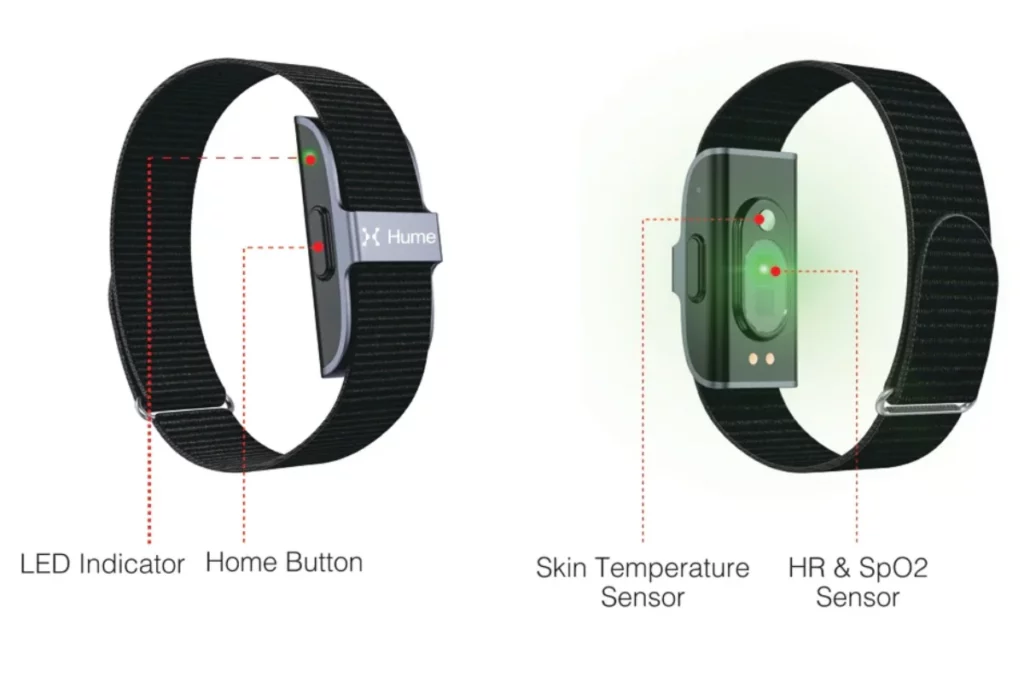
When I first heard emotion tracking through Emotion AI, I pictured a mood ring from the ’90s. But Hume’s approach is far more scientific. The band uses a high-density sensor array. It has 5 LEDs and 4 photodiodes to monitor physiological signals like Heart Rate Variability (HRV), skin temperature and respiratory rate.
By running these through its unique AI algorithm, the band assesses your emotional state. For example, a spike in heart rate combined with low HRV and a change in skin temp might be interpreted as High Stress or Anxiety.
A 2015 study published in IEEE EMBC suggests that HRV is a solid proxy for emotional states, but you need to keep in mind that the band is making an educated guess based on your biology, not reading your actual feelings.
Design, Comfort and Build Quality
If you’ve used a WHOOP, the Hume band will feel familiar. The Hume band uses a SuperKnit material that makes it incredibly weight weighs 8.6 grams.
This band is comfortable enough for 24/7 wear, especially during sleep, which is where most bulky watches fail. It comes with an IP68 rating, which means you can wear it even in the shower, although personally I don’t like it because the elastic material gets wet.
What Does Hume Band Track?
Hume band will also have a blood pressure feature post an FDA approval via future app updates. It doesn’t just give you raw numbers, it tells you about your health and breaks down your data into:
Emotion Metrics & Stress

© Hume
It monitors for signs of immune system dysfunction or inflammation even before you sneeze, which is called Metabolic Momentum. It is essentially a score of whether your habits are slowing down or speeding up your biological clock.
Heart Rate & HRV

© Hume
It tracks your heart rate 24/7. The HRV tracking is the main thing here, as its primary data point is used to calculate your Recovery Score. Instead of focusing on spikes during workouts alone, the band looks at HRV trends throughout the day. Especially during sleep, to understand how your nervous system is responding to stress.
Over time, these patterns help the app identify whether your body is adapting well to your routine or showing signs of accumulated strain, which then influences daily readiness and recovery recommendations.
Sleep Tracking
Hume band breaks your sleep into Light, Deep and REM stages. In my testing, it was as accurate as my Oura Ring 4 for identifying overall sleep trends rather than minute-by-minute precision.
It also monitors SpO2 during sleep, along with breathing rate and overnight heart rate variability, which helps build a clearer picture of recovery.
Stress & Recovery

© Hume
It provides a Daily Readiness score that blends HRV, sleep quality, resting heart rate and metabolic signals to estimate how well your body has recovered. If your HRV drops and your Metabolic Capacity is drained, the app will tell you to take a rest day.
What I like about the Hume band is that it doesn’t just flag stress, it tries to balance strain and recovery, showing when your nervous system is shifting back into a “rest-and-digest” state.
App Experience and Data Interpretation

© Hume
The Hume app is where the magic happens. The dashboard is clean, using visual gauges rather than confusing spreadsheets.
You get a Longevity Index, which is a mix of your activity, sleep and metabolic health. It gives actionable nudges, which means instead of just saying your HRV is 40, it says, “Your recovery is low, try a 5-minute breathing session”.
However, there is a slight risk of over-interpretation. Like any AI, it can sometimes flag a high-stress moment when you were just running to catch a bus.
The Hume Band syncs perfectly with your Apple Health, Google Fit and Samsung Health.
Accuracy and Scientific Plausibility
Can a wristband really tell if I’m happy? Not exactly. But it can tell if your Autonomic Nervous System is in fight or flight or rest and digest mode.
HRV is widely accepted in the medical community as a marker for stress. However, the Hume Band is a consumer device, not a medical tool. While the 5-LED array is impressive for a wearable, real-world factors like how tight the band is or your skin tone can affect the PPG sensors.
It’s best used for trend tracking over weeks, rather than obsessing over a single day’s data. In my experience, the band is excellent at catching physiological strain like illness, overtraining and chronic stress, often a day before I actually start to feel sick.
Battery Life and Charging
Hume Band gives a battery life of 4-5 days, which is not what you get with a Garmin, but it beats the Apple Watch battery life very well.
The best part is the charging. I usually just need to pop it on the charger and it goes to a 100% in about 20-80 minutes.
Subscription Economics
This is where Hume makes a strong case against competitors like WHOOP. It is priced at $356 USD. Unlike WHOOP, which requires a monthly fee to access your data, Hume offers its core metrics for free once you buy the band.
There is an optional membership starting at $8.99/month for Hume Plus, advanced AI coaching and longevity reports, but the device is fully functional without it. The subscription also earns you weekly health reports and a weekly Health Score, along with progress tracking. One of the biggest perks is that with a subscription, you get a free band upgrade every 2 years, so that you always stay updated with the tech.
This band is also HSA/FSA eligible.
Real-World Usage Scenarios: Who Is This For?
- If you work 12-hour days, the Hume Band acts as an early warning signal for mental and physical fatigue.
- It is for biohackers who are obsessed with metabolic age and longevity and will love the proprietary scores.
- If you want the data but hate the “smartwatch” lifestyle, this is a perfect invisible companion for you.
Who Should Avoid the Hume Band?
- If you need real-time GPS for running or a screen to see your heart rate during a HIIT session, this isn’t for you.
- If you want medical-grade EKG accuracy.
- If you expect a wearable to tell you exactly why you’re sad, you’ll be disappointed. It tracks the body signals, not the soul.
Wrap Up
The Hume Band is a meaningful innovation in the way it handles data ownership and longevity metrics. By moving the focus away from basic step-counting and towards Metabolic Momentum, it offers a more sophisticated look at how we age.
The Emotion AI is more like an advanced stress and nervous system tracker that provides the kind of early-warning insights essential for preventing burnout in a high-pressure world.
What makes the Hume Band stand out in a crowded market is its “invisible” nature. If you are looking for a performance-heavy tool for the gym, you might find the Speediance Strap more suited to tracking explosive strength and lifting metrics.
Similarly, if you want a recovery tool that lives within a massive fitness ecosystem, the Amazfit Helio Strap offers a more traditional athletic recovery experience. But WHOOP remains the gold standard.
The Hume band is a great alternative to subscription-heavy trackers. It focuses on how your emotions and habits impact your long-term health rather than just counting your steps. If you are new to screenless wearables, this is where I’d start.
FAQs
Decode the Decor
The Smart Jewelry Revolution
A practical guide to wearable tech's future — delivered straight to your inbox.
Author

Missed one of my biggest disappointments with it and that is that you have to take it off to charge it so you lose a couple hours of tracking each week, while my Whoop I can charge it while it is still on my wrist.
Also, I would have liked to have learned more about what the subscription gets you. Your section on that was very vague.
Hi, Rob. Thank you for your comment! Personally, the off-wrist charging didn’t bother me enough to call out because I’m not paying a yearly subscription like with WHOOP, so that trade-off felt acceptable. About the subscription, Hume Premium is where you get AI-driven insights, personalized coaching, weekly health reports, a weekly Health Score, and progress tracking. Perks like a free band upgrade every two years is a great addition so you stay updated with the tech, but other than that, all basic metrics are accessible without a subscription.