

 Add Us On Google
If you have been following any health-related TikTok lately, you must have come across someone strapping a glowing red belt around their waist and swearing it fixed their back pain. I wasn’t buying it either. You see, we have been so conditioned by social media that red light therapy instantly means skincare, but wearable red light therapy belts have truly emerged as one of the most intriguing gadgets in the world of recovery tech, mainly because they offer the benefit that neither panels nor hand-held devices ever offered: You don’t need to stay still.

You simply wrap yourself in a belt, let it do its magic as you fold laundry or scroll on your phones. This hands-free feature is much more important than people realize as consistency, after all, is the secret to effective red light therapy (or lack thereof).
Decode the Decor
The Smart Jewelry Revolution — a practical guide to wearable tech.
So I tested out a bunch of wearable red light therapy devices for pain relief like belts and wraps, analyzed the wavelengths, the power output, the battery life, the comfort and the price and came out with a list of the most useful products worth your money. These are not magical solutions to any problems that can go wrong with your body; this is an accessory tool to muscle pain and stiffness.
Quick Picks: Best Red Light Therapy Belts
- Novaa Light Pad – Best overall, most powerful
- Hooga Red Light Therapy Belt – Best wireless option
- MitoQUAD Wavelength Belt – Best for multi-wavelength recovery
- Lifepro Red Light Therapy Belt – Best budget pick
- Bon Charge Infrared PEMF Wrap – Best for relaxation
- Therabody ThermBack LED – Best for back pain
- Kineon MOVE+ Pro – Best for joint pain
- Lumaflex Essential – Best simple everyday wrap
- FlexBeam – Best app experience
What Red Light Therapy Can (and Can’t) Do for Pain
But before dropping hundreds of dollars on a wearable red light therapy device, it’s worth knowing what you’re actually signing up for. Red light therapy or photobiomodulation refers to the penetration of your skin and tissue with red and near-infrared lights, which supposedly interact with your cells or more precisely, your mitochondria, helping the body in its self-repair. At least this is what the researchers have found when investigating the effect of red light therapy on various conditions such as muscle soreness, joint pain and inflammation.
The evidence isn’t uniform across every condition though. The scientific support is greater for some categories of problems like post-exercise muscle soreness and general inflammation, while there are others where results are inconclusive or lacking. In other words, the statement that “red light therapy relieves pain” is true in a general sense, while its application to specific cases may vary.
The thing these belts can be used for is providing you with some temporary relief from pain, but they do not treat your health problem and are not a substitute for actually figuring out what’s causing your pain in the first place. If something’s been bothering you for weeks or it’s getting worse, that’s a conversation for a doctor, not just a belt session.
FDA Cleared, Registered, or Neither?
You’ll see these terms thrown around a lot in this space and honestly, brands aren’t always great about being clear on which one applies to them. Here’s the actual difference:
If a device is described as FDA cleared, it means that it has passed the FDA 510(k) process and it is found to be substantially equivalent to a legally marketed device. This is a regulatory process, not just registration.
If a device is FDA registered, it means that the company has registered its facility and has provided the FDA with information about this device. This does not mean that it was reviewed or approved by the FDA for a certain purpose.
Neither means the brand hasn’t gone through either process, which isn’t necessarily a dealbreaker for a low-risk wellness device, but it does mean you’re relying more on the brand’s own claims than any outside verification.
It is crucial to make sure what particular device you are going to buy and not only what brand it belongs to, because a company may have only one FDA cleared product among many others.
Novaa Light Pad: Best Overall
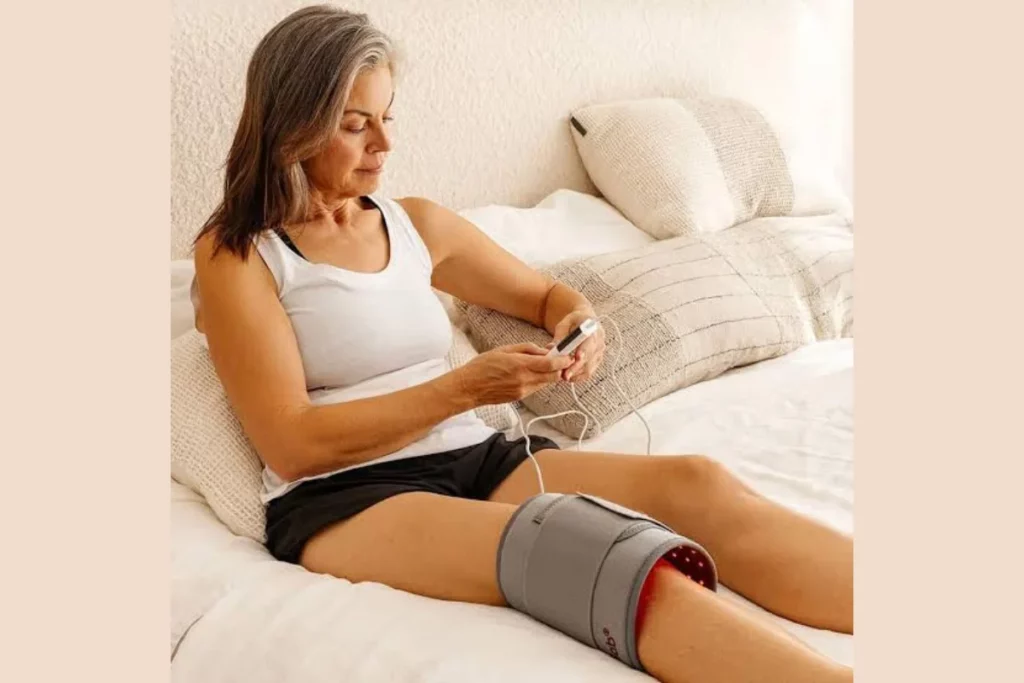
© Novaa
Price: $349.90 | Battery: Plug-in | Wavelengths: 660nm and 850nm
This one is clearly the highest-powered belt on my list of best wearable red light therapy devices for pain relief, operating at 150mW/cm², significantly more powerful than most other brands. FDA-cleared and with integrated timers so that you know when your session has ended, this one gives you peace of mind that it is safe to use. While it is light, it is also large enough to be used all over your back and is flexible enough to be wrapped around a knee or elbow just as easily.
The problem is that it needs to be plugged in for the entire duration of the session, making it unsuitable for anyone looking for portability. A separate battery pack is available at $99.90. Sessions usually last 10-20 minutes but it doesn’t have an app, so there is nothing fancy about this one at all.
Pros
- Highest power output on this list
- FDA-cleared
- Flexible enough to be used on joints or back
- Integrated safety timers
Cons
- No battery
- No app and session tracking
Hooga Red Light Therapy Belt: Best Wireless Option
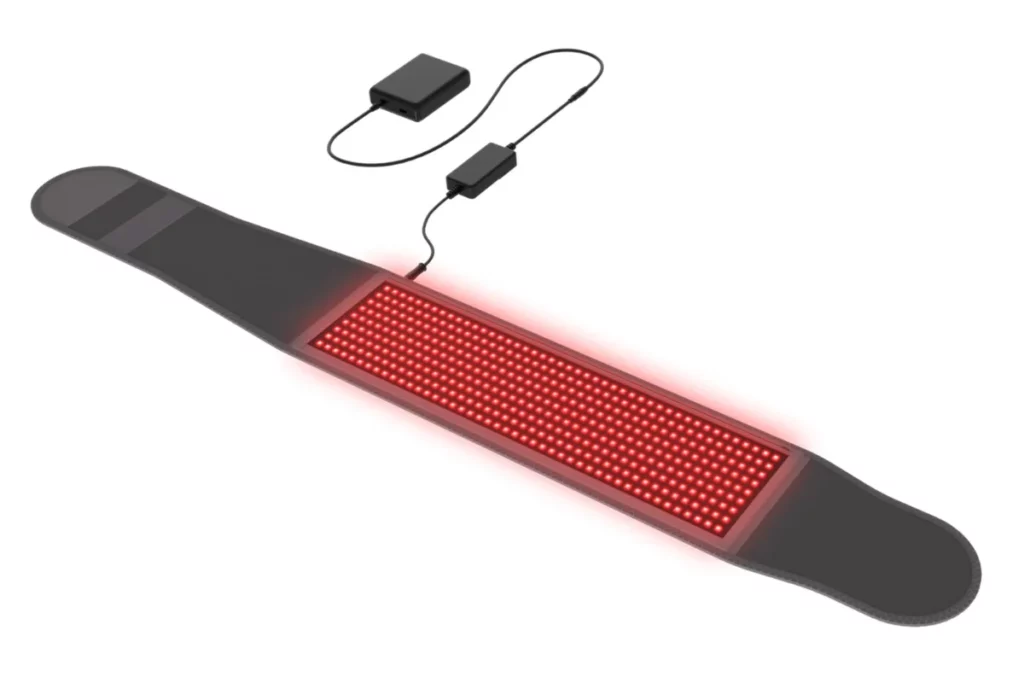
© Hogahealth
Price: $249 | Battery: Rechargeable, about 150 minutes | Wavelengths: 660nm and 850nm
If portability matters to you more than raw power, Hooga’s belt is the one to grab. The belt is wireless and rechargeable, it holds up to 10 sessions between charges and the neoprene material is surprisingly soft to the touch. Also, it has the pulsing light mode, which works better for inflammation targeting.
The output is 70 mW/cm², which is lower than that of Novaa, but intensity adjustment is included in the features list, so the power level can be adjusted to suit different areas. No app required so you control the settings manually from the belt.
Pros
- Wireless and rechargeable
- Soft neoprene material
- Intensity and pulse mode adjustment
- Easy cleaning
Cons
- Output level is lower than those of other plug-in models
- A battery allows for only 10 sessions
MitoQUAD Wavelength Belt: Best for Multi-Wavelength Recovery
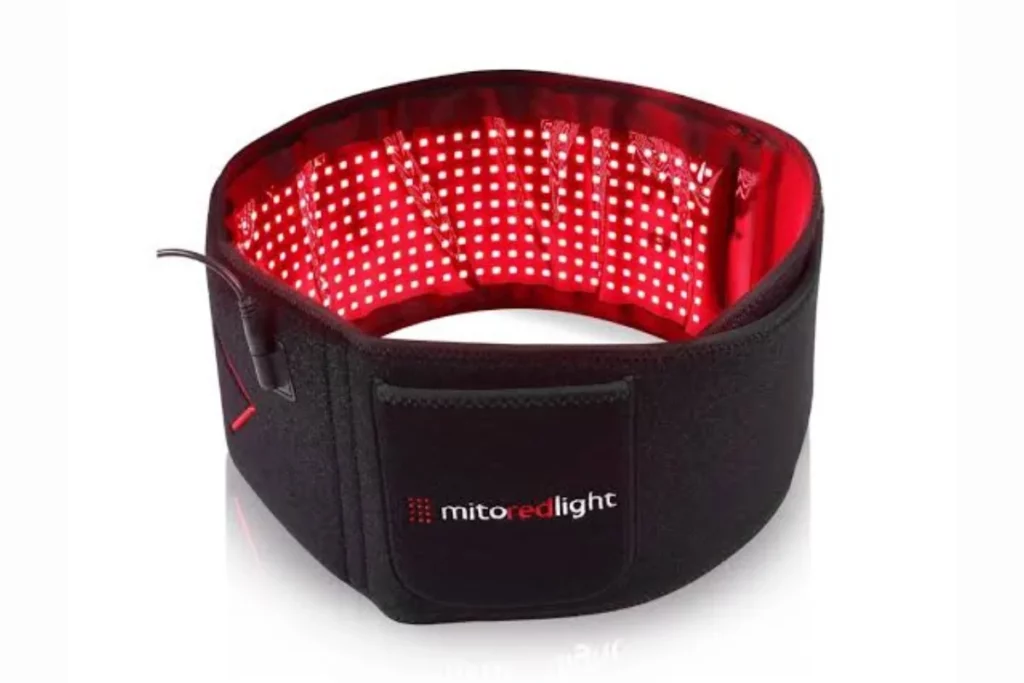
© Mito Red Light
Price: $349 | Battery: Sold in a separate bundle, $429 | Wavelengths: 630nm, 660nm, 810nm, 850nm
This is the only belt on the list that operates on four different wavelengths, rather than the standard two, which in theory allows you to achieve better tissue penetration depth in a single session. This belt meets safety and performance requirements for domestic usage and its material can be easily shaped around odd joint shapes, such as elbows or ankles.
The only thing I have a problem with is its power source issue, as it requires a separate battery pack, which is currently not available at the time of ordering, so you cannot use it without being near an electrical socket. With its price of $349, it also remains the most expensive belt on the list and with the External DC Power Bank, it will burn you $429.
Pros
- Four wavelengths for a wider coverage area
- Conforming material
- Works well with joints and curves of your body
Cons
- The most expensive option on the list
- Battery pack is unavailable at the moment
- No application experience
Lifepro Red Light Therapy Belt: Best Budget Pick
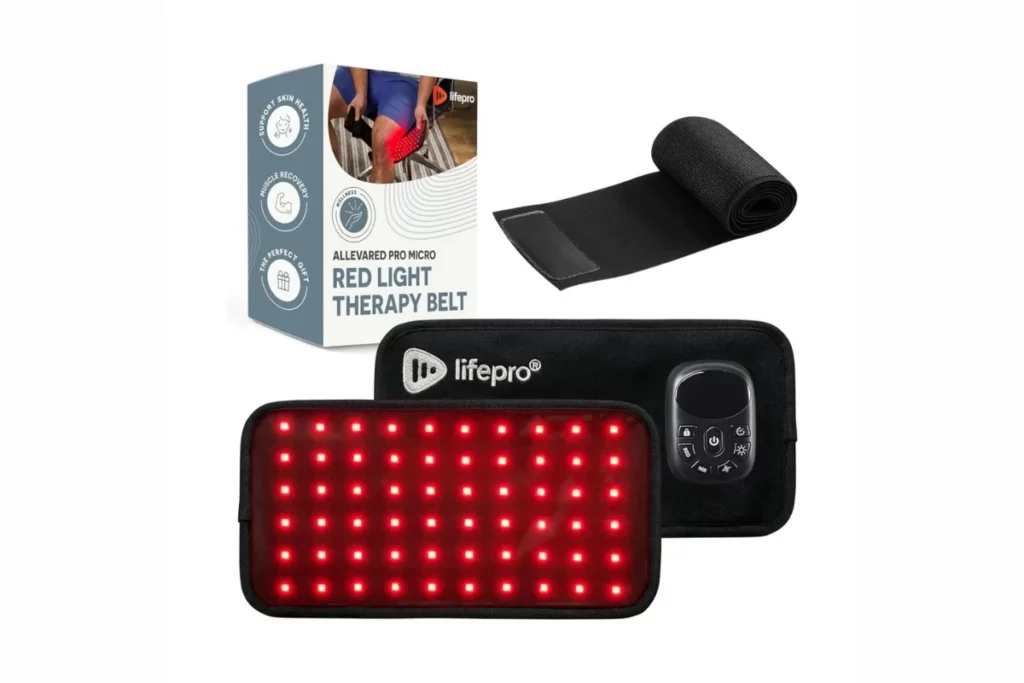
© lifeprofitness
Price: $274.99 | Battery: Plug-in only, battery sold separately | Wavelengths: 660nm and 850nm
The value-for-money ratio of this model should be taken into account since it outperforms similar products. Apart from the usual pulsed light mode, there is a vibration therapy mode, which is a really great additional feature for dealing with sore muscles, which is usually missing in cheaper models. Another great feature of this belt is the presence of an extension strap, which will be useful if you want to use it on your chest or shoulders instead of just your back.
The power output equals 96.8mW/cm², which is decent for such an inexpensive product. The only thing I don’t like about this device is that the portable battery pack is optional and you have to pay extra for it in order to use it on the go.
Pros
- The cheapest option
- Incl. vibration therapy
- Extension strap available
- Decent power output for the price
Cons
- Battery pack is an extra purchase
- No app available
Bon Charge Infrared PEMF Wrap: Best for Relaxation

© Bon Charge
Price: $349 | Battery: Plug-in only | Wavelengths: 660nm, 850nm, plus far infrared LED 8
One thing that makes the Bon Charge Infrared PEMF Wrap unique is the way it combines both the red light technology and PEMF (pulsed electromagnetic fields). It also uses a layer of semi-precious gemstones, such as quartz and amethyst, which ensures even heat distribution. The maximum temperature is 176°F and the longest possible session lasts up to 60 minutes, making it the best choice for those who prefer something that resembles a heating pad.
The product is FDA registered and approved under ARTG, which deals with the regulatory aspect of this device. However, this belt is 4 pounds in weight and is not battery-powered, which means that you cannot use it anywhere but right next to the electrical socket during the session.
Pros
- Red light + PEMF
- Longest possible sessions, up to 60 min
- FDA registered and ARTG certified
- Even heat distribution through gemstones layer
Cons
- Heaviest option, 4 pounds
- Requires an electrical socket during the session
- Runs warm compared to other products
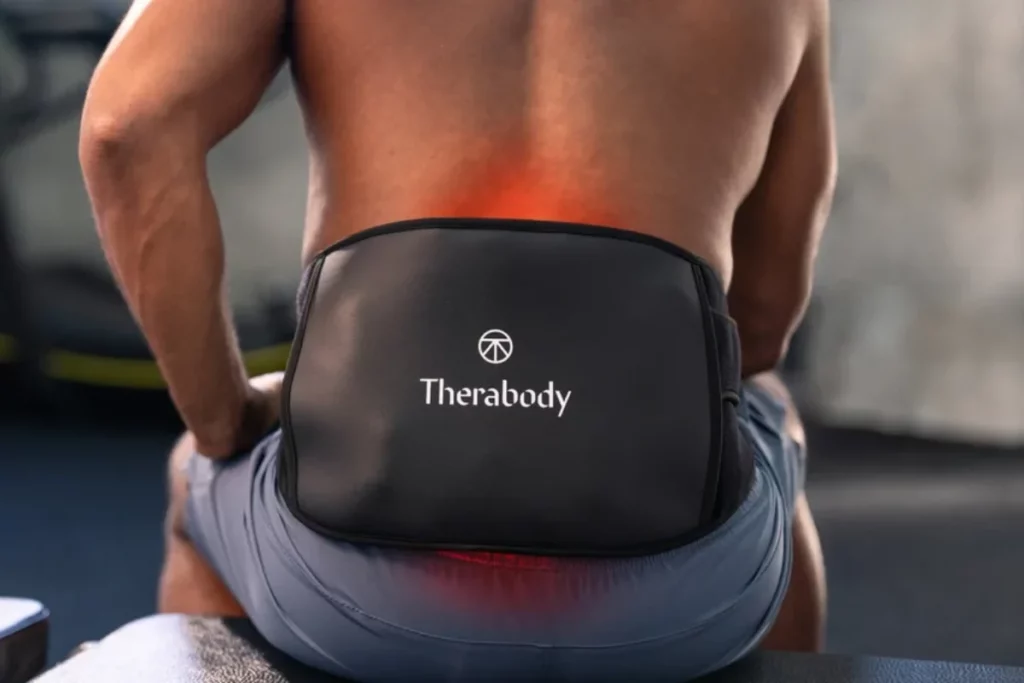
Therabody ThermBack LED: Best for Back Pain
© Therabody
Price: $329.99 | Battery: Rechargeable, up to 180 minutes | Light type: Near-infrared LED plus far-infrared heat
The Therabody ThermBack LED is made specifically to relieve lower back pain, meaning it does not aim to cover all possible spots on the body. This wearable red light therapy device combines near-infrared LED, far-infrared heat, heat therapy and vibration into one product, giving you the full effect of light, massage and heating. Three heat levels (102, 107 and 113°F) and three vibration options will help you personalize treatment according to the degree of pain that day.
Battery capacity allows the device to work for up to 180 minutes, which is quite sufficient to have several treatment sessions before charging it again. But there is an automatic shut-off after 20 minutes for battery usage to control doses of each session. If you decide to use it plugged in, you will be able to use it continuously without any interruption. It is FDA registered, not FDA cleared, which is something you should be aware of when making your choice. Also, you get a 1-year limited warranty and 30 days return period.
There is an app included which makes this product special and you can personalize treatment right on your smartphone, adjusting settings according to whether you are using the wrap over or under clothing, saving your favorite treatment options and not changing settings again and again. It is one size fits all and has adjustable velcro straps and an additional compression strap.
Pros
- Comprehensive approach (LED, heat and vibration)
- Long battery life (up to 180 minutes)
- Customizable and saved settings via the app
- One size fits all (adjustable strap)
- 30 days return period
Cons
- FDA registered but not FDA cleared
- Designed only for back pain, not joints or areas
- Automatic shut off after 20 minutes for battery usage
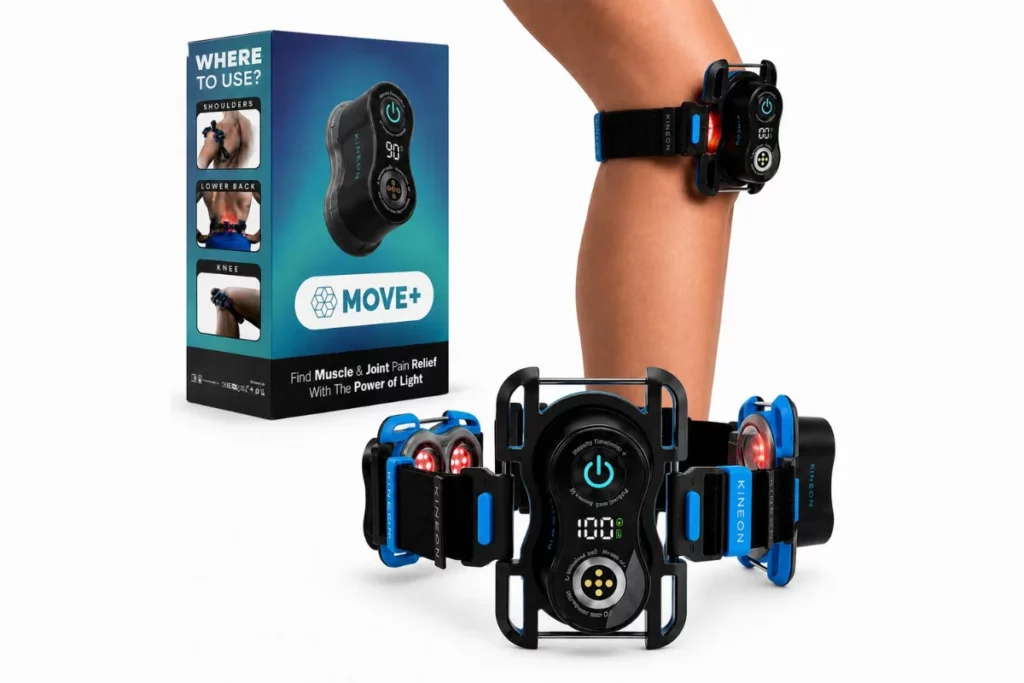
Kineon MOVE+ Pro: Best for Joint Pain
© Kineon
Price: $699 | Battery: Rechargeable, 4 hours of continuous use | Light type: Red light plus near-infrared laser
The Kineon MOVE+ Pro is a bit more premium and that’s reflected in the cost, but if you need relief from joint pain, this belt is the way to go if you’re focusing specifically on knees, elbows, or shoulders. This is one that uses both the LED technology and the near-infrared laser, which is more advanced than the LED belt alone on this list. It is flexible enough to go around a joint or be used on your back as well.
It comes with an app where you can monitor the use and progress, which more belts on this list don’t have. There is, however, just a one-year warranty which is less than what you would expect from this particular belt, and it is also bulky and heavy compared to a regular wrap.
Pros
- Laser and LED combined
- Good for joints specifically
- Has an app to track sessions
- HSA/FSA eligible
Cons
- More expensive than the other ones
- Just one year warranty
- Bulky and heavy to wear
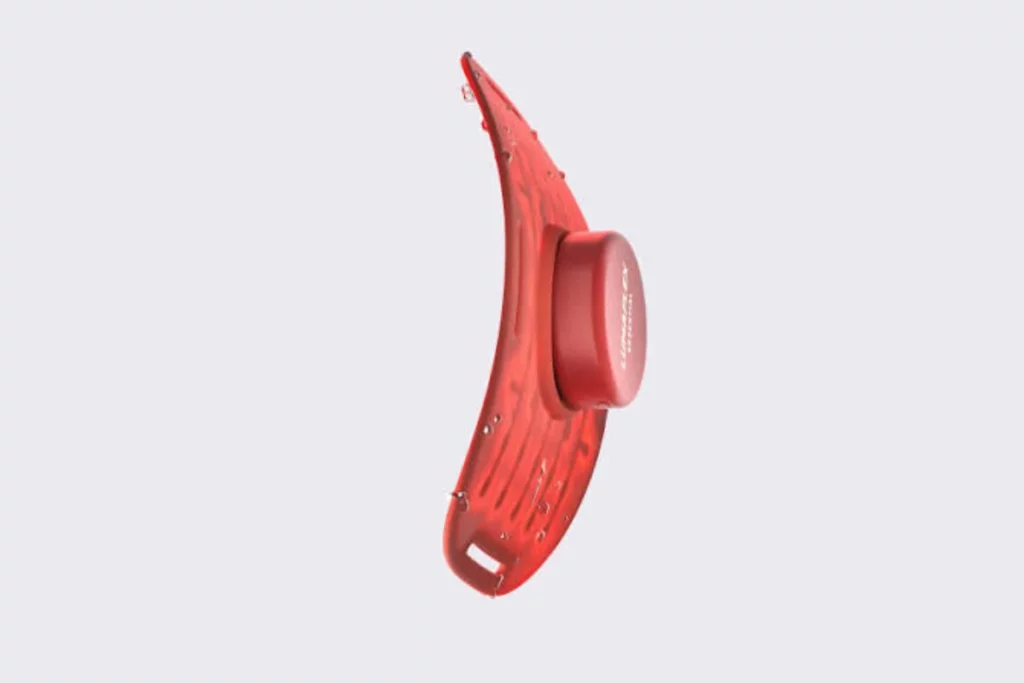
Lumaflex Essential: Best Simple Everyday Wrap
© Lumaflex
Price: $399 | Battery: Rechargeable, up to 130 minutes | Wavelengths: 630nm Red and 850nm near-infrared
If you want something simple, which you will use every single day without worrying too much about the specifics, then the Lumaflex Essential is the one for you. It is a flexible silicone band with an adjustable strap, each session lasts just 10 minutes and there are two straps included to help you to use it either for your waist or even around your ankle. No app, no fuss, just wear and go.
The cons of this product are that people who have large body size may experience discomfort due to the strap being too tight. Also, it is FDA 510(k) Class II cleared for pain relief and recovery, making them officially eligible for HSA and FSA.
Pros
- Simple 10-minute sessions
- Two sizes of strap included
- Lightweight and comfortable to wear daily
- HSA/FSA eligible
Cons
- Not suitable for people with large body sizes
- No app and no session tracking
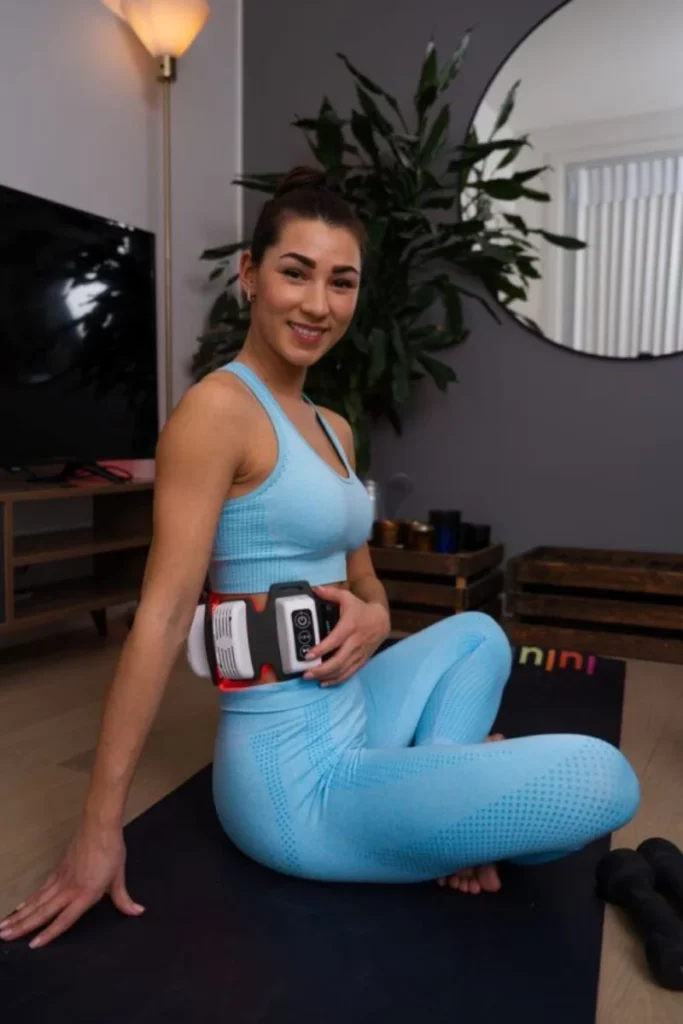
FlexBeam: Best App Experience
© Rechargehealth
Price: $599 | Battery: Rechargeable, 5-9 sessions per charge | Wavelengths: 610-650nm and 800-850nm
The FlexBeam is the most technologically advanced belt in this list of best wearable red light therapy devices for pain relief, but it is expensive too. It is manufactured in Norway, FDA registered and it comes with three light pods incorporated into a belt that you put onto the affected area, be it knees, shoulders or back. Session times are 10 minutes with three preset programs while irradiance is 110mW/cm² and it ranks among the top two with Novaa when it comes to power.
It distinguishes itself with its mobile app, FlexBeam App. You connect it to your phone and depending on whether you purchase Basic or Pro membership, you get a protocol guidance and the ability to track how many sessions you had. It includes a carry case, three sets of velcro bands and a pretty extensive guidebook, so that opening the package does not feel as daunting.
The problem is that its price is a huge drawback. It costs $599, the app is quite good and most of its advanced features are available through a membership. It does come with a 60-day money-back guarantee and a 5-year warranty, which makes it the longest one in this review.
Pros
- FDA cleared
- Very good mobile app with guided protocols and session tracking
- 5-year warranty, the longest on this list
- 60-day money-back guarantee
- Includes carry case and various sizes of bands
Cons
- The most expensive belt in this review
- App’s advanced features require a paid membership
- Not for use on the face or head
How to Actually Pick One
To be honest, most of them have quite a lot of common features on paper: red and near-infrared light around 630-850nm, similar session duration and similar promises. The differences lie in several factors though:
Where you’re treating. An individual band, such as the Lumaflex, suits perfectly for the knee and ankle, but for covering larger areas, especially your entire lower back, you’d better take a model with increased surface area like Novaa, Lifepro, or ThermBack LED.
Plug-in vs battery. If you want to perform exercises while using it, you need the rechargeable one, such as Hooga or ThermBack LED. If you are not going to move from the spot during the session, then plug-ins are usually stronger.
Power output. High mW/cm² usually implies that you can get the necessary amount of energy during shorter sessions, but there are other aspects that play an equally important role, fit and consistency of use.
Budget. In case your problems concern joint pain specifically, you may go for the expensive Kineon. Otherwise, you do not need to spend $500 on it as Lifepro and Hooga would give you almost all you need.
A Quick Note on Safety
None of these belts are a substitute for medical care. If you are pregnant, have a pacemaker or other implanted device, are dealing with active cancer, or any illness for which you haven’t been officially cleared, consult your physician first. Stop using any device immediately should it start producing any burning sensation or irritation.
Other Options If a Belt Isn’t the Right Fit
There are plenty of alternative treatments for different sorts of pains and red light belts are not the only possible option. Here are some facts to take into account:
Physical therapy or an appointment with a physician. That’s supposed to be the very first step when it comes to persistent or worsening pain and is not a matter of a gadget.
Heat or cold therapy. Cheaper and more proven option than red light therapy for acute cases and worth trying before investing in a device.
TENS units. They utilize electric current, not light and may be more useful in particular cases involving nerve pain.
Massage and compression devices. Useful for improving circulation and dealing with muscle stiffness but still supplementing red light, not replacing it.
All of them are not mutually exclusive and many users combine two or even several of them along with a red light belt.
Wrap Up
Honestly, the belt you end up with matters less than whether you actually use it. I’ve seen people drop $600 on a fancy wrap and let it sit in a drawer after two weeks, and I’ve seen the $190 Lifepro get worn every single day because it was easy to grab and didn’t feel like a chore. In this case, it is consistency, not the additional wavelength or slightly larger mW/cm², that does all the work.
A special mention for KneeMo, which is not a red light therapy device but it something very worth looking into for knee pain relief!
So don’t overthink this one. Determine which areas are affected by pain, understand whether you can use a rechargeable product, and choose from this list of wearable red light therapy devices. If you are still in doubt about something, the Novaa is the most optimal choice in case of back pain or joint soreness. Everything past that comes down to how much you want to spend and whether an app matters to you. If the pain does not go away despite regular usage of the product for several weeks, then it is time to stop looking for solutions in the world of devices and ask a professional.
FAQs
Decode the Decor
The Smart Jewelry Revolution
A practical guide to wearable tech's future — delivered straight to your inbox.
Author
