

A few years ago, smart glasses still felt like science fiction. Most people imagined bulky headsets, awkward controls and devices that looked more like gadgets than something you would actually wear outside. But things are changing fast. Today, smart glasses like Ray-Ban Meta Smart Glasses are starting to feel more natural, more stylish and much smarter.
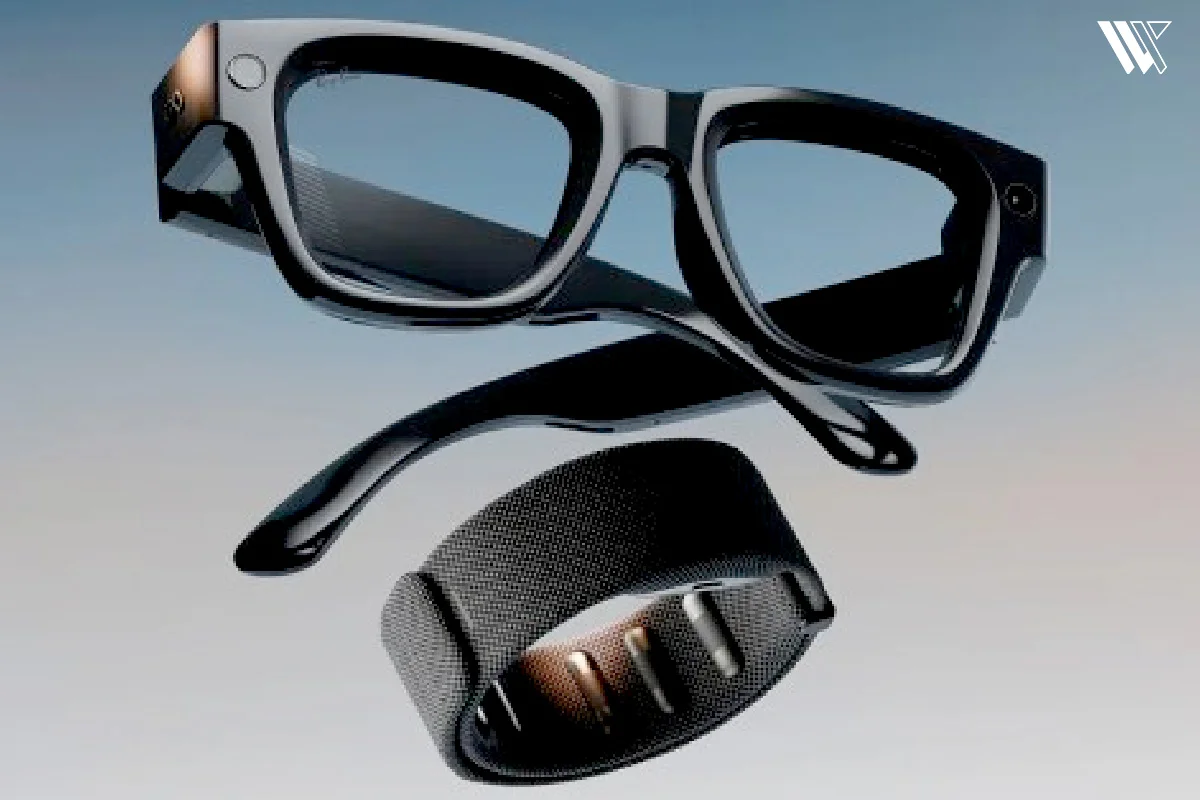
Now Meta is pushing things even further with something called Meta Ray-Ban Air Typing.
Imagine sitting in a cafe, wearing your glasses and replying to a message without pulling out your phone or touching a keyboard. Instead, you simply move your fingers on a table or make tiny hand gestures and the glasses understand what you are trying to type. That is the idea behind Meta Ray-Ban neural typing and it could become one of the biggest changes in how people interact with AI glasses.
Decode the Decor
The Smart Jewelry Revolution — a practical guide to wearable tech.
The Meta Ray-Ban neural typing feature is not just about typing faster. It is part of Meta’s bigger plan to make smart glasses feel like a real everyday computer that you can wear all day. Here is everything you need to know about how Meta Ray-Ban air typing works, which glasses support it and why it matters for the future of wearable computing.
What Is Meta’s New Air Typing Feature?

The brand-new Meta Ray-Ban air typing feature is a revolutionary way to input text on your smart glasses. Instead of typing on a phone or using your voice to dictate a message, you can now use simple hand movements to type. This system relies heavily on neural handwriting, which is a cutting-edge gesture-based text input method that reads the tiny movements of your hand and translates them into digital text.
Imagine sitting at a desk, riding on a subway or simply walking down the street. If you get a notification on your glasses, you do not have to say a single word out loud. Instead, you can simply use your finger to start tracing letters on desk surfaces or even right on the palm of your hand. As you write out each letter, the smart glasses instantly recognize the shapes you are drawing and turn them into typed text on your lens.
This silent, invisible style of typing is made possible because the glasses work hand-in-hand with a specialized wristband interaction system. By pairing the glasses with a separate wristband, Meta has created an environment where your physical surroundings become a blank canvas for typing. It completely changes the way we look at wearable computing.
How Air Typing Actually Works
To understand how Meta Ray-Ban neural typing functions, we have to look closely at the hardware doing the heavy lifting behind the scenes. The entire experience relies on a two-part hardware system: the smart glasses on your face and a unique accessory worn on your wrist called the Meta Neural Band.
The main magic happens due to a technology called surface electromyography, which is commonly known as sEMG. The Meta Neural Band is packed with advanced sensors that sit against your skin. When you move your fingers to type or draw a letter, the muscles and tendons in your wrist naturally contract and move. Even if you make a very tiny or subtle finger movement, your wrist muscles send out distinct electrical signals.
The wristband then detects this muscle activity instantly. And it uses this incredibly smart on-device machine learning to handle gesture detection. When you engage in surface writing, the band acts as a neural input interpretation engine. It looks at the specific pattern of muscle firing in your wrist, figures out exactly which letter your finger is tracing and instantly sends that data straight to your glasses via a low-latency Bluetooth connection.
What makes this system so special is that it does not use a camera to watch your hands. Older gesture systems required cameras to constantly look at your fingers, which failed if your hands left the camera’s field of view or if you were in a dark room. Because Meta Ray-Ban air typing relies entirely on internal muscle signals, you can type with your hand under a table, inside your jacket pocket or in complete darkness and the system knows exactly what you are writing based on how your muscles move.
To look a bit closer at the technical side, the wristband reads signals from the flexor digitorum superficialis and extensor digitorum, which are the exact forearm muscles that control your fingers. To get a clean reading, the band uses pairs of bio-sensing electrodes that measure the voltage difference between points on your skin. This technique is called differential signal amplification.
Once the band captures these microvolt waves, it uses an internal processor to instantly turn the analog signals into digital data. Instead of sending raw files, the band handles on-device feature extraction, tracking how fast and how hard your muscles flex.
A lightweight, local pattern recognition model then takes over. This AI is trained to recognize the exact spatial-temporal signature of your wrist movements, easily telling the difference between letters like an “a” or an “o.” It can even read isometric intent, meaning it registers your writing even if your fingers are barely moving against your leg. As soon as the AI figures out the letter, it beams a tiny, fast data packet up to your glasses using a custom, ultra-low-latency version of Bluetooth Low Energy (BLE). The whole process happens in milliseconds, making the text pop up on your display lens as fast as you can think it.
Which Meta Ray-Ban Glasses Support It?

It is incredibly important to clear up a common point of confusion regarding which specific models support this fancy new feature. Meta offers two completely different categories of eyewear right now and Meta Ray-Ban neural typing is exclusive to their highest-end tier.
This feature will not work on the standard, older camera-only models like the second-generation Ray-Ban Meta Smart Glasses. Those standard glasses lack any form of visual display, meaning they have no way to show you the text you are typing.
Instead, this gesture typing smart glasses feature is built specifically for the premium Meta Ray-Ban Display glasses. This flagship device features a sharp, monocular full-color display built directly into the right lens. The built-in display provides a 20-degree field of view with a resolution of 600 x 600 pixels, creating a floating private screen that only you can see.
When you purchase the Meta Ray-Ban Display system for its $799 retail price, the Meta Neural Band comes bundled right inside the box. With the recent global rollout of software update v125, Meta has officially released this feature out of its limited-access beta phase.
This means that widespread rollout availability is officially live and every single owner of the Meta Ray-Ban Display model can now utilize the system across both iOS and Android platforms.
Why Meta Is Adding Neural Typing to Smart Glasses
When you look at the bigger picture, it becomes obvious why Meta is pushing so hard to add Meta Ray-Ban neural typing to their premium eyewear lines. This is a necessary part of realizing Meta’s wearable computing aspirations and not just an odd gimmick created to demonstrate technology.
For years, the biggest hurdle holding smart glasses back from becoming true phone replacements has been the input problem. Voice control is fantastic when you are alone in your car or walking through an empty park, but it is completely useless when you are sitting in a quiet office, standing in a packed elevator or trying to manage private personal details. By introducing a silent, reliable way to type, Meta is drastically reducing phone dependency.
Furthermore, this feature significantly elevates the way users engage in AI assistant interaction. When you want to ask Meta AI a complex question or give it multi-step instructions, typing it out silently through the wristband lets you maintain complete privacy. It transforms the glasses from a passive notification screen into an active, two-way conversational tool.
This update also establishes a massive foundational brick for Meta’s future AR/XR ecosystem. Meta knows that true augmented reality requires a seamless, low-friction smart glasses interface. By mastering muscle-reading neural bands today, Meta is ensuring that when full-scale holographic AR glasses arrive for consumers in the future, users will already know exactly how to navigate them without a physical mouse, keyboard or touchscreen.
Meta vs Apple vs Samsung in AI Glasses
The race for AI glasses is becoming one of the biggest technology battles right now.
Right now, Meta holds a massive lead in consumer smart glasses because of the success of the Ray-Ban Meta Smart Glasses lineup. Unlike competitors who are still stuck in their RND, Meta is actively selling devices that normal people actually wear in public. A massive part of this success comes down to style. Their brilliant partnership with Ray-Ban allowed them to build cutting-edge tech directly into iconic frames, keeping them from looking like clunky tech experiments. This approach is also adopted by brands like Google and Samsung through fashion-focused collaborations with brands such as Gentle Monster for Google’s AI-Powered smart glasses.
Meanwhile, the rest of the tech industry is moving quickly to catch up. Apple is deeply invested in its own wearable hardware ecosystem, which is focusing heavily on bringing Apple Intelligence and advanced Visual Intelligence to lightweight frames. Analysts indicate that Apple is working on multiple premium smart glasses under the codename N50, a development that closely aligns with recent reports surrounding the Ray-Ban Meta Blayzer and Scriber Optics projects in the evolving AI glasses market. Apple’s long-term goal is to create a sleek accessory that connects directly to the iPhone to deliver seamless Augmented Reality (AR) experiences.
On the other hand, Samsung is expanding its own Samsung XR ecosystem to capture the Android market. By partnering closely with Google and Qualcomm, Samsung is building its highly anticipated Galaxy Glasses on the brand-new Android XR platform. These upcoming glasses are designed to tap directly into Google’s Gemini AI, offering a screenless, camera-equipped model built to compete directly with Meta’s features.
However, despite these looming threats, Meta remains the most aggressive player in the market today. The addition of Meta Ray-Ban neural typing gives them an incredible advantage because typing and interaction are the single biggest challenges holding smart glasses back. Voice control is simply too loud for public spaces and pulling out a phone defeats the purpose of hands-free tech. By introducing a silent, muscle-reading Meta Neural Band that enables fluid text input, Meta is answering the industry’s toughest question first.
Ultimately, whoever masterminds the most intuitive input controls will dominate the next generation of wearable computing. That is why Meta’s neural handwriting technology matters far beyond just being a cool feature, it is successfully building the fundamental control interface for the future of AR glasses, ambient AI assistants and true hands-free computing.
What You Can Actually Do With Air Typing

Now that software update v125 has rolled out globally, this gesture typing smart glasses feature is no longer confined to a few test applications. It has been integrated directly into the core operating software, meaning you can use Meta Ray-Ban neural typing to handle a massive variety of real-world digital tasks.
- Hands-Free Messaging: The most obvious everyday benefit is messaging. When you receive an incoming text, you can read it on your right lens display and instantly type out a response using your finger on any nearby surface.
- Social Media Integration: Meta has baked this feature deep into its own app family. You can seamlessly use air typing to reply to direct messages or search for specific contacts inside WhatsApp, Instagram and Facebook Messenger.
- Smart Navigation & Searching: Looking for a local coffee shop? You can pull up the built-in maps and type out your destination. The glasses have updated their mapping feature to show rich place cards and detailed walking directions across the United States and major European hubs like London, Paris and Rome.
- Silently Generating AI Prompts: If you need to use Meta AI to translate a sign, draft an email response or look up information, you can type your prompts completely silently. The visual answer then pops up directly on your 600 x 600-pixel lens display.
The Biggest Limitations Right Now
While the concept of Meta Ray-Ban neural typing feels like it was ripped straight out of a science fiction movie, it is important to look at the technology through a realistic lens. This first-generation consumer system has several notable limitations that prevent it from being a perfect product just yet.
First, there is a very steep learning curve. Because you are tracing letters onto a blank flat surface without any physical keys or outlines to guide you, learning how to control your hand movements precisely takes a lot of practice. If you trace your letters too fast or too sloppy, the system will misinterpret the muscle signals, leading to frustrating accuracy limitations.
Because of this, your overall typing speed is going to be significantly slower than what you are used to on a traditional smartphone touchscreen. This tool is built for quick, short responses like “On my way” or “See you in ten minutes”, you certainly will not be using it to type out long essays or detailed work reports.
There is also a strict hardware dependency on the neural wristband itself. If you leave the house wearing your glasses but forget to strap the Meta Neural Band onto your wrist, the air typing feature becomes completely unavailable. You also have to manage two separate battery lifespans. While the glasses get about 6 hours of mixed-use battery life, the Meta Neural Band itself delivers impressive all-day endurance with up to 18 hours of use on a single charge, though it still requires its own separate charging cycle to keep the sEMG sensors running.
Finally, we cannot ignore the growing privacy concerns around always-on AI wearables. Even though neural typing itself is completely silent and incredibly private for the person wearing the device, the general public remains highly skeptical of smart glasses that feature front-facing cameras and built-in microphones. Walking around with a wristband that constantly reads your muscle movements alongside glasses that can record your environment creates an understandable level of social discomfort that tech companies are still struggling to navigate.
Could Air Typing Replace Phones in the Future?
Whenever a groundbreaking new input method arrives, tech enthusiasts immediately ask the same big question: Is this the beginning of the end for the traditional smartphone? When we look closely at Meta Ray-Ban neural typing, the honest answer requires a healthy dose of realistic skepticism.
In the long run, this technology gives us a beautiful glimpse into the true potential of ambient AI and wearable computing. There is a clear, undeniable magic to a hands-free interface that lets you interact with the internet without staring down at a glowing piece of glass in your hand. As the software matures and the muscle-tracking algorithms get smarter, typing in the air will become much faster, more fluid and incredibly natural.
However, completely replacing a smartphone requires more than just a smart glasses keyboard alternative. Smartphones are powerful pocket computers because they can handle high-resolution video consumption, complex multi-window multitasking, heavy mobile gaming and vast data storage.
A tiny, lightweight pair of glasses with a monocular display and a 6-hour battery simply cannot handle those massive workloads today. Air typing is not going to kill off the smartphone anytime soon. Instead, it acts as a phenomenal companion feature that reduces how often you need to pull your phone out of your pocket during a busy day. It is an extension of our digital lives, not a total replacement.
Wrap Up
When you look at the hype, Meta Ray-Ban neural typing is a major leap ahead in wearables technology. Despite the need to get used to them at first, Meta has achieved something that no other brand is doing: they have created an entirely silent and screenless method of typing for everyday users.
By combining the recognizable design of Ray-Ban glasses with the Meta Neural Band, which reads your muscle movements, Meta has created a device that is truly something which feels out of this world.
FAQs
Decode the Decor
The Smart Jewelry Revolution
A practical guide to wearable tech's future — delivered straight to your inbox.
Author
