

Choosing a smartwatch in 2026 isn’t just about picking a gadget, it’s about choosing a device that will suit your lifestyle. I’ve spent the last few months with both the Google Pixel Watch 4 and the Fitbit Sense 2 strapped to my wrist, turn by turn.

The irony? Both of these devices live under the same company: Google. They also use the same Fitbit app to track steps and activity. Yet, they felt different. One wants to be my personal assistant, while the other wants to make sure I am getting my cardio in, sleeping enough and actually recovering from yesterday’s workout.
If you’ve been staring at your screen, wondering which one actually belongs on your arm, you aren’t alone. In the Pixel Watch 4 vs Fitbit Sense 2 comparison, I’ll tell you what it’s really like to live with these two very different products from Google.
The Core Difference
The biggest thing I noticed in the Pixel Watch 4 is a high-end smartwatch that happens to have Fitbit-like features. It’s built for the Google ecosystem and it wants you to reply to texts and talk to Gemini.
Decode the Decor
The Smart Jewelry Revolution — a practical guide to wearable tech.
On the other hand, the Fitbit Sense 2 is a health tracker that has some smart features added to it. It doesn’t care about the Play Store or fancy apps, as its main goal is to tell you why you’re stressed and how well you recovered from yesterday’s HIIT sessions.
Specification Table
| Features | Pixel Watch 4 (45mm) | Fitbit Sense 2 |
|---|---|---|
| Processor | Qualcomm Snapdragon W5 Gen 2 + Cortex M55 co-processor | Custom Fitbit Chipset |
| Memory (RAM) | 2 GB SDRAM | – |
| Storage | 32 GB | No user music storage, 7 days of motion data |
| Connectivity | Bluetooth 6.0, Wi-Fi (2.4/5GHz), NFC, UWB, 4G LTE | Bluetooth 5.0, Wi-Fi, NFC |
| GPS | Dual-frequency (L1 + L5) GPS, GLONASS, Galileo | Single-band GPS + GLONASS |
| Durability | IP68 (Dust/Water) + 5 ATM | 5 ATM |
| Glass/Build | Custom 3D Corning Gorilla Glass 5/ Recycled Aluminium | Corning Gorilla Glass 3/ Aluminium |
| Fast Charging | 15 mins to 50%, 60 mins to 100% | 12 mins for 1 day of battery, 2 hours to 100% |
| Special Sensors | Barometer, Compass, Ambient light, Magnetometer | Altimeter, 3-axis accelerometer, Ambient light |
| Safety Features | Fall Detection, Emergency SOS, Satellite SOS (LTE model) | Fall Detection, Emergency SOS |
| Color | For 41 mm: Iris, Lemongrass, Porcelain, Obsidian For 45 mm: Moonstone, Porcelain, Obsidian | Shadow Grey/ Graphite Aluminium, Lunar White/ Platinum Aluminium, Blue Mist/ Soft Gold Aluminium |
| Price | Starts at $349.99 USD | $249.95 USD |
Design and Comfort
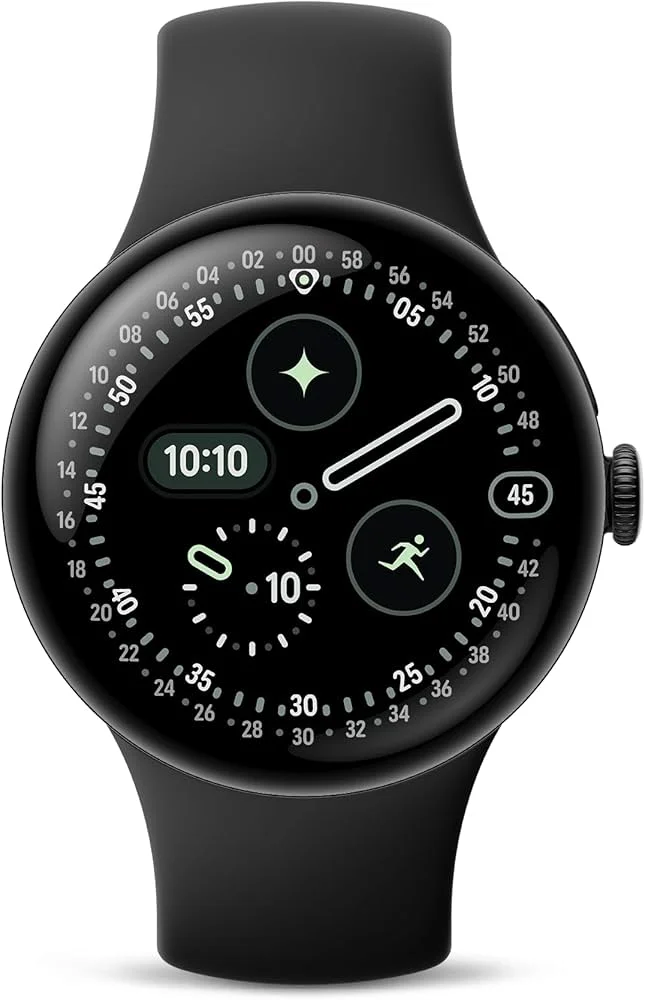

The Pixel Watch 4 is a masterpiece of modern engineering. The new Actua 360 domed display doesn’t just look curved, the actual screen panel beneath the glass is also domed, which creates a bubble effect where text seems to float at the edges. With a 10% larger active area and 15% smaller bezels than the Pixel Watch 3, the display feels more immersive, making notifications, maps and workout stats easier to read.
Even though it’s lightweight and it uses 100% recycled aluminium case, the 45mm model weighs around 36.7g and the 41mm sits at 31g. It has a thickness of 12.3mm, which is noticeable. It also comes with Gorilla Glass 5 during the day.
The Fitbit Sense 2 uses a slimmer, more aerodynamic squircle design that’s only 11.2mm thick. It weighs around 37.6g with the band.
The Aluminium Case is rounded and the flexible elastomer strap feels soft and breathable.
If comfort for 24/7 tracking is your priority, the Sense 2 is the go-to watch for you. But for a night out or a professional meeting, the Pixel Watch 4’s stunning round aesthetic and high-end finish make it the clear winner.
Health Tracking

This is the heart of the Pixel Watch 4 vs Fitbit Sense 2 comparison. While both watches track heart rate, sleep and stress, the way they present data and the sensors they use to track it reveal their different personalities.
Sleep Tracking
Fitbit is still the king of sleep tracking and the Fitbit Sense 2 proves it every morning. I love looking at my sleep profile because the Sense 2 lasts a week, so it builds a massive, unbroken history of my sleep, one that I can actually use to understand what triggers a good sleep cycle and what doesn’t.
Over time, it even helped me notice a pattern that whenever I eat after 11pm, my heart rate dips around 7 AM, which clearly isn’t ideal for recovery .

The Pixel Watch 4 uses the same Fitbit algorithms, but the experience is different. Because it requires daily charging, I actually missed tracking some nights simply because the watch was sitting on my nightstand, which breaks the continuity of sleep data and makes it difficult to identify long-term patterns or connect habits with recovery.
Both watches use Fitbit Premium’s animal-based Sleep Profile to explain recovery patterns and long-term sleep habits in a more visual and easy-to-understand way. Right now, I’m classified as a Hedgehog, reaching Dolphin status feels unrealistic with my current schedule, but moving up to Bear, that’s a goal I can actually work towards.
Stress and Body Response (cEDA)
Both watches feature a cEDA sensor, which is a continuous electrodermal activity sensor to track stress, but the Sense 2 is much more vocal about it. It would frequently buzz to ask me how I am feeling when it detected a spike in my skin’s sweat levels or heart rate.
On the other hand, on the Pixel Watch 4, these stress alerts felt buried under loops like emails and calendar reminders. If you’re looking for a watch that actively helps you manage anxiety in the moment, the Sense 2 feels more like a dedicated watch for this.
Heart Health: ECG and AFib

Both watches are equipped with an ECG app to check for Atrial Fibrillation (AFib). However, there’s a subtle difference in how they handle heart health:
The Fitbit Sense 2 is built for background monitoring. It is designed to analyse the heart rhythm while you are staying still or sleeping and it will send an Irregular Heart Rhythm Notification if it sees something concerning.
While the Pixel Watch 4 also supports these background notifications, it feels more like a manual device. You have to actively decide to take an ECG reading by holding your finger on the crown.
Skin Temperature and SpO2
The Fitbit Sense 2 includes a dedicated skin temperature sensor that tracks variations every night, which is great for spotting when I am coming down with an infection.
The Pixel Watch 4 has also finally leaned into this, using its own sensors to provide a health metrics dashboard that tracks breathing rate, SpO2 (oxygen saturation) and skin temperature.
Fitness Tracking

Let me be honest here, neither of these watches is a pro-athlete level watch like a Garmin. They are best for the rest of us who go for a 30-minute walk or even a 5k run.
In the Pixel Watch 4, the GPS is faster. It locks on almost instantly thanks to its dual-frequency GPS. The workout screen is also much easier to read while running because of that massive, bright screen.
In Fitbit Sense 2, it’s a bit slower to find a signal, but I prefer its Active Zone minutes focus. It doesn’t care how fast you ran, it only cares how hard your heart worked.
For my daily walks, the Sense 2 felt more supportive, whereas the Pixel Watch 4 felt like it was just judging my pace.
Battery Life
The Google Pixel Watch 4’s 41mm variant comes with a 325mAh battery. It gives up to 30 hours of battery life with Always On Display and with battery saver mode, it gives up to 48 hours of battery life.
The 45mm variant of Google Watch 4 comes with a 455 mAh battery, which gives up to 40 hours of battery life with Always On Display and with battery saver mode, it gives up to 72 hours of battery life.
While the Fitbit Sense 2 gives a battery life of 6+ days, it is powered by a 162 mAh battery, which might sound small, but it is far more efficient, all thanks to its lightweight OS and health-first design.
In day-to-day use, this means I can wear it continuously for sleep, stress and activity tracking without constantly thinking about charging it.
Software Experience
The Pixel Watch 4 runs on Wear OS 6. It’s fast and it has built-in Gemini AI, which is actually helpful for setting reminders by voice and it has access to third-party apps via a full app store. You can use Google Maps with a full map view or control your Spotify directly.
The Fitbit Sense 2 uses a much simpler interface. It doesn’t have a Play Store but you get Google Maps, Google Wallet and Alexa.
Price and Availability
The price for the Pixel Watch 4 for the 41 mm variant starts at $349.99 USD and for the 45mm variant it starts at $399 USD. You can purchase the Pixel Watch 4 from Google’s official website, Best Buy and from Amazon.
However, the Fitbit Sense 2 is priced at $249 USD and it can be purchased from Google’s official website, Best Buy and from Amazon.
Final Verdict
If I had to choose one between the Pixel Watch 4 vs Fitbit Sense 2, I would choose the Fitbit Sense 2. I know the Pixel has many features, but for me, a health tracker should be something I don’t have to think about. I love the 6-day battery, the lightweight design and the calm experience of just focusing on my recovery and stress.
You should choose the Pixel Watch 4 if you want the best features and Google apps. It feels like an extension of your Android phone. It’s better if you care about replying to messages from your wrist, using Google Maps with full navigation, controlling music, making payments with Google Wallet and relying on Gemini for quick voice commands.
If apps, notifications and convenience matters more to you than week-long battery life, the Pixel Watch 4 is the more powerful and capable choice for you. I am only looking for something that is primarily a health tracker, therefore, I am sticking to my Fitbit Sense 2.
FAQs
Decode the Decor
The Smart Jewelry Revolution
A practical guide to wearable tech's future — delivered straight to your inbox.
Author
