

 Add Us On Google
Sleep has become the most significant health measure of the decade thus far. Not hitting 10K steps, not calories burned, not the amount of effort you put in and definitely not whatever wellness hack is trending on Instagram. Sleep.

For the first time, we’re finally able to measure it with the best sleep trackers on the market that can track it passively and over long periods of time. Not just how long you sleep, but how well you’re able to rest. The uncomfortable truth most people learn, though, is that most people don’t have a sleep issue.
Most people have a measurement issue.
The truth is, once you start to take your sleep seriously, you learn that most sleep tracking devices on the market have wildly divergent opinions about the exact same night of sleep. Some of them are incredibly accurate, some of them are useful, while some of them are just making a lot of noise.
Decode the Decor
The Smart Jewelry Revolution — a practical guide to wearable tech.
After months of testing, using various devices to compare their long-term tracking and watching how they work in the real world, day in and day out, not just in a demo, here’s what the sleep tracking landscape looks like in 2026, all combined in a list of the best sleep trackers in 2026 for you to choose from.
Best Sleep Trackers in 2026 (Quick Picks)
If you want the short version:
- Best overall: Oura Ring 4
- Best for optimization: Whoop 5.0
- Best all-in-one: Apple Watch
- Best no-subscription: Ultrahuman Ring Air
- Best for brain-level tracking: Muse
- Best Sleep Tracker for Active Intervention: DUSQ Sleep Regulator
But the nuance is where this gets interesting.
Sleep Tracker Comparison Table
| Features | Oura Ring 4 | WHOOP 5.0 | Apple Watch Series 11 | Ultrahuman Ring AIR | Muse | DUSQ Sleep Regulator |
|---|---|---|---|---|---|---|
| Accuracy | Excellent | Excellent | Good | Very Good | High (brain-focused) | Lab-tested |
| Battery | 5–8 days | ~14 days | 1–2 days | ~6 days | ~10 hours | Not yet reported |
| Comfort | Very high | High | Medium | Very high | Medium | Behind-ear patch |
| Subscription | Yes | Yes | No | No | Yes | No (patch refills, ~$25/3-month pack) |
| Price | $349 | WHOOP One: $199/ year WHOOP Peak: $239/ year | Starts at $399 | $349 | $584.98 | $350 |
Best Sleep Tracker Overall
Oura Ring 4

© Oura
The Oura Ring 4 is the gold standard in sleep tracking in 2026. Not because it offers the most devices and features in one package, but because it excels at the most fundamental aspects of the job: high-quality, consistent signal collection, analysis, clean and actionable presentation that actually makes sense.
Oura’s strength over all other devices in the business is abstraction. Rather than bombarding you with raw data and complicated charts and graphs, Oura condenses your nightly data into three simple and meaningful numbers that actually make sense:
- Sleep Score
- Readiness Score
- Activity Score
The simplicity of these numbers belies the robust underlying physiological model that’s actually working away in the background. Rather than just tracking your raw data and providing complicated charts and graphs that don’t actually make sense, Oura’s underlying model learns your personal baseline, which is your average resting heart rate, body temperature, heart rate variability and recovery rhythms. It gets better at this over time and provides subtle cues about the things that actually matter.
Where the Oura Ring 4 succeeds:
- One of the most well-rounded and accurate sleep tracking experiences out there.
- Great at detecting sleep stages, efficiency, latency and disruptions.
- Incredibly lightweight, at just 3-5 grams, it’s virtually undetectable and long-lasting with up to 8 days of battery life.
Where the Oura Ring 4 fails:
- Requires a subscription ($5.99/month) to get the most out of the device and unlock all the features.
- The ring itself can be inconvenient at times. Gym rats and exercise enthusiasts might find it inconvenient during heavy workouts and exercise sessions.
- The ring might be inconvenient if you prefer wearing devices on your wrist.
However, if your goal is to actually understand your sleep and not just how long you spent in bed, the Oura Ring 4 is the place to start.
Best Sleep Tracker for Accuracy
WHOOP 5.0

© WHOOP
Let’s set expectations right off the bat: No consumer sleep tracking device is medically accurate. However, some devices are more accurate than others.
During real-world testing, the WHOOP 5.0 emerged as one of the most accurate and reliable devices available for sleep tracking. It accomplishes this by using a wide range of physiological signals:
- Continuous heart rate monitoring
- Heart rate variability (HRV)
- Respiratory rate patterns
- Skin temperature
However, what sets WHOOP apart is its ability to adjust to your normal baseline quickly. It learns your normal patterns over time and is highly sensitive to changes in your lifestyle, whether that’s heavy training, bad sleep, alcohol, stress or recovery.
When it comes to sleep tracking, WHOOP 5.0 is also more accurate and clean compared to other smartwatches available in the market. The recovery score is also highly correlated with your sleep and readiness to tackle the day, making it more actionable and not just informative.
If you’re looking for an accurate sleep tracking device that is highly sensitive to your daily activities and also provides accurate recovery guidance, the WHOOP 5.0 is one of the best sleep trackers in 2026. But it does come with a subscription, so if you’re looking for WHOOP alternatives that don’t require a subscription, we’ve got you covered.
Best Sleep Tracker Without Subscription
Ultrahuman Ring Air

© Ultrahuman
Subscriptions have become the new norm in 2026, but that’s no longer the case with the Ultrahuman Ring AIR. Subscription free smart rings are becoming increasingly popular because people are realising the long term costs associated with subscription based wearables and it is not pretty!
The Ultrahuman Ring AIR offers a unique and refreshing approach with one-time purchases and no hidden features or subscription costs. Everything the device offers is immediately available right out of the box, reason why it is one of the best smart rings to get your hands on in 2026!
But most importantly, it’s not just the affordable option. The Ultrahuman Ring AIR offers robust tracking features such as:
- Accurate sleep stage tracking and Sleep Score
- Metabolic and recovery tracking
- Continuous heart rate monitoring
- HRV
- Skin temperature trends
Paired with the sleek and lightweight design of the ring and the clean and clutter-free user interface of the application, it’s one of the most important features in modern wearables.
Of course, there’s always the flip side. The features and insights offered by the Ultrahuman Ring AIR are robust but slightly less advanced and personalized in comparison to the Oura Ring 4. The physiological model and long-term pattern detection are slightly less advanced and one step back in comparison to the gold standard.
But for the average user, the Ultrahuman Ring AIR is the most sensible and long-term solution. If you’re looking for robust and reliable sleep and recovery tracking without the need for any subscription costs and artificial features, the Ultrahuman Ring AIR offers the most value in 2026, making it the best sleep tracker.
Best Sleep Tracker Smartwatch
Apple Watch Series 11

© Apple
For most people, their entry into wearable technology was through an Apple Watch and in 2026, that still holds true for the ultimate generalist.
If you’re looking for something that can track your sleep, fitness, notifications, calls, apps and all of that with maximum ecosystem integration, you’re essentially looking for a smartwatch. The Apple Watch Series 11 excels in all of those areas.
While the Apple Watch does track your sleep, it’s still a secondary function to the main purpose of the Apple Watch, which is to be a smartwatch.
Where the Apple Watch Series 11 succeeds:
- Excellent fitness metrics in real-time
- Seamless integration with your iPhone, including your health data
- Excellent overall health tracking, including heart rate, blood oxygen, etc.
Where the Apple Watch Series 11 fails:
- Battery life is a major drawback as it needs charging every day.
- Very uncomfortable to wear while sleeping.
- Misses out on capturing sleep/ nap data sometimes.
If your goal is solely to better understand and improve your sleep, then there are better devices out there. However, if your goal is to have one device that does just about everything well, including sleep tracking, then the Apple Watch Series 11 is one of the best sleep trackers in the market in 2026.
Best Sleep Tracker for Deep Sleep Insights
Muse S Athena

© Muse
This is where the sleep tracking experience starts to get interesting.
The Muse S Athena not only track your sleep, but it also tracks your brain waves. With the use of EEG (electroencephalography) and fNIRS (functional near-infrared spectroscopy) technologies, it can track your brain waves, breathing, heartbeat and movement while you are asleep.
It excels in:
- Detailed analysis of your deep sleep
- Tracking your smooth transition from one sleep stage to another
- Meditation and mindfulness
The trade-offs are obvious. It requires you to wear a headband to track your sleep, which needs a little more getting used to as compared to wearing a smart ring or a wrist-worn tracker. It is limited in use, making it unsuitable for general users who just want to track their sleep.
This is not for everyone, but for those who want to get the deepest possible insight into their brain waves while they are asleep, the Muse S Athena offers incredibly powerful data and is the best sleep tracker in 2026.
Best Sleep Tracker for Active Intervention
DUSQ Sleep Regulator
© Dusq
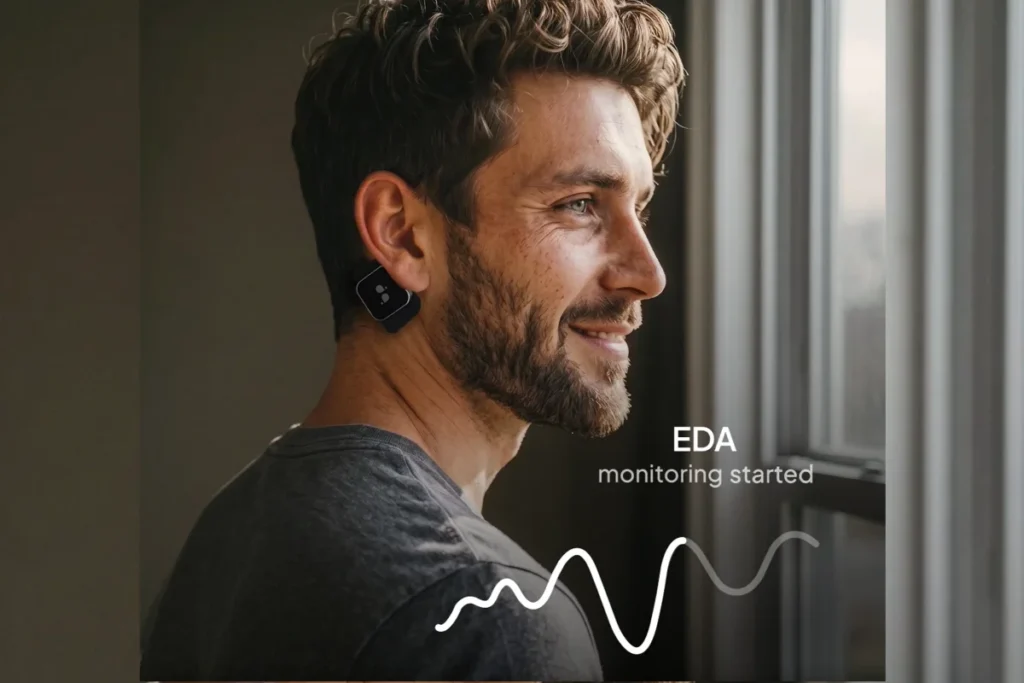
Each one of the devices mentioned in this list performs basically the same function- they monitor your sleep and reports about it in the morning. This is not the case with the DUSQ Sleep Regulator. Rather than tracking the your sleep, it regulates it in a unique way. A small patch which goes behind your ear, DUSQ uses an EDA sensor which is capable of reading the autonomic nervous system. It helps DUSQ detect the micro-arousals which affect deep sleep without your awareness and then it takes action. Through vagus and vestibular nerve stimulation, DUSQ helps people get back to their deep sleep mode without any action being taken by the user.
This gives it quite a different character from Oura and Whoop. The main feature of both products is giving the user a score and leaving him/her to draw conclusions. But the DUSQ device is intended to address the problem in the process, which will provide the user with a score based on undisturbed sleep.
Still, this is very new technology making waves in the wearable industry. DUSQ was first presented on Kickstarter, but then the technology was tested in its own sleep lab through polysomnography (PSG). This is not enough for DUSQ to advise people to buy or not to buy the product since it hasn’t been tested by the audience.
How Sleep Tracking Actually Works
This is the part that most people still don’t get. Sleep trackers don’t actually measure your sleep. They interpret it.

© Karpathy
Rather than having direct access to your brain waves like in a clinical sleep lab setting, wearables make an educated guess based on several factors that your body is telling them. The better and more accurate the data your body provides, the better the educated guess.
1. Sleep Stages
The wearable device estimates the time spent in various stages of your sleep- Light Sleep, Deep Sleep, REM Sleep and awake. The device makes these estimates by combining data from several sources:
- Lack of movement
- Heart rate
- HRV (Heart Rate Variability)
- Breathing Rate
- Skin Temperature
The important thing to remember is that this is an educated guess. The accuracy of this data can vary greatly from one device to another.
2. Heart Rate Variability (HRV)
HRV has become one of the most valuable sources of data in modern sleep tracking.
A high HRV during the night is an indication of better recovery, less stress and better balance in your nervous system. A low HRV during the night indicates poor recovery, fatigue and/or high levels of stress the previous day. It can also be helpful in predicting flare-ups if someone has an autoimmune disease.
Therefore, most advanced devices now utilize this data in calculating your overall Sleep Score and Readiness.
3. Sensors
Modern sleep trackers utilize various hardware-based sensors:
- PPG Sensor– Measures heart rate, blood oxygen levels (SpO2) and helps calculate your HRV.
- Accelerometer– Measures your movements and periods of stillness.
- Temperature Sensor– Measures skin temperature trends that relate to recovery and early detection of illness.
The quality of the device’s hardware is important. However, the algorithms used to process all the data the device collects are the most important factors that make one device better or worse than another.
Ring vs Watch vs Band: Which Is Better for Sleep?
This is the choice that matters more than brand, more than features and more than price. This is because the form factor affects the quality of your data and ultimately, the likelihood of wearing it. Consistency is key in sleep tracking.
Smart Rings
Smart rings such as Oura Ring 4 and Ultrahuman Ring AIR have emerged as the gold standard in sleep tracking. But why is this?
This is because your finger is one of the cleanest places on your body to pick up cardiovascular data. This means your heart rate, your HRV and your trends are all going to be better. It also means it’s completely invisible, without a screen or buzzing of notifications.
The trade-off is obvious- no interaction with your data in real-time and no interaction with your data in real-time. But for sleep, this is actually a feature, not a bug.
Bands
Devices such as WHOOP 5.0 are in a different category. This is because they don’t just track your sleep, they interpret your sleep in relation to your entire day.
You’re not getting: “You slept 7 hours”. You’re getting: “You’re 68% recovered. Train light today.”
This is what sets WHOOP apart. The form factor also plays a role here. It is lightweight, no screen and can be worn 24/7, including charging.
It’s not as invisible as a ring, but it’s a heck of a lot more useful.
Smart Watches
Smartwatches, like the Apple Watch Series 11, are great for everything. Be it workout tracking, notifications, health tracking or sleep tracking.
But that’s also the problem. Sleep tracking is a secondary feature in smart watches, not a primary focus.
And that’s where the problems start. They are bulkier and less discreet on your wrist, have a short battery life that requires daily charging, more notifications and distractions that keep you awake. They’re also not the best if you’re a light sleeper and want something nearly invisible while sleeping.
Headbands
Headbands like the Muse S Athena devices are the most accurate of all. They don’t simply guess or infer sleep patterns, they get closer to measuring sleep patterns than any device on this list.
This allows for real sleep stages insights, meditation feedback and brain state awareness.
But there’s a downside- you need to wear a device on your head while you’re sleeping. For most people, this is a non-starter. But for the right person, it’s the next best thing to a clinical study, outside of a clinical study.
If you remember nothing else from this list, remember this:
If you want the best sleep performance and data → get a smart ring
If you want to optimize performance and recovery → get a band
If you want a device that does everything → get a smartwatch
Everything else is simply icing on the cake.
Are Sleep Trackers Accurate?
Short answer: Yes, but within limits. Long answer: accuracy depends on what you’re asking the device to do.

© Karpathy
Sleep trackers aren’t directly measuring sleep. They’re using the data they get from the body- heart rate, movements, temperature, to make educated guesses about what probably happened. And within those limits, they’re actually pretty good at what they do.
What sleep trackers get right:
- Tracking trends over time
- Estimating total sleep duration
- Recognizing changes in recovery (HRV, heart rate)
- Identifying behavioral patterns (late meals, alcohol, stress)
Not because they’re super accurate. But because they’re super consistent. Consistency is more important than accuracy.
What they get wrong:
- Sleep stage detection (REM, deep, light sleep) are all estimates
- Awakenings, especially short ones, which they miss or get wrong
- Environmental factors (movement, pets) can affect the data
Even the best sleep trackers in 2026 available to the public are unable to accurately tell the difference between lying still and sleeping or the difference between light sleep and wakefulness.
It is important to remember that they are not medical equipment or diagnostic tools. The gold standard is polysomnography (PSG). This is where they hook up equipment to the body to measure brain waves, eye movements, muscle activity and breathing.
Wearables simply do not have access to this data. So the question is- are they worth the investment?
For general use? Absolutely. Most people do not need accuracy, they need awareness and sleep trackers provide exactly that.
Don’t think of sleep trackers as providing medical data, think of them as providing feedback. Because in the end it’s not a truth machine, it’s a trend detector.
And if you think of them that way, they’re incredibly powerful.
Who Should Use a Sleep Tracker
- Poor Sleepers- If you wake up tired, trackers help identify patterns such as late meals, alcohol impact, irregular schedules or physical activity affecting sleep.
- Athletes- Recovery drives performance, therefore, devices like WHOOP 5.0 turn sleep into a training variable.
- Health-Focused Users- If you already track your diet, workouts and stress, sleep is the missing layer.
Who Should Avoid Sleep Trackers
- Casual Users- If you’re not going to engage with the data, don’t buy one.
- Users Expecting Medical Accuracy- These devices cannot diagnose sleep disorders.
- Anxiety-Prone Users- Obsessing over sleep scores can make sleep worse. Yes, this is a real phenomenon.
Wrap Up
So, after all of that, testing, data and real-world usage, the hierarchy is clear. But, honestly, that’s not really the point. Because, let’s be honest, the point of choosing the best sleep tracker isn’t to find out who the “winner” is, it’s not to declare a champion.
The point of a sleep tracker is to find a system that works for you, that you’ll use and that you’ll use consistently. So, the best sleep tracker for you is the one that works within your lifestyle, gives you information that you can understand and encourages you to make better choices without overwhelming you.
And, if you can stick to that, well, then something pretty interesting happens. You stop wondering, you start to see patterns: like how late nights affect your recovery or how workouts affect your deep sleep.
That’s where the value is. Not in analyzing every single metric, but in using that information, just enough, to make better choices. Night after night.
FAQs
Decode the Decor
The Smart Jewelry Revolution
A practical guide to wearable tech's future — delivered straight to your inbox.
Author
