

Today’s wearable devices like smartwatches, smart rings and medical-grade bands can track HRV, resting heart rate, sleep, stress, temperature, blood oxygen and even ECG, which can help us understand how our body is reacting day-to-day.

So it is well worth wondering if these technological advancements can help one manage autoimmune diseases, such as Lupus. Managing Lupus means navigating unpredictable fatigue, inflammation spikes, point pain, sudden flare-ups and shortness of breath. While these wearables don’t diagnose Lupus or any other autoimmune disease, they do help track the sudden body changes that happen before a flare, which help manage the symptoms before they become severe.
The Most Important Metrics for Lupus
Lupus flare-ups rarely appear “out of nowhere”. Most people can’t detect these small changes before a flare until symptoms are unmanageable. This is where wearables come into the picture.
Here are the most important metrics for Lupus that these wearables track:
Decode the Decor
The Smart Jewelry Revolution — a practical guide to wearable tech.
HRV (Heart Rate Variability)
The number one predictor for flare-ups and fatigue, a low HRV means inflammation, stress and poor recovery.
Resting Heart Rate (RHR)
An elevated RHR can signal an early flare, infection or exhaustion.
Temperature Trends
Wearable devices like Apple Watch, Samsung Galaxy Ring, Oura Ring and Whoop, amongst others, can track skin and wrist temperature. This is useful for detecting an onset of fever, inflammation spike or hormonal cycle shifts, which can affect autoimmune symptoms.
Sleep Quality
A poor deep sleep leads to brutal fatigue, ultimately leading to a higher flare risk.
Stress
Lupus is extremely sensitive to stress. Therefore, stress tracking helps prevent crashes.
Blood Oxygen and Respiratory Rate
Keeping a track of blood oxygen and respiratory rate is useful for pleurisy, pericarditis and breathing changes before fatigue spikes.
ECG / Arrhythmia Detection
This is an especially useful metric because Lupus can affect the heart.
Best Wearables for Lupus
| Wearable | Best For | Tracks HRV | Temperature | ECG | Blood Pressure | Sleep Accuracy | Subscription | Features |
|---|---|---|---|---|---|---|---|---|
| Garmin Venu 2S / Venu 3 | Best for fatigue pacing and spoon theory | ✔ Night HRV | ✖ | ✔ (Plus/3 models) | ✖ | 4/5 | None | Body Battery, stress, GPS safety alerts, medical ID, long battery |
| Oura Ring 5 | Best for discreet comfort and sharper flare prediction | ✔ Night HRV | ✔ Skin temp | ✖ | ✔ Beta/research | 5/5 | ✔ | Smaller/lighter ring, week-long battery, nighttime breathing insights, Cardiovascular Age |
| Apple Watch Series 8–11 | Best for medical alerts and iPhone users | ✔ | ✔ Wrist temp | ✔ | ✖ | 4/5 | None | Cycle tracking, AFib detection, SpO₂, emergency SOS |
| Samsung Galaxy Watch 5/6 | Best for stress and temperature on Android | ✔ | ✔ Skin temp | ✔ | ✖ | 4/5 | None | Stress coaching, detailed sleep stages, body composition |
| Whoop 5.0 / MG | Best for continuous HRV, blood pressure and at-home ECG | ✔ Continuous HRV | ✔ Advanced skin temp | ✔ (MG model) | ✔ (MG model) | 4/5 | ✔ Required | Heart Screener, Blood Pressure Insights, Healthspan/WHOOP Age, 14-day battery |
| Visible + HR Armband | Best for pacing and avoiding crashes | ✔ 1/day HRV | ✖ | ✖ | ✖ | 4/5 | ✔ | PacePoints, symptom trends, crash prediction for chronic illness |
| Withings ScanWatch 2 | Best medical-grade smartwatch | ✔ Night HRV | ✔ Temp | ✔ | ✖ | 4/5 | None | Long battery, AFib detection, simple hybrid design |
| Clair | Best for correlating hormonal shifts with flare timing | ✖ | ✖ | ✖ | ✖ | N/A | ✔ $9.99/mo | 10 biosensors, hormone & cycle phase tracking, inflammation/bloating markers, voice-based AI onboarding |
| Gem | Best for photosensitive Lupus and UV-triggered flares | ✖ | ✖ (UV, not skin temp) | ✖ | ✖ | N/A | None | UVA/UVB photodiode sensor, real-time sun exposure alerts, pendant design, vitamin D guidance |
Garmin Venu 2S / Venu 3 – Best Overall Wearable for Lupus Fatigue Tracking and Spoon Theory

Many users of the Garmin who have Lupus have reported that it feels like the spoon theory in numbers, all thanks to the Body Battery feature. What makes Garmin the best overall wearable for Lupus:
- Very accurate nighttime HRV tracking
- Stress tracking, along with all-day heart monitoring
- Body Battery feature
- Fall detection and safety alerts
- Shares GPS and health status in emergencies
- On-watch medical ID (diagnoses, medication and allergy information)
- No subscription
- One-lead ECG (Venu 2 Plus / Venu 3)
All these features make it best for people who want to track fatigue pacing, people who crash from overexertion and anyone who needs safety features with reliable tracking.
Oura Ring 5- Best for Sleep, Temp Trends and Flare Prediction

Oura’s latest ring comes in 40% thinner compared to the Ring 4 and Oura’s slimmest yet, coming down from 3.5 mm thickness to 2.8 mm, making a difference if inflamed joints make wearing anything on your hands challenging during a flare. Oura redesigned the hardware inside the device with more powerful LED sensors and 12 signal pathways ensuring better consistency when reading data for fingers of different shapes and skin colors. Specifically, regarding Lupus monitoring, the ring takes such measurements:
- HRV and resting heart rate with improved sensoring that the company claims increases nighttime readings’ accuracy
- Trends in skin temperature during the nighttime for spotting fevers or inflammation onset
- Levels of blood oxygen during nighttime to identify breathing problems
- Cardiovascular age and stress/recovery assessment
- Increased battery life to last up to a week between charges
- Increased battery life to last up to a week between charges
Unfortunately, the ring requires a subscription to provide all insights and lacks an ECG feature. Yet, this may be a good choice for those who found the Ring 4 too bulky to wear and wanted overnight temperature and HRV information without having to wear a watch on their wrist. The Oura Ring has a lot of pros, a few of them being that it is extremely comfortable to wear throughout the day and night, it has a long battery life and is very lightweight. However, it does require a subscription.
It is best for fatigue and recovery monitoring, tracking temperature-based flare signals and for people who don’t like to wear smart watches, especially at night.
Apple Watch Series 8-11 – Best for Health Alerts and Temperature Tracking

Apple is the only major device that has FDA-cleared AFib alerts and temperature-based health predictions. It tracks:
- Temperature trends to predict fever and illness onset
- SpO2
- Heart Rate and ECG
- No subscription
Although it has a shorter battery life and the sleep tracking is decent, not elite, it is best for people who love the Apple ecosystem. Also for people who have heart-related Lupus complications, such as pericarditis and arrhythmia or temperature-based flare-ups.
Samsung Galaxy Watch 5 / 6 – Best for Stress and Temperature Tracking (Android)

Samsung is an established name for tracking:
- Temperature
- Stress
- Sleep insights
- Body composition
- Heart rate
- SpO2
Many people love the fact that they can predict their energy levels dipping before they actually start feeling it. It is best for people who love their Android smartphones and want to monitor sleep and stress patterns.
Whoop 5.0 / MG model – Best for HRV, Respiratory Rate and Recovery Scores

WHOOP 5.0 and WHOOP MG are the variants out of which the MG ventures more aggressively towards the adjacent healthcare space, which makes it well worth considering for Lupus. The Heart Screener comes with an FDA-cleared ECG that you can record at any point throughout the day through your wrist and send it straight to your doctor. It also has an option for Atrial Fibrillation detection and Irregular Heart Rhythm Notifications, quite useful given the fact that Lupus often impacts the heart. Features that help track symptoms:
- An advanced skin temperature sensor that integrates into the Health Monitor as well as hormonal insights
- Daily Blood Pressure Insights that approximate systolic and diastolic range from sensor readings and are exclusive to the MG version
- HRV, respiratory rate and recovery metrics
- A completely redesigned sleep tracking function along with “WHOOP Age” metric based on recovery, sleep and physical activity
- Battery life up to 14 days in a smaller, lighter design
It remains screenless and subscription-based, with the blood pressure and ECG functions of the MG available only at the highest WHOOP Life plan. It is a great option for people who care about the deepest recovery and cardiovascular data tracking, particularly those who suffer from heart complications related to Lupus and don’t mind going to an app rather than wrist.
The downside of the Whoop band is that it has a subscription-based model that could burn a $199 to $359 hole in your pocket every year. It is best for people who want detailed insights into their date, along with deep recovery analysis, especially for people with autoimmune conditions.
Visible + HR Armband – Best for Pacing, Energy Budgeting and Crash Prevention

Visible is a wearable band that is specifically manufactured for chronic illness, fatigue disorders, ME/CFS, POTS, Lupus, EDS and Fibromyalgia. It’s unique features include:
- PacePoints system
- Morning check-ins with HRV
- Tracking daily symptoms
- Alerts before overexertion
- Uses continuous HR data from armband
Users have had very positive experiences with the Visible band with this being the most helpful device in preventing crashes. It is best for people with severe fatigue and who struggle with PEM/flare cycles.
Withings ScanWatch 2 – Best Medical-Grade Watch Without Being “Smartwatchy”

A smartwatch that doesn’t look like a smartwatch but also accurately measures:
- Nighttime temperature
- SpO2
- ECG
- Atrial fibrillation detection
- Long battery life
- Simple, clean design
It is best for people who have heart-focused Lupus complications and those who prefer a classic watch aesthetic.
Clair – Best for Correlating Hormonal Shifts with Flare Timing

Not optimized for Lupus patients specifically, it’s an opportunity for a lot of women who have flares associated with their menstrual cycle. It’s a smart band made by Stanford graduates Jenny Duan and Abhinav Agarwal named Clair Health. With the help of 10 biosensors and more than 130 proprietary biomarkers, it constantly evaluates your hormones like estrogen, progesterone, LH, FSH and PdG without taking any blood or urine samples. When it comes to symptoms tracking, you can get the following:
- Monitoring continuously through all four phases of the menstrual cycle (not only period days)
- Inflammation and bloating biomarkers along with perceived effort scale
- Classification of the current cycle phase, so you’ll be able to see in which week your flare is occurring
- Voice-based onboarding combined with AI based on the data about your hormonal biomarkers
- Sleep, fitness and recovery
It costs $369 and you need to pay a $9.99 monthly subscription and unlike the other devices mentioned in this article, it’s new and hasn’t been tested in the field yet. If you suffer from Lupus and it manifests itself at certain phases of the cycle, this device will be useful for you.
Gem – Best for Photosensitive Lupus and UV-Triggered Flares
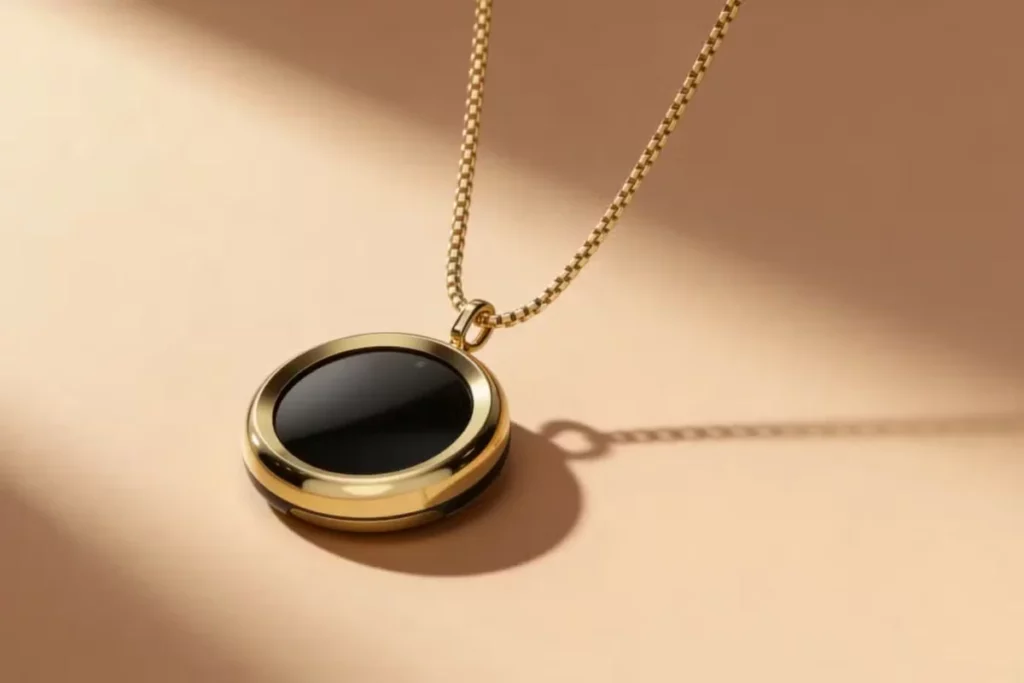
Exposure to sunlight is one of the most documented Lupus flare causes and Gem from The90 is the first consumer wearables that is dedicated to measuring just that. As opposed to a ring or band, it is a pendant device that comes with a photodiode sensor measuring two types of UV radiation- UVA, which is responsible for aging and UVB, which causes burns. The key features about Gem are:
- Real-time personal measurement of sun exposure as opposed to area-wide UV Index from a weather app
- Alerts delivered to the companion app, notifying when to find some shade depending on your level of sun tolerance, use of sunscreen and need for vitamin D
- Pendant-like shape that is clipped to a necklace, with the sensor resembling Apple AirTag
- Ability to integrate with other wearables such as Oura and Whoop, allowing for tracking of sun exposure together with sleep and heart health
- Currently splash-proof, not fully waterproof, priced at $299 including the necklace and the app
Also, it does not measure internal metrics such as HRV and temperature measured by the other wearables from this list and would be better used along with another wearable. Gem is great for those with Lupus flares caused by photosensitivity or skin flares, as it is the only device that directly measures the cause of those flares.
Wrap Up
Wearables in today’s day and age are not just for fitness; for people with chronic illness, they’re health companions. These tiny tech gadgets can be a non-invasive way to catch flares early, prevent overexertion, help with pacing, provide emergency safety, track heart health and build long-term symptom patterns.
The best device for you is the one that matches your symptoms, lifestyle, budget and the one you will wear consistently.
FAQs
Decode the Decor
The Smart Jewelry Revolution
A practical guide to wearable tech's future — delivered straight to your inbox.
Author
