

A few years ago, smart glasses seemed like an exciting idea that was built for the future. However, most of the glasses either relied heavily on a smartphone or felt more like experimental gadgets than products people could use every day.

When I first learned about Raven Prism, it caught my attention for a different reason. Instead of being marketed as just another pair of smart glasses with AI in them, Raven Resonance calls it an “ambient computer”. This approach makes it one of the most interesting wearable devices introduced in 2026.
Decode the Decor
The Smart Jewelry Revolution — a practical guide to wearable tech.
In this Raven Prism explained guide, we’ll explore what the device is and how it compares with other AR and AI smart glasses available in the market today.
What Are Raven Prism AR Glasses?
The Raven Prism represents a completely new category in wearable tech. It is built by San Francisco-based startup Raven Resonance, founded by Thomas Suarez and showcased at the Augmented World Expo (AWE) 2026. While many people call them augmented reality (AR) glasses or smart glasses, the creators actually call the Raven Prism an “ambient computer.”
Ambient computing simply means technology that is always there when you need it but completely blends into the background when you do not. Instead of acting like a basic screen mirror for your smartphone, this device is a standalone 64-bit Linux computer built directly into a stylish pair of premium everyday prescription eyewear frames.
The main target audience for this device includes creative professionals, software developers, makers and tech enthusiasts who want hands-free access to data. Because it runs on an open operating system called RavenOS (which is based on Linux), it appeals heavily to people who love open-source software and hate being locked into closed corporate ecosystems. It marks a major shift in the 2026 wearable market, moving away from simple phone accessories and moving toward true independent computers that sit right on your face.
Raven Prism Hardware & Specs

When looking at a Raven Prism hardware breakdown, the tech inside these frames is incredibly impressive for its size. The company managed to fit an entire 64-bit ARM processor running at approximately 1 GHz. It comes with either 2 GB or 4 GB of mobile RAM alongside dedicated storage, making it fully capable of running local apps, streaming video and processing AI on-device.
Display Tech and Visual Experience
The visual system in the right eye uses a full-color Liquid Crystal on Silicon (LCoS) waveguide display. It offers a 30-degree diagonal field of view (FOV). When you look through the lenses, the virtual screen looks just like a crisp 16-inch laptop display sitting at arm’s length. This allows you to read text, check terminal windows or view notifications clearly while remaining completely aware of the physical world around you.
Form Factor and Weight
One of the biggest issues with older AR headsets was their heavy, bulky design. Raven Resonance fixed this by engineering the hardware to look and feel like premium prescription glasses. The weight is distributed evenly so it does not hurt your nose during long sessions.
The glasses weigh 70 grams and the weight distribution is tailored precisely for all-day wear, avoiding the front-heavy fatigue.
Swappable Battery System
Battery life is always a challenge for smart wearables. Raven Prism, with these glasses, comes with a unique solution: a patent-pending system called Raven Wings. These are hot-swappable batteries located on the tips of the glasses’ arms.
If your battery runs low, you can pull the battery out and swap it with a fresh one without shutting down the system. The device preserves its exact state, meaning your open apps, notes and code lines stay right where you left them without needing a reboot.
Sensors & Inputs
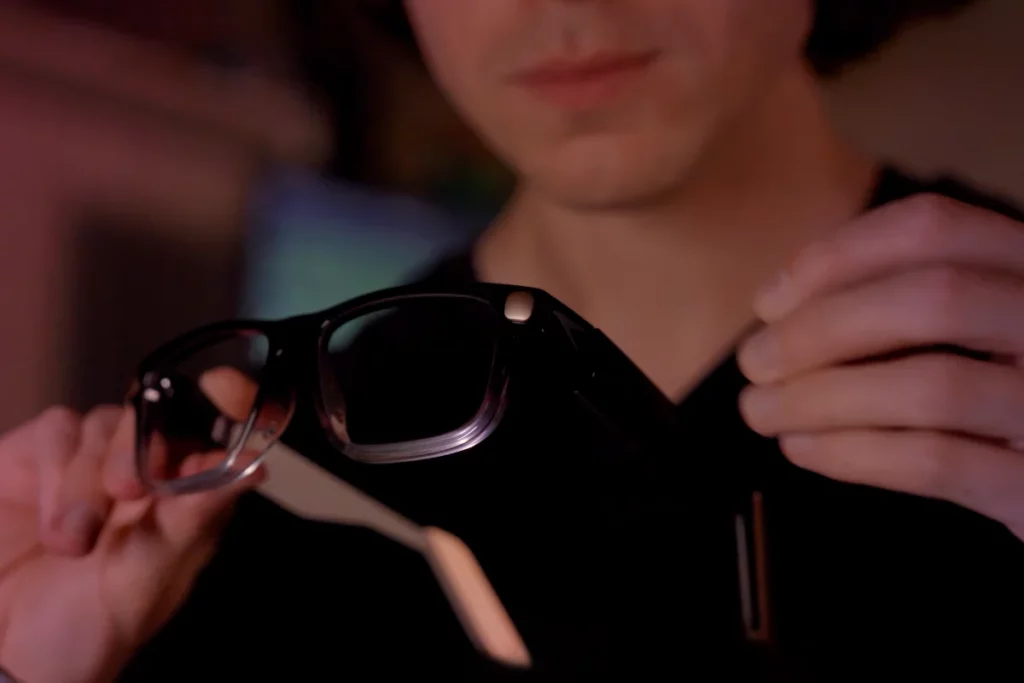
The hardware includes a camera mounted on the left side, multiple microphones, an Inertial Measurement Unit (IMU) for head-tracking and a hardware-enforced eye-tracking sensor suite.
Connectivity
The glasses have built-in Wi-Fi and Bluetooth and they support external wireless peripherals such as keyboards, computer mouses and coding decks.
AI Capabilities: What Raven Prism Actually Does
Artificial intelligence on the Raven Prism is built around privacy and utility rather than marketing buzzwords. Because the device runs native ARM64 Linux (via RavenOS), it can process data locally without sending your life to a remote cloud server.
Voice & Assistant Features
The device balances local language models with cloud processing. For basic tasks like hands-free note-taking, text summarization and system commands, the Raven Prism relies on its local processor. When you need to interact with a voice assistant or run an advanced AI agent, it utilizes its secure wireless connection. Because it is an open Linux platform, developers can deploy tools like Claude Code directly onto the system, allowing them to debug or review code scripts completely hands-free.
AR Overlay & Information Display
The full-color LCoS display on the right lens functions as a crisp contextual overlay. Instead of immersive virtual reality that blocks out your surroundings, the Raven Prism pins reference material, documentation or application windows directly into your line of sight. The interface operates on a “gaze-first” paradigm. Internal sensors track your eye movements, allowing you to highlight text, click buttons and scroll through menus simply by looking at them.
Productivity & Interaction
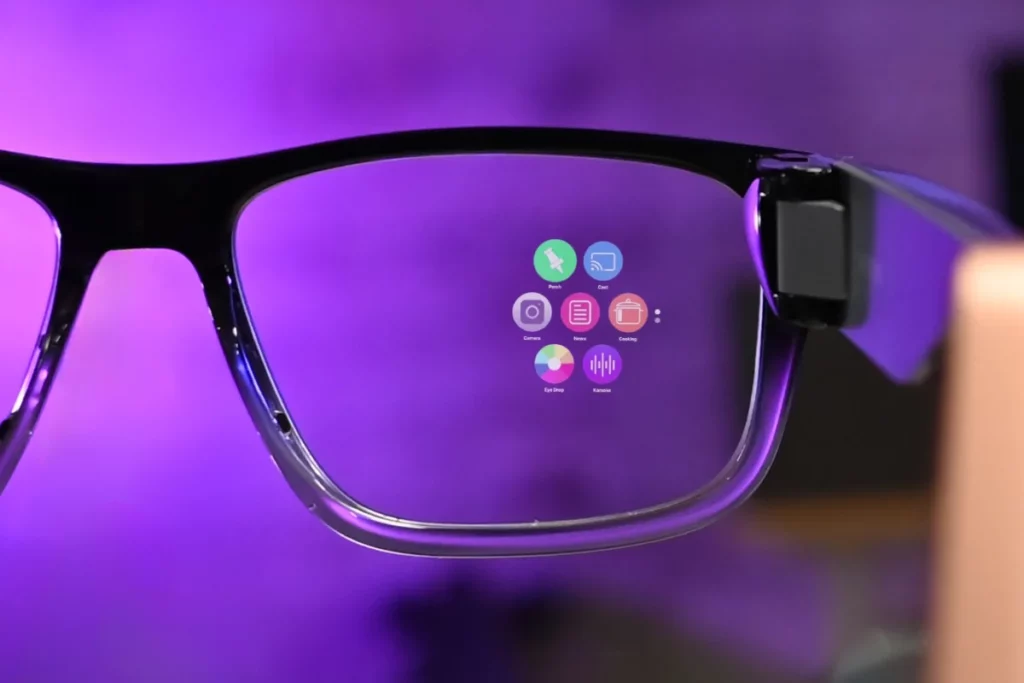
The combination of eye control and voice input creates a seamless workflow when your hands are busy. If you are cooking, working with tools or typing on a physical keyboard, you can view incoming notifications, translate foreign text in real time or read meeting transcriptions without picking up a phone.
How Raven Prism Works With Your Phone / Apps
The most important detail to remember about the Raven Prism is that it does not require a smartphone. It operates as a standalone computer. However, it still fits comfortably into your digital ecosystem.
It runs on RavenOS, which is an operating system that is built from the ground up for wearable eye-tracking. For users who want to stay connected, Raven Resonance provides companion sync applications for mobile operating systems. This allows standard notifications to pass through via Bluetooth.
Because it is an open platform, data syncing can be handled via standard network protocols like SSH or SFTP out of the box. At launch, the device is set to ship with more than 25 built-in, ambient applications and the Python-based Raven SDK is already live on GitHub for building custom software.
Privacy as a Core Feature
In an era where many users worry about smart glasses secretly recording data, the Raven Prism implements hardware-enforced privacy protections:
- Physical Camera Cover: The device features a built-in physical camera shutter that must be manually slid open to capture images. If it is closed, light is physically blocked from reaching the lens sensor.
- Beakon™ Visibility Lights: Bright, integrated indicator lights turn on automatically when the camera is active. This provides a visible cue to the user and everyone around them that recording is taking place.
- Secure Enclaves: Sensitive data, processing keys and eye-tracking metrics are stored locally within hardware-isolated secure enclaves, ensuring your private information is never uploaded or tracked by third-party clouds.
Real‑World Use Cases
The open operating system of RavenOS makes the device incredibly flexible. The core use cases focus heavily on hands-free utility:
- Software Development & Making: Here, programmers can pin API documentation, server logs or terminal outputs in their peripheral vision while keeping their hands free to type on a physical keyboard or solder components.
- Meetings & Productivity: It can read real-time captions, view calendar schedules or even review meetings silently during a live consultation without the need to stare down at a laptop screen.
- Navigation: It can show you subtle directional indicators or map overlays step-by-step while walking through a city or riding a bicycle, keeping your hands entirely free.
- Accessibility: The combination of eye-tracking and real-time audio-to-text translation provides helpful tools for individuals with mobility or hearing challenges.
What Raven Prism Can’t Do and Why It Matters
To understand these glasses, you need to understand their boundaries too because Raven Resonance has designed a focused tool, not a generic gadget.
- Not for Virtual Reality Gaming: With a 30-degree field of view located on a single eye, this device cannot run immersive 3D games like a VR headset. It is designed for text, UI elements and reference windows.
- No Heavy Cloud Telemetry: Because it prioritizes privacy, you won’t get hyper-personalized ad recommendations. If you prefer automated, cloud-heavy ecosystems that track your habits to make predictions, this system will feel overly manual.
- Battery Management: Running continuous local AI models or streaming video will drain the internal battery quickly. While the hardware handles this gracefully, heavy processing requires regular battery swaps.
Raven Prism vs Other AR/AI Glasses
| Feature | Raven Prism | Meta Ray-Ban AR | XREAL Air / Aura |
|---|---|---|---|
| Operating System | Linux (RavenOS) | Proprietary | Android XR |
| Core Dependency | Standalone Computer | Requires Smartphone | Requires Phone or Compute Pack |
| Primary Interaction | Eye Gaze & Voice | Voice & Touchpad | Hand Tracking / Tethered Phone |
| Privacy design | Local AI, Physical Camera Cover | Cloud-reliant Processing | No Built-in Native AI OS |
| Power System | Hot-Swappable Batteries | Internal Battery | Tethered Cable Power |
While the Meta Ray-Ban glasses focus on media capture and cloud-based consumer AI assistant features, they lack a true display overlay. On the other hand, the XREAL Air series offers massive virtual screens for entertainment but relies on external phone processing or specialized Android computing pucks. The Raven Prism stands alone as a fully self-contained, open-source-friendly developer machine on your face.
Battery, Comfort & Daily Usage Expectations

One of the best engineering on the Raven Prism is its power management system. The glasses utilize Raven Wings, which are patented, hot-swappable, modular batteries built directly into the frame arms.
Unlike conventional mobile electronics that force a full system reboot when the battery dies, the Raven Prism features custom circuit logic that preserves the exact system state during a power exchange. You can click off a depleted battery wing, snap a fresh one on and continue writing code or reading text without losing your place or restarting your applications. This hot-swappable design provides true all-day wearability for professional field use.
Price
According to the Raven Resonance team, the glasses will come at the price of $1,499. Raven Prism is expected to launch later in 2026, with pre-orders opening through Raven Resonance’s official website.
Who Should Buy Raven Prism
You Should Buy Raven Prism if:
- You want hands-free productivity.
- You work with technical information daily.
- You are a developer or engineer.
- You value privacy-focused AI.
- You enjoy open computing platforms.
- You want a wearable AR experience beyond simple notifications.
Who Should Skip Raven Prism
You Should Skip Buying Raven Prism if:
- You primarily want VR gaming.
- You need advanced immersive AR.
- You prefer simple consumer wearables.
- You expect smartphone-level computing power.
- You only need fitness or notification tracking.
Wrap Up
After learning more about Raven Prism, I think what makes it different is that it doesn’t try to be another smartphone accessory or a bulky AR headset. Instead, it focuses on providing useful information when you need it while staying out of the way when you don’t.
As this Raven Prism explained guide shows, the device combines a Linux-based operating system, eye-tracking controls, AI-powered features and a lightweight glasses design into a single wearable computer. It may not be the right choice for VR gaming or immersive entertainment, but for developers, professionals and users who value privacy and hands-free productivity, Raven Prism offers an interesting look at where wearable computing could be heading in the years ahead.
If you do wear prescription glasses, here are some of the best smart glasses with prescription lenses.
FAQs
Decode the Decor
The Smart Jewelry Revolution
A practical guide to wearable tech's future — delivered straight to your inbox.
Author
