

For years, fitness trackers have followed the same formula: add a screen, pack in more notifications and try to become a mini smartphone on your wrist. While that approach works for many people, not everyone wants another screen demanding attention throughout the day.

A few weeks ago, while comparing different health wearables, I found myself wondering whether a fitness tracker could focus purely on health data without constantly flashing notifications. That’s when I came across the Hume Band 2.0, a screenless fitness band without a subscription.
Decode the Decor
The Smart Jewelry Revolution — a practical guide to wearable tech.
The Hume Band 2.0 takes a different approach from smartwatches. Instead of adding a display, it removes one completely. The idea is simple: collect meaningful health data in the background and let the companion app handle the analysis. The absence of distractions is a reason why screenless fitness trackers are gaining so much popularity.
In this Hume Band 2.0 review, I’ll take a closer look at its design, health tracking capabilities, sleep insights, battery performance, app experience and overall value. If you’re considering a minimalist wearable, this review should help you decide whether the Hume Band 2.0 deserves a place on your wrist.
What is the Hume Band 2.0?
The Hume Band 2.0 is a screenless fitness tracker designed for users who want health monitoring without distractions. Instead of focusing on smartwatch features, the device concentrates on collecting health and wellness data throughout the day and night.
According to Hume Health, the wearable is designed to monitor multiple health metrics while remaining lightweight and comfortable for long-term wear.
Design and Comfort

When you completely remove a digital screen from a wearable, it stops feeling like a distracting tech gadget and starts feeling like a premium wrist accessory. During my testing, this minimalist design was easily one of my favorite things about the device.
The main highlight for me is the updated UltraLux fabric band. Unlike those cheap, sticky silicone straps that always trap my sweat and pinch my skin, this band is woven from a smooth, highly breathable blend. It uses a hook-and-loop system that allows me to micro-adjust the tightness perfectly to my wrist. Getting that snug, flush fit is crucial so the health sensors can collect accurate data without cutting off your circulation.
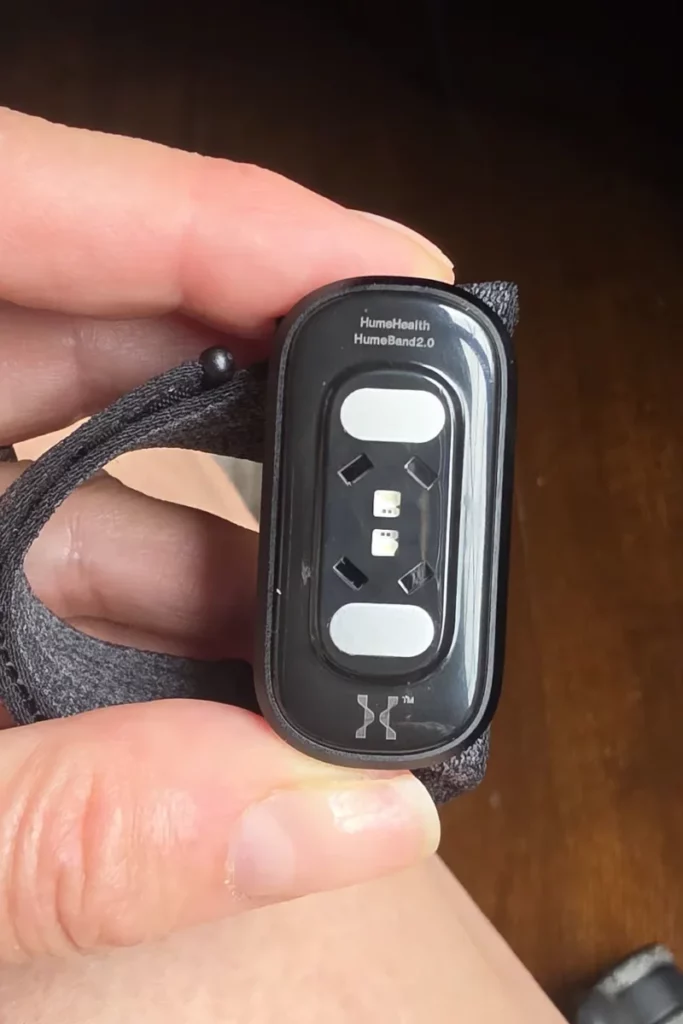
Visually, the tracker keeps an incredibly low profile. The actual sensor module is made of a matte aluminum alloy that hides completely inside the fabric strap, leaving no flashing logos or shiny glass panels. It looks exactly like a high-quality braided bracelet. When I wore it to the office, it slid smoothly under my button-down shirt cuffs.
Wearing it 24/7 proved how comfortable it really is. At the gym, the woven fabric stayed dry and comfortable, but the real test was wearing it to bed. I usually hate sleeping with bulky smartwatches because they press against my face when I rest my arm under my pillow. Because the Hume Band 2.0 module is thin and slightly curved, I completely forgot I was wearing it by the second night. Plus, the screenless design means I never had to worry about a bright screen blinding me in pitch-black darkness when I rolled over.
Keep in mind that the band has an IP68 dust and water resistance rating, it handled my daily showers and heavy rain with ease. However, the woven fabric naturally retains moisture for about 15 to 20 minutes after getting wet. To prevent skin irritation, I highly recommend popping the module out twice a week to give the strap a quick rinse, letting it dry completely before strapping it back on.
Health & Fitness Tracking

When I dug into the actual technology powering the Hume Band 2.0, I realized it operates quite differently from standard step counters. Instead of just tracking how much you move, this hardware is built to measure your long-term health and biological aging process. To achieve this, it relies on a dense optical sensor array packing 5 LEDs and 4 photodiodes that scan your skin constantly, gathering raw biometrics at a much higher frequency than most basic wearables.
The software translates this continuous data stream into a personal longevity dashboard. Instead of focusing heavily on daily workout exhaustion, it monitors five foundational health metrics:
- Heart Rate Variability (HRV): The variation in time between consecutive heartbeats, which indicates how well your nervous system manages daily stress.
- Resting Heart Rate (RHR): The baseline pulse rate that serves as a key indicator of overall cardiovascular efficiency.
- Blood Oxygen Levels (SpO2): A continuous measurement of your respiratory efficiency and blood oxygen saturation.
- Skin Temperature Variations: Overnight temperature tracking used to identify early signs of physical stress or incoming sickness.
- Continuous Blood Pressure Trends: A standout 2.0 feature that maps your body’s cardiovascular patterns across days and weeks.
During my gym sessions, I paid close attention to the heart rate sensor. During steady-state cardio, like a continuous jog on the treadmill, it tracked perfectly alongside my chest strap, keeping pace within 2 to 3 beats per minute. However, during rapid weightlifting intervals and high-intensity circuits, I noticed the optical sensors lagged slightly behind the sudden, sharp spikes in my pulse. If you are an elite athlete who needs to check their exact heart rate zone in the middle of a sprint, the screenless design means you won’t have real-time visual feedback on your wrist.
The most impressive hardware upgrade on the 2.0 model is the continuous blood pressure trend tracking. It is crucial to remember that this is not a diagnostic tool and does not provide an absolute, clinical millimeter-of-mercury (mmHg) reading like an inflating arm cuff. Instead, the band spends your first week building a personalized baseline from your daily and overnight biometrics. The more consistently you wear it, especially while sleeping, the better it understands your normal cardiovascular patterns. Rather than focusing on a single blood pressure reading, it tracks how your baseline pressure shifts in response to your daily habits after wearing for 5-7 days consistently.
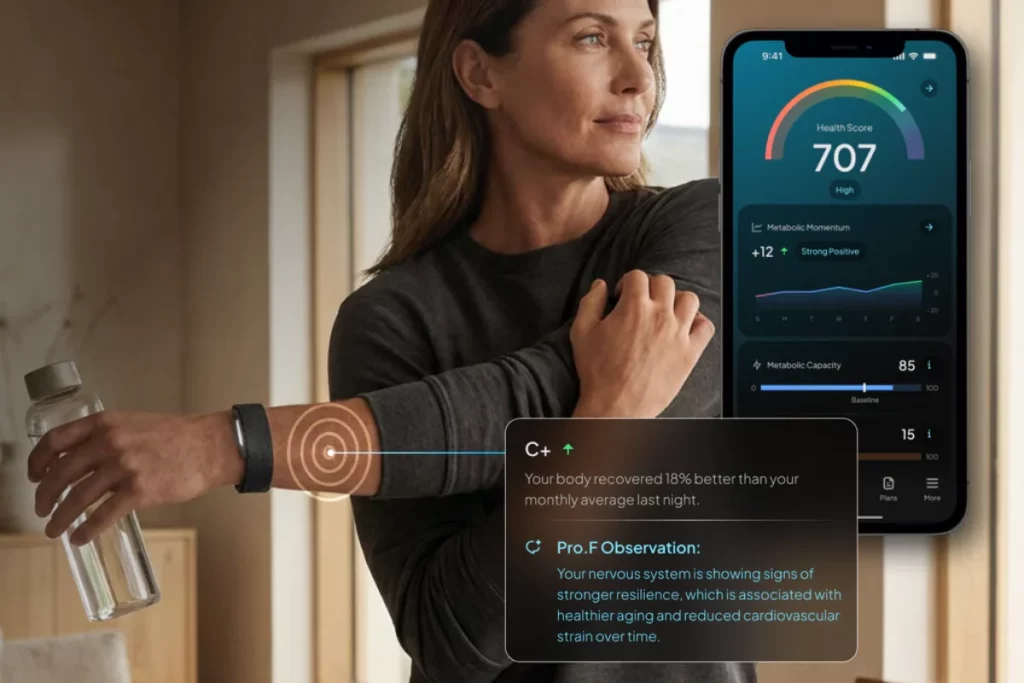
For me, this feature was incredibly eye-opening. The app clearly showed my baseline pressure trends creeping upward the morning after a high-sodium ramen dinner or a particularly stressful afternoon at the office. The system pairs these cardiovascular insights with a “Chronic Illness Indicator“, an AI model trained to flag systemic stress, immune decline or recovery delays up to six weeks before you actually feel physically sluggish. It essentially acts like an early warning radar for your body, helping you adjust your sleep and habits well before you get run down.
Sleep Tracking

Because this band is completely screen-free and featherlight, it quickly became my favorite tool for tracking sleep. I didn’t feel any bulky watch frame pressing against my face when sleeping with my arm under the pillow and there was zero risk of a bright screen accidentally blinding me if I rolled over.
From a technical side, the band continuously scans your vitals while you rest. It measures your resting heart rate, breathing rate, blood oxygen (SpO2) and nocturnal HRV (heart rate variability). The app uses these metrics to break your night down into light, deep and REM sleep stages. In my testing, the total sleep time matched my smart ring almost perfectly.
What I appreciate most is how the app handles Sleep Debt. Instead of just giving me a generic score, it tracks how specific cycles affect my body. For instance, it maps deep sleep to physical muscle recovery and REM sleep to mental clarity. Seeing my exact sleep metrics linked directly to my next-day energy levels made it incredibly easy to understand my fatigue and actually focus on improving my bedtime habits.
Battery Life & Charging

Battery life is a massive make-or-break factor for any screenless wearable. Since you can’t look down at your wrist to see a low battery icon, you need a device that you can trust to run for days without constantly checking your phone app. With the latest upgrade, the brand claims the Hume Band 2.0 can last up to 14 days on a single charge which is a massive jump from the Gen 1’s 5-day limit.
In, real-world testing, my experience looked a bit different from that maximum 14-day lab claim. Because I wore the band 24/7, logged daily gym workouts and left the app on auto-sync, the battery consistently lasted me between 7 and 8 full days. While that falls short of the advertised two weeks, getting a solid week of uninterrupted data tracking is highly convenient. It completely eliminated my daily charging anxiety.
When it is time to charge, the charging process is incredibly fast. The sensor module easily snaps onto its dedicated USB Type-C charging dock. It jumped from an empty battery up to 80% in about 20 to 30 minutes, with a full top-off finishing in just under an hour.
To make things even easier, the charging module has a small color-changing indicator light. It glows red when you’re low, cycles to blue as it fills up and turns solid green the second it hits 100%. This rapid turnaround means I could easily slide it onto the charger right before taking a shower and pop it right back onto my wrist without missing a single hour of sleep tracking or health metrics.
App Integration & Ecosystem

Because the physical hardware doesn’t have a screen, the smartphone software is doing all the heavy lifting. The Hume Health app works seamlessly on both iOS and Android, serving as your command center. Instead of overwhelming you with complicated, laboratory-style charts that require a medical degree to understand, the app keeps things incredibly clean and visual. Every morning when I opened it, the software compiled my continuous sensor data into three simple, easy-to-read numbers:
- Metabolic Capacity: A daily percentage that acts like a battery gauge for your nervous system, showing you exactly how much physical or mental stress your body can handle that day.
- Metabolic Momentum: A long-term trend indicator that tracks whether your daily habits are moving your health forward or backward over time.
- Lifespan Meter: A highly motivating longevity score that dynamically projects “days added” to your life based on consistent improvements in your sleep patterns and resting heart rate.
Beyond these scores, the app features a broad ecosystem design. It easily integrates with major platforms like Apple Health and Google Fit, allowing you to pool all your data in one place. If you want a complete picture of your wellness, you can even pair the band with the optional Hume Smart Scale to automatically blend your body composition trends, like muscle mass and body fat percentage, right into your daily health dashboards.
The best part of this app experience is the price model. Unlike competitors that lock your basic health graphs behind a mandatory monthly paywall, Hume keeps all these core biometrics, sleep breakdowns and history charts completely free for hardware owners, making it a great screenless fitness tracker without a subscription.
If you do want to take things a step further, they offer a Premium Membership subscription. Upgrading unlocks an AI-driven digital coach that gives you custom daily habit recommendations based on your unique numbers, along with deep wellness reports and a complimentary hardware upgrade every two years. The free version provides more than enough data to help you accurately track your recovery and understand your body.
Hume Band 2.0 vs Competitors
| Features | Hume Band 2 | Fitbit Air | WHOOP 5.0 |
|---|---|---|---|
| Display Type | Completely Screenless | Screenless (LED indicators) | Completely Screenless |
| Pricing Model | $229 | $99.99 | Subscription Only ($30/month) |
| Weight | 18 grams | 12 grams | 27 grams |
| Sensor Architecture | 5 LEDs / 4 Photodiodes | 3 LEDs / 2 Photodiodes | 5 LEDs / 4 Photodiodes |
| Specialist Metrics | Blood Pressure Trends, Longevity Index | Basic Activity, Google AI Coaching | Recovery, Strain, Any-Wear Pods |
| Waterproof Rating | IP68 | IP68 | IP68 |
| Battery Life | 7 to 8 Days | 5 to 6 Days | 4 to 5 Days |
| Charging Method | Proprietary Type-C Dock | Magnetic Pogo Cable | Slide-on Wireless Pack |
| Subscription Fee | None | Optional ($9.99/mo Premium) | Mandatory ($199–$239/year) |
Real-World Performance
Living with the Hume Band 2.0 on a day-to-day basis highlights the unique freedoms of a screenless wearable. Without a display continually lighting up your wrist, you quickly forget you are even wearing it.
Daily Wear & Comfort
During focused office hours, the fabric strap is a dream. It sits quietly under dress shirts and doesn’t clunk against the surface of a laptop while typing. At the gym, the soft UltraLux band performs well, though I did notice that during heavy, sweaty workouts, I occasionally had to loosen the strap slightly or shift its position to prevent minor chafing.
Metric Consistency
Over a multi-week period, the baseline biomarkers like resting heart rate (RHR) and heart rate variability (HRV) proved to be stable and directionally consistent. The device doesn’t suffer from erratic data dropouts, provided you keep the strap reasonably snug against the skin so the 5 optical LEDs can maintain clean contact.
Price and Availability
The Hume Band 2 is priced at $356 USD and you can purchase it from the official Hume Health Store. If you want to maximize the software’s capabilities, Hume also comes with an optional Premium Membership available for $8.99 a month.
Limitations
No wearable device is perfect and the Hume Band 2 review wouldn’t be complete without highlighting where the hardware falls short:
- No On-Device Display: You cannot check the time, view your current heart rate mid-run or see how many steps you have taken without opening the smartphone app.
- Absence of Built-in GPS: The band relies entirely on your smartphone’s connected GPS to map outdoor running or cycling routes.
- Basic Workout Detection: The automated activity tracking functions well for running and walking, but frequently misses alternative exercises like resistance weightlifting or yoga, requiring you to log those sessions manually inside the app.
- No Built-In Altimeter: The hardware completely lacks an elevation sensor. This means it cannot track vertical metrics, so you won’t see how many flights of stairs you climbed during the day or elevation gains during outdoor hikes.
- No Smart Alarms or Vibration Alerts: Because the device does not have a built-in vibration motor or speaker, it cannot function as a silent morning alarm clock or vibrate to gently wake you up during your lightest sleep cycle, which feels like a missed opportunity for a recovery-focused wearable.
Who Should Buy Hume Band 2.0
Hume Band 2.0 is a good choice for:
- Minimalist wearable fans
- Recovery-focused athletes
- Sleep optimization enthusiasts
- Health-conscious users
- People trying to reduce screen time
You may want to look elsewhere if you:
- Need smartwatch apps
- Want on-wrist notifications
- Prefer a visible display
- Need extensive third-party integrations
Wrap Up
After using the Hume Band 2.0, what I liked most was its simplicity. I didn’t have to keep checking a screen or deal with constant notifications. It quietly tracked my health data, sleep and daily activity in the background, while the app made it easy to understand the information.
Personally, I think the Hume Band 2.0 is a great choice for anyone who wants to focus on their health without wearing a full smartwatch. It’s not perfect, but if sleep tracking, recovery insights and a distraction-free experience matter more to you than apps and notifications, this is a band I would happily keep wearing.
FAQs
Decode the Decor
The Smart Jewelry Revolution
A practical guide to wearable tech's future — delivered straight to your inbox.
Author
