

There was a time when I thought meditation was simply about sitting quietly with my eyes closed and hoping my mind would calm down. The reality was very different. Every time I tried meditating, my thoughts wandered within minutes. I had no idea whether I was doing it correctly or simply sitting there thinking about work, emails and daily tasks.

That curiosity led me to try the Muse 2 Headband. Unlike traditional fitness wearables that focus on steps, heart rate or workouts, the Muse 2 takes a completely different approach. It focuses on your mind and uses brain-sensing technology to measure your meditation sessions and provide real-time feedback based on your mental activity.
Decode the Decor
The Smart Jewelry Revolution — a practical guide to wearable tech.
After spending several weeks using it during meditation sessions, before bedtime and even during relaxation exercises, I gained a good understanding of what it does well and where it falls short. In this Muse 2 Headband review, I’ll share my hands-on experience and if you should spend your money on it.
What is the Muse 2 Headband?
The Muse 2 Headband is a specialized wellness wearable engineered by InteraXon to provide real-time audio biofeedback for meditation and mindfulness. While smartwatches and fitness trackers rely almost exclusively on optical sensors to monitor physical output, the Muse 2 is built around a non-invasive multi-channel EEG array that reads the electrical activity of your brain.
The hardware functions by translating abstract neurological and physiological signals into dynamic soundscapes. When your brain is active or agitated, the companion Muse app generates turbulent weather sounds. When your mind settles into a calm, focused state, the audio clears up.
Within the broader product lineup, the Muse 2 serves as the anchor daytime training device. It sits alongside the fabric-based Muse S (and newer Athena iterations), which are explicitly optimized for all-night sleep tracking. The Muse 2 features a rigid, adjustable silicone-and-polycarbonate frame designed to wrap around the forehead and hook securely behind the ears, ensuring its gold-plated sensors maintain tight contact with the skin.
Design and Comfort
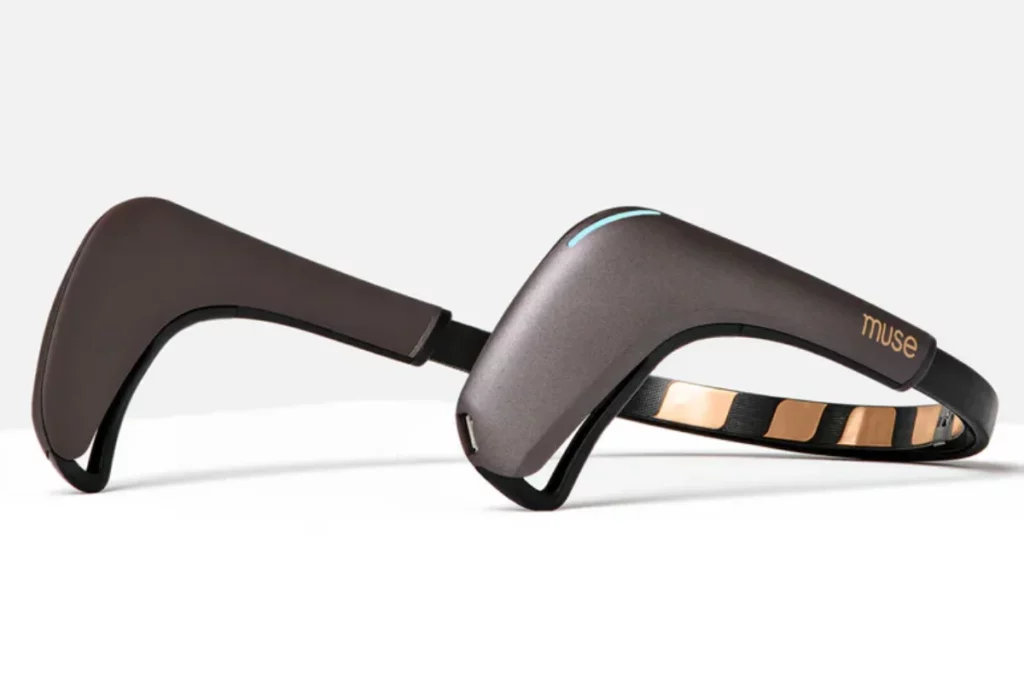
When you first hold the Muse 2, the physical engineering makes it immediately clear that this is a premium, specialized piece of hardware. The headband features a sleek, matte-finish polycarbonate frame integrated with flexible silicone elements.
Instead of wrapping completely around your head like an elastic athletic band, the Muse 2 uses an adjustable, dual-slider mechanism that expands and contracts from the sides. The band hooks over your ears exactly like a pair of sports sunglasses worn backward, anchoring the device firmly in position.
Looking at the interior design, you will see shiny, gold-plated silver/silver-chloride sensors lined right across the forehead strip. These are flanked by conductive rubber ear-piece sensors that hug the skin behind your ears.
Because the headband relies on this semi-rigid frame to maintain clinical-grade data conductivity, the fit is secure but intentionally firm. To get accurate EEG readouts, those sensors require consistent, flat contact with your skin, so the band has to apply a slight amount of continuous pressure against your forehead.
For daytime meditation sessions lasting 10 to 30 minutes, the ergonomics are excellent. At just 41 grams, the entire unit is incredibly lightweight and the sliding mechanisms adjust smoothly to match different head shapes without sliding out of alignment while you are sitting upright.
However, using the Muse 2 sleep tracking features introduces a few comfort trade-offs due to this rigid design. If you are an exclusive back-sleeper, the thick plastic pods housing the battery and processor behind your ears will remain entirely out of your way. But if you tend to toss and turn or sleep strictly on your side, that hard plastic casing will press uncomfortably against your skull.
During my overnight tests, this side pressure occasionally shifted the sensors out of position, breaking the skin contact and triggering an “Adjust Headband” audio alert that ended up disrupting my sleep instead of improving it.
Key Features
The primary appeal of the Muse 2 is its multi-modal sensor suite. Instead of evaluating your mental state through a single metric, it matches brainwave activity with cardiovascular and physical indicators to construct a multi-dimensional picture of your immediate autonomic nervous system response.
EEG Brainwave Tracking

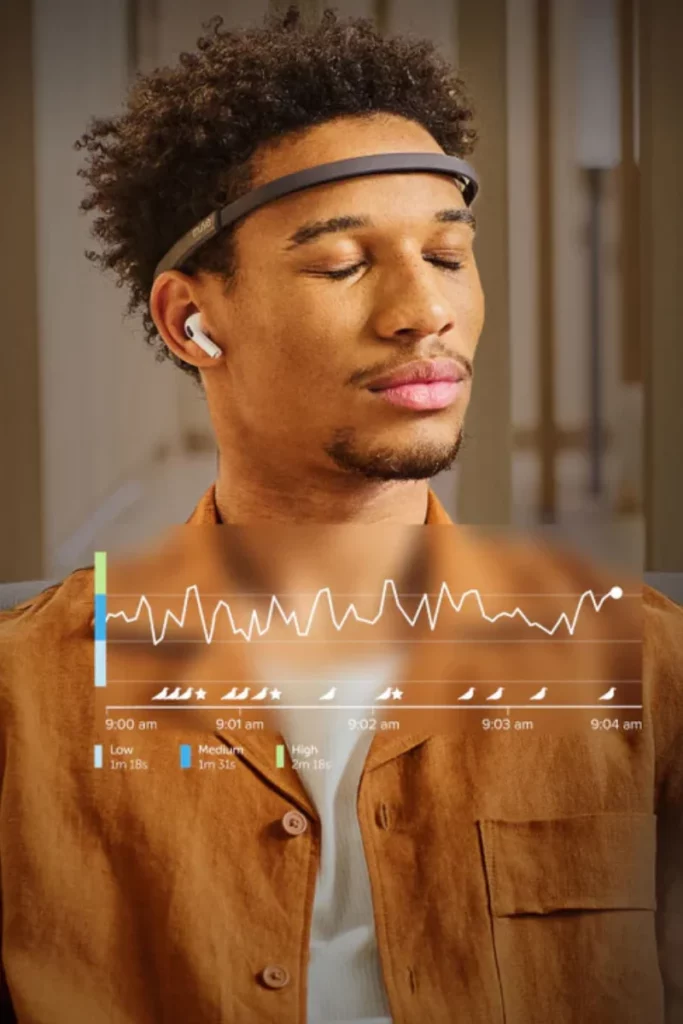
The core of the hardware relies on 4 primary EEG channels that are supplemented by 2 reference sensors. This allows the Muse 2 to record the microvolt-level electrical discharges of neural populations, segmenting them into distinct brainwave frequencies:
- Alpha Waves (8 – 12 Hz): Associated with relaxed wakefulness, light meditation and creative flow states.
- Beta Waves (12 – 30 Hz): Linked to active thinking, analytical focus, problem-solving and high cognitive load.
- Delta Waves (0.5 – 4 Hz): The dominant frequency during deep, restorative, slow-wave sleep.
- Theta Waves (4 – 8 Hz): Observed during deep relaxation, daydreaming and early stages of light sleep.
- Gamma Waves (30 – 100 Hz): Tied to high-level information processing, cognitive binding and intense focus.
During a meditation session, the Muse 2 continuously measures the ratio between these frequencies. If your Beta wave output spikes, indicating a wandering or anxious mind, the app immediately responds with audio cues to prompt cognitive redirection.
Sleep Tracking
Though primary daytime meditation remains its strongest suit, the Muse 2 includes basic overnight sleep tracking. Utilizing its internal photoplethysmography (PPG) optical pulse sensor alongside a 3-axis accelerometer and gyroscope, the headband monitors:
- Time spent in light, deep and REM sleep stages.
- Total sleep duration and nighttime wakefulness events.
- Position shifts and physical restlessness.
The app pairs these metrics with guided sleep sequences and sleep-induction soundscapes, helping users transition smoothly into a restful state while mapping the physiological correlates of their recovery.
Guided Meditation
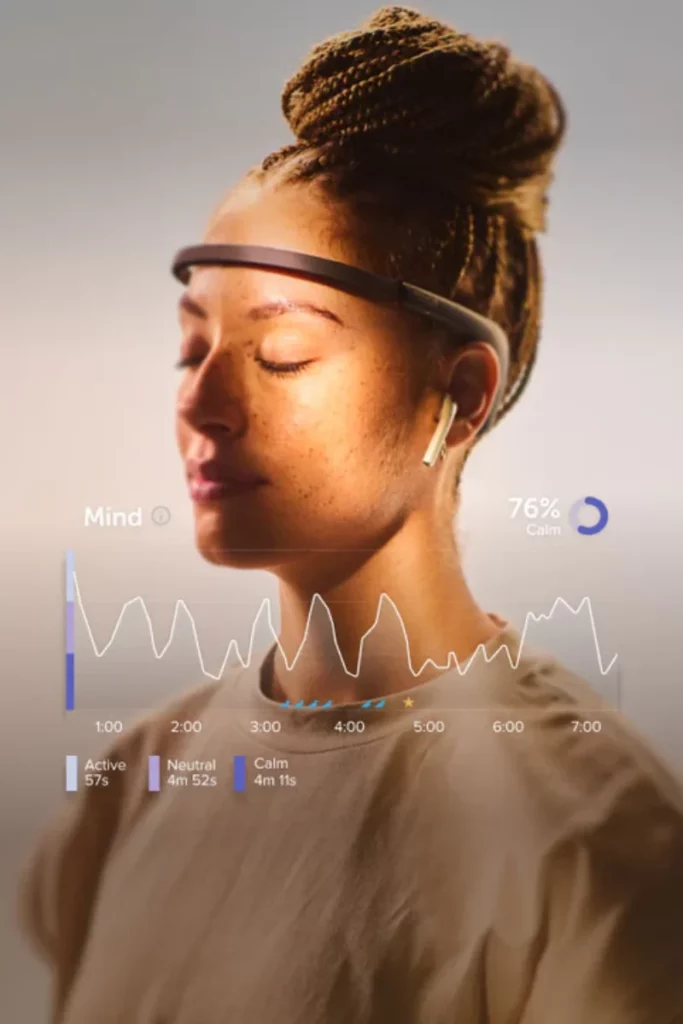
The companion app serves as your interactive audio guide during every session, ensuring you are never left sitting in unguided silence. When you launch a practice, you can choose from four distinct biofeedback modules depending on your personal focus goals: Mind, Heart, Body and Breath.
The Heart and Breath experiences are particularly fascinating because they lean heavily on the headband’s built-in Photoplethysmography (PPG) optical sensor. The Muse 2 tracks your blood flow changes to map out your real-time heart rate and breathing rhythm. It then mirrors these biometrics back to you as soothing, rhythmic audio, like a steady drumbeat or a gentle ocean wave that speeds up or slows down alongside your pulse.
By hearing your internal physiology played back to you, you can consciously slow down and sync your breathing patterns, which helps activate your parasympathetic nervous system to rapidly reduce physiological stress.
App Integration

The companion app acts as the command center for the entire hardware experience, housing all your history, brainwave graphs and daily tracking tools. After you finish any session, the app compiles your raw biometric data into clean, easy-to-read charts so you can see exactly when your mind was active versus calm.
For users who want a unified view of their wellness habits, the platform features straightforward data integration with Apple Health and Google Fit. This ensures your mindful minutes are instantly credited alongside your daily gym workouts, steps and activity metrics. By syncing your mental fitness data with your broader physical tracking ecosystem, you get a much more comprehensive view of your daily energy expenditure, stress management and overall physical recovery cycles.
Battery Life
On a full charge of Muse 2, the internal lithium-ion battery provides roughly 5 hours of continuous active tracking.
Because you only wear it during specific windows rather than all day, that 5-hour battery life is surprisingly good in daily use. For my routine, which consists of a 20-minute focused session in the office before answering emails, followed by an evening winding-down session, a single charge easily covers a week of daily use.
For charging, it uses a standard micro-USB port, which is located on the side pod and takes approximately 2 to 3 hours to charge it completely from an empty battery.
Muse 2 vs Muse S
| Features | Muse 2 | Muse S |
|---|---|---|
| Form Factor | Rigid Polymer & Silicone | Flexible Composite Band |
| Primary Use Case | Daytime Meditation & Focus | Multi-Modal Focus Training |
| Sensors Included | EEG, PPG, Accelerometer, Gyro | Enhanced EEG, Multi-Wavelength PPG |
| Battery Performance | 5 Hours Active | 8 Hours Active |
| Sleep Optimization | Basic (Rigid side pods) | Advanced Sleep Stage Modeling |
| Price | $249.99 | $474.99 |
The core brain-sensing technology across these devices remains highly consistent, but the physical builds and auxiliary tracking metrics vary significantly based on your target use case.
The biggest differentiator between the Muse 2 and the Muse S line is the structural architecture. The Muse S utilizes a soft fabric sleeve that keeps the sensors flat against your head, making it vastly superior for overnight comfort and side-sleeping. Furthermore, advanced variants like the Muse S Athena incorporate functional Near-Infrared Spectroscopy (fNIRS) to monitor localized changes in brain blood oxygenation, providing deeper insight into cognitive loading.
The Muse 2, conversely, focuses on giving you the fundamental EEG and heart-rate tracking features at a far more accessible price point, making it the practical choice for users who plan to do most of their brainwave training while sitting upright at a desk or on a cushion.
Real-World Performance
Sensor Responsiveness & Audio Latency
The most impressive aspect of the Muse 2 is the low latency of its neurofeedback loops. The moment you experience an internal distraction, like remembering an unanswered email, the soundscape responds in under a second. The rushing wind or heavy rain acts as an immediate mirror for your cognitive state.
This rapid, closed-loop accelerates the process of noticing mind-wandering, making it an incredibly efficient training tool for anyone who struggles with standard, unguided mindfulness practices.
Connection Stability & Calibration
Establishing a solid connection requires clean skin contact. If you have thick hair behind your ears or oil on your forehead, the app’s pre-session signal calibration can take an extra minute or two to clear. I found that wiping down the gold sensors with a slightly damp cloth prior to a session completely resolved any pairing or tracking drops over Bluetooth. Once the signal indicators turn solid green, the data stream remains stable throughout the entire exercise.
Pricing
The Muse 2 is priced at $249.99. It can be purchased from the Muse Official store and Amazon.
The baseline purchase includes full access to all real-time biofeedback layers (Mind, Heart, Body and Breath) alongside standard post-session graphs. However, unlocking Muse’s premium tier, which includes over 500 guided meditations, external audio integration (allowing you to run Muse tracking over Spotify or Headspace) and advanced cognitive performance scoring, requires an optional subscription. The subscription costs $12.99 per month or $94.99 per year, with the annual plan offering better value for regular users.
For a dedicated mindfulness practitioner, biohacking enthusiast or anyone seeking quantified, data-driven stress reduction, the standalone value proposition is exceptional. It provides deep, actionable neurological metrics without forcing you into an absolute brand lock-in or a mandatory monthly paywall for core tracking.
Limitations
No wearable device is perfect and the Muse 2 has clear functional trade-offs that prospective buyers should keep in mind:
- App Dependency: The headband has no internal screen or storage capability. It must be actively paired to an iOS or Android smartphone running the Muse app to perform a session or view data.
- Rigid Form Factor: The polymer band can feel stiff or cumbersome during side-sleeping, making it less than ideal for full-night sleep tracking compared to fabric wearables.
- Not a Clinical Medical Tool: While the Muse 2 utilizes neuroscience-grade EEG tracking principles, it is a consumer wellness tool. It is not intended to diagnose, treat or monitor clinical neurological conditions like epilepsy or clinical insomnia.
- Sensor Maintenance: The sensor array requires regular cleaning to ensure accurate skin conductivity. It cannot tolerate heavy moisture, making it unsuitable for active movement or post-workout cool-downs when heavy sweating occurs.
Who Should and Shouldn’t Buy Muse 2
The Muse 2 Headband is a great fit for:
- Meditation enthusiasts
- Mindfulness practitioners
- People who want to improve their sleep
- Wellness-focused users
- Biofeedback technology fans
You may want to skip Muse 2 if:
- You expect medical-grade EEG readings
- You rarely meditate
- You want a smartwatch replacement
- You mainly care about fitness tracking
Wrap Up
After using the Muse 2 Headband, I found it to be a unique wearable for anyone who wants to improve their meditation practice and better understand their mental wellness. Its real-time brainwave feedback, helpful sleep features, comfortable design and easy-to-use app make it a solid choice for mindfulness enthusiasts.
While it’s not meant to replace a medical device, it offers a rewarding experience for users who are committed to building healthier meditation and sleep habits. If you’re serious about meditation and mindfulness, the Muse 2 is worth considering. For everyone else, it may be more of a niche wellness gadget than an everyday essential.
FAQs
Decode the Decor
The Smart Jewelry Revolution
A practical guide to wearable tech's future — delivered straight to your inbox.
Author
