

With the launch of Lumia 2, which is coming up next year, the promise of minimal tech sounds so amazing, right? No more screens, no more tan lines on your wrist, just a piece of jewelry doing all the work.

So I did something a little crazy. For this month, I turned myself into a walking experiment. I wore the Oura Ring 4 on my finger and the Apple Watch Series 11 on my wrist to compare if they would work better than the Lumia 2 Smart Earring. And today, I bring you my results while comparing smart earrings vs smart rings vs smartwatches!
I know you are thinking that it is not a fair fight and you are right. Comparing a smart earring to a smart ring, further with a smart watch, is not fair on paper. But that is exactly why we need to talk about it.
I do not want to just believe the hype or the numbers on the paper. I want to see which of these devices could actually survive a real Tuesday in my life. If you are confused whether you should wait for the smart earring or just buy a watch or a ring today, this article is for you. So let’s break down the information so you can decide which wearable is good for you.
Decode the Decor
The Smart Jewelry Revolution — a practical guide to wearable tech.
Design and Comfort
The smart earrings are the biggest surprise to me, as I found out that they weigh less than 1 gram. This makes them incredibly light compared to the smartwatch, which weighs 43.1 grams. Smart rings weigh 3 to 5 grams (depending on the ring size).
The best part I like about these earrings is the flexibility. They come in different styles and colours, like studs and hoops for people with piercings and cuffs for those without piercings. Another thing I like about these earrings is that I can attach them to any earring I already own.
The Core (back of the earring where sensors are placed) can be attached to any push-back earring that I already have. This can be done because Lumia 2 comes with the Switch Back system, for which the patent is still pending.
After pitting smart earrings, smart rings, and smartwatches against each other, I concluded that the ring is smoother. It took me about two days to get used to the feeling of something thick on my index finger.
For me, sleeping while wearing this ring was so smooth that I cannot compare it to a watch. For the gym, it is a different story. Lifting weights with a smart ring is so uncomfortable. I usually take it off for heavy sessions to avoid scratches on my ring.
While in Apple, you never forget it is there. It has a weight, but after a full day of typing and a night of sleep tracking, my wrist feels like it needs a break. It also comes with different strap options, which help me a lot to change the look of the watch anytime I want to. It also comes with a wide range of watch faces that can be customized according to my mood.
smart earrings vs smart rings vs smartwatches: Specifications
| Specifications | Lumia 2 | Oura Ring 4 | Apple Watch Series 11 |
|---|---|---|---|
| Battery Life | 5-8 Days | 7-8 Days | Up to 18 Hours |
| Water Resistance | Shower Use | Water Resistant (100m) | Swimproof (WR50) |
| Connectivity | Bluetooth | Bluetooth | Bluetooth, Wi-Fi, Cellular |
| Charging | Swappable Battery Pack | Puck Charger | Magnetic Fast Charger |
| Price | $249 | Starts at $349 | Starts at $399 |
| Monthly Membership | Starts at $9.99+ | $5.99 | $0 |
| Unique Feature | Tracks Blood Flow to Head (predicts focus/energy) | Smart Sensing adapts to finger skin tone/position | Safety (Crash/Fall Detection) + Communication (Calls/Text) |
| Compatibility | iOS & Android | iOS & Android | iPhone Only |
| Sleep Tracking | ✓ | ✓ | ✓ |
| Cycle Tracking | ✓ | ✓ | × |
| HRV | ✓ | ✓ | ✓ |
| Gym Friendly | ✓ | × | ✓ |
| Blood Flow Tracking | ✓ | ✓ | ✓ |
Health and Wellness Tracking
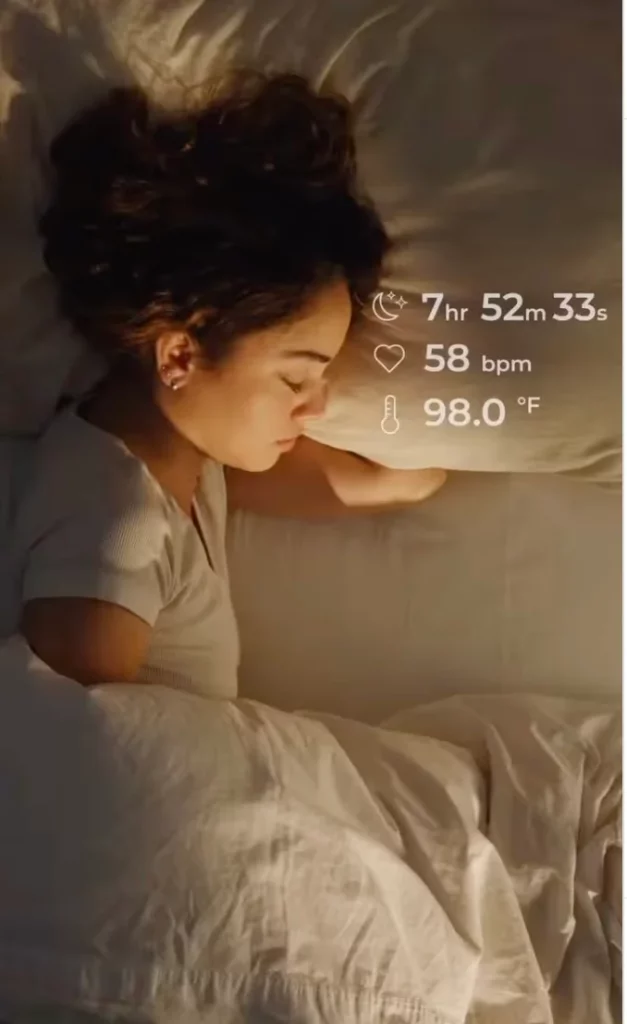


Heart Rate Monitoring
For heart rate monitoring, the Apple Watch is the best right now. If I am running up the stairs, I can just look at my wrist and see my heart rate spiking instantly. The Oura and Lumia, on the other hand, take a more passive approach. They track it constantly, but since there is no screen, I am unable to check the data as often.
The watch comes with an FDA-approved ECG, blood oxygen and an AFib or sleep apnea notification feature. It is the best choice if you want medical-grade data. While the smart ring takes a much quieter approach. Instead of giving you instant alerts, it works in the background and tracks your sleep patterns without the distraction of a screen.
The Lumia 2 is powerful for people with chronic conditions like POTS or Long COVID. By tracing blood flow to the head, it stays accurate even when you are moving. While Apple and Oura focus on general heart metrics, Lumia, on the other hand, monitors how your blood is actually moving. It is important for managing some health issues.
Sleep Tracking and Recovery
Sleep tracking is an area where smart rings shine as they consistently track sleeping patterns and provide you with a Sleep Score (0-100).
The feature I like the most in my Oura Ring is the Readiness Score. By measuring the Resting Heart Rate (RHR) and Heart Rate Variability (HRV) at my finger, where the pulse signal is very strong, it tells me exactly how much stress my body can handle that day.
In the smartwatch, Apple has moved away from just tracking towards interpreting a shift driven largely by Watch OS. Through their new Vitals app and Sleep Score in WatchOS 26 and newer, Apple uses its high-performance sensors to track respiratory rate, wrist temperature and blood oxygen. The Series 11 includes Sleep Apnea notifications (available on watchOS 11 and above) and a more detailed Sleep Score (comparable to Oura) enabled at the WatchOS level that focuses on bedtime consistency.
Unlike the others, Apple focuses on Training Load. It compares your recent workouts to your body’s baseline vitals to tell you if you are overtraining or if you are ready for performance training.
While smart earring Lumia 2 introduces a metric that others can’t see, Blood flow to the brain. This changes the definition of recovery from physical to mental. Like the others, it tracks sleep stages and temperature. But because it sits on the ear (close to the carotid artery), its placement is supposed to be exceptionally accurate at detecting nightly temperature shifts for cycle tracking and illness detection.
While Oura tells you if your body is recovered, Lumia tells you if your brain is fueled. It tracks arterial blood flow to see if you are experiencing brain fog or if your brain is getting the oxygen it needs to be sharp.
Stress and Readiness
Oura Ring makes me obsessed with my Readiness score because it tells me to push hard or to take rest. It is the most hands-off experience because it synthesizes all my vitals into a clear instruction for the day.
On the other hand, Lumia 2 uses blood flow to the head data. It helps the smart earring to predict brain fog and energy dips, which feels helpful for my workday. It targets mental readiness rather than just physical recovery.
While Apple Watch Series 11 mainly focuses on closing rings. It can sometimes be a dumb motivator that pushes me to work out even when I am feeling tired. Unlike the others, Apple still has no built-in daytime stress tracking or even a singular Readiness Score.
While it collects the heart rate and HRV data, it does not give me a daily score out of 100 to tell me how recovered I am. To get similar insights to Oura, I have to rely on third-party apps like Athlytic or Bevel. Without them, the focus remains mainly on activity and fitness goals rather than holistic recovery.
Battery Life
Battery life is the most crucial when buying a wearable device, be it smart earrings, smart rings, or smartwatches. Apple Watch 11 gives a battery life of up to 18 hours, because of this, I had to make a routine to charge it while I shower or right before bed.
Whereas the Oura Ring 4 gives a battery life of 7 to 8 days. So I have to charge it once a week. It comes with a small charger, and the ring tops up quickly on it.
The Lumia 2, on the other hand, comes with swappable batteries that give 5 to 8 days of battery life each.
Accuracy
When it comes to heart health, specifically ECGs and irregular rhythm notifications, I trust the Apple Watch because these features are also FDA-approved. The wrist is a perfect spot for detecting sudden spikes in heart rate or detecting falls, making it my go-to for safety.
A 2025 systematic review confirmed that the Apple Watch is 94.8% accurate at detecting AFib. Plus, their new Hypertension feature is backed by years of clinical testing to help spot high blood pressure before it even becomes a problem.
For sleep, I trust Oura. Because the blood vessels in your fingers are much easier to read than the ones in your wrist, the ring gets a much cleaner signal. Independent research has shown that Oura’s data closely matches medical-grade sleep lab equipment (PSG). In fact, it is widely considered the most accurate consumer wearable for tracking your sleep stages and recovery.
For body temperature and menstrual cycle tracking, the Lumia 2 seems promising. Because it sits on your earlobe, specifically the left lobe, which is highly vascular and is close to the heart, it captures core temperature much better than a watch, which can be easily affected by outside room temperature.
Lumia’s technology was developed with experts from Johns Hopkins and Harvard, proving that the ear is a superior spot for detecting blood flow and thermal shifts compared to the traditional monitoring locations.
Price and Availability
The Lumia 2 starts at $249 USD, while its monthly membership costs start at $9.99.
It is not available yet, but you can currently reserve your spot for $1. With this offer, you will get 40% off when it launches. The preorders for these smart earrings will open in January for the US and Canada, except Quebec. Meanwhile, the shipping will begin in 2026 the dates are not confirmed yet.
The Oura Ring 4 costs start at $349 USD, while its monthly membership costs start at $5.99. You can buy the Oura Ring 4 from their website or from authorised retailers like Best Buy, Target or Amazon.
The Apple Watch Series 11 starts at $399 USD with no monthly membership. It is available on Apple’s official online and offline stores, Amazon and other authorised retailers.
Final Verdict
According to me, you can choose Lumia 2 if you want a tracker that feels almost invisible. If you care about style first and hate wearing wristbands, then this earring is for you. If you are interested in unique metrics like energy level, then go with this.
If sleep recovery and long-term health trends are your priority and you want a set-it-and-forget-it device with a long battery life, then you can go with the Oura Ring 4.
You can choose the Apple Watch Series 11 if you want features that give you reminders throughout the day via notifications. You can also choose this if you are already working with the Apple ecosystem and most importantly, if you do not mind charging a device every day.
In the debate of smart earrings vs smart rings vs smartwatches, you need to understand that you should stop asking which one is better and start asking which one fits my life.
FAQ’s
Decode the Decor
The Smart Jewelry Revolution
A practical guide to wearable tech's future — delivered straight to your inbox.
Author
