

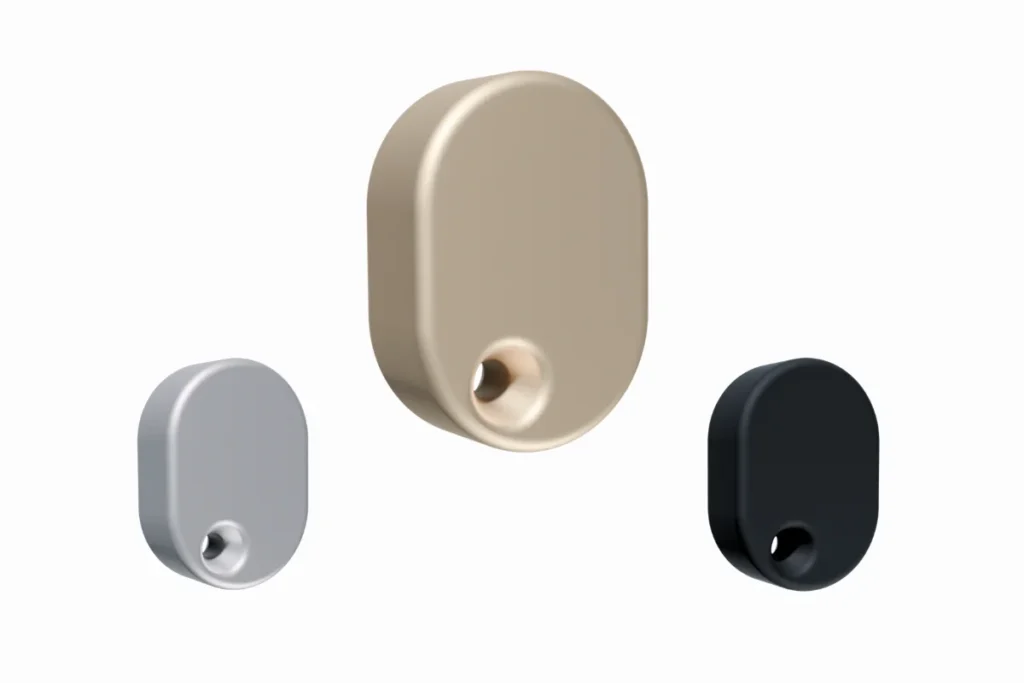
There’s a new wearable that’s trying to do something that most trackers on your wrist or finger haven’t really achieved yet and it looks nothing like a smartwatch. It looks like an earring back.

Yes, Phira, made by the Houston-based startup Aurelia Vitals, is meant to be clipped behind your ear to measure continuous thermal signals that correspond to fluctuations of hormones such as estrogen, LH and progesterone. You don’t need any needles to take your blood, no strips to pee on every morning. All you need is a little bit of hardware attached to your existing earring post.
But before I go further into details, I want to be clear about one thing here that Phira is not measuring blood hormone levels, it says so on its website. What it is trying to achieve is to infer the patterns of hormones based on physiological signals and it is crucial for how you should read everything below. The company launched its waitlist in September 2026 and the clinical study is ongoing, so here we have an early stage device that looks promising.
Phira Is Trying to Put Hormone Tracking Into an Earring
Smart earrings are new but not unheard of in the wearables space. A company called XPANCEO built tech for measuring glucose levels through tears for heaven’s sake! Lumia is one of the more prominent names in the smart earrings space and now, Phira is making it more accessible with their earring back.
Decode the Decor
The Smart Jewelry Revolution — a practical guide to wearable tech.
Phira was built by Dr. Alisha Menon, who says her own cycle trackers often gave her data that didn’t match how her body actually felt. That experience led her to create something she felt could do a better job.
The hardware of this product looks like an accessory that replaces a normal earring back and works with most post earring you already have. It is designed to be worn all the time including during the night and is described as waterproof with a battery life lasting multiple weeks.
Phira is not a continuous blood hormone monitor though. The company makes it clear that it does not sample hormones but uses some other indicator to monitor them. So the question arises…
How Can a Wearable Track Hormones Without Measuring Blood?
© Phira
Speaking of wearables that track hormones without measuring blood and sticking needles into you, Clair is another hormone tracker that is built on the same principal.
Your hormones do not just wander around freely within your system. There is some connection between them and your body’s temperature regulation throughout your period. The connection between the reproductive hormones and body temperature has been investigated in detail for many years and Phira is not the first one to discover it.
However, what Phira is trying to accomplish is new. Rather than directly measuring a hormone concentration with a panel test or a strip like a urine test, Phira tries to detect the thermal signature of hormones, namely estrogen, LH and progesterone and estimate their level based on how that pattern looks. You could say that Phira is not testing hormones but rather the consequences of them.
When you hear “hormone tracking” in relation to Phira, understand that this implies an inference based on patterns and not lab-grade hormone concentration levels. This is not inherently bad but simply is what it is.
If fertility tracking is what you’re after, I personally trust Oura and here are some more wearables for fertility tracking that could be of help.
Why Phira Sits Behind the Ear
This kind of sensor is normally placed on the wrist and finger in other wearables, then why behind the ear? This is the same question that I had when I first found our about Lumia, or when Temple decided to stick a wearable onto our temple.
The answer that Phira comes up with is the superficial temporal artery, which is very close to the skin surface around that area. According to the company, the use of this location makes it possible for Phira to have a much more accurate reading of the core body temperature dynamics because of the lack of ambient temperature or movement factors affecting the reading as it does in a more active part such as the wrist.
In order to detect any change in the levels of hormones in the body, one needs to detect changes of about a fraction of a degree. With its sensors being accurate to 0.03°C, the effect of the environmental noise becomes a serious problem. This is definitely a different way of doing things from others in the category although I won’t declare it to be superior without data proving that.
What Signals Does Phira Actually Detect?
Phira isn’t tracking just one measurement. The company divides its sensing into four overlapping metrics.
Thermoregulatory Dynamics
How your body controls its temperature before, during and after ovulation.
Temperature Trends
Unlike most devices which will give you one temperature a day, Phira is measuring a continuous trend and it’s important because a single piece of information can completely misrepresent the trend.
Thermal Distribution
How the heat distribution changes around the ear and Phira believes that this can be linked to vascular changes during the cycle.
Thermogenic Shifts
Changes in body heat production due to various factors such as exercise, certain foods, stress or any other changes in the person’s lifestyle.
The last point is important to consider. Not all thermal changes picked up by Phira are due to hormonal activity. Physical exercise, stress, sickness, they all can affect the results.
What Hormones Is Phira Designed to Track?
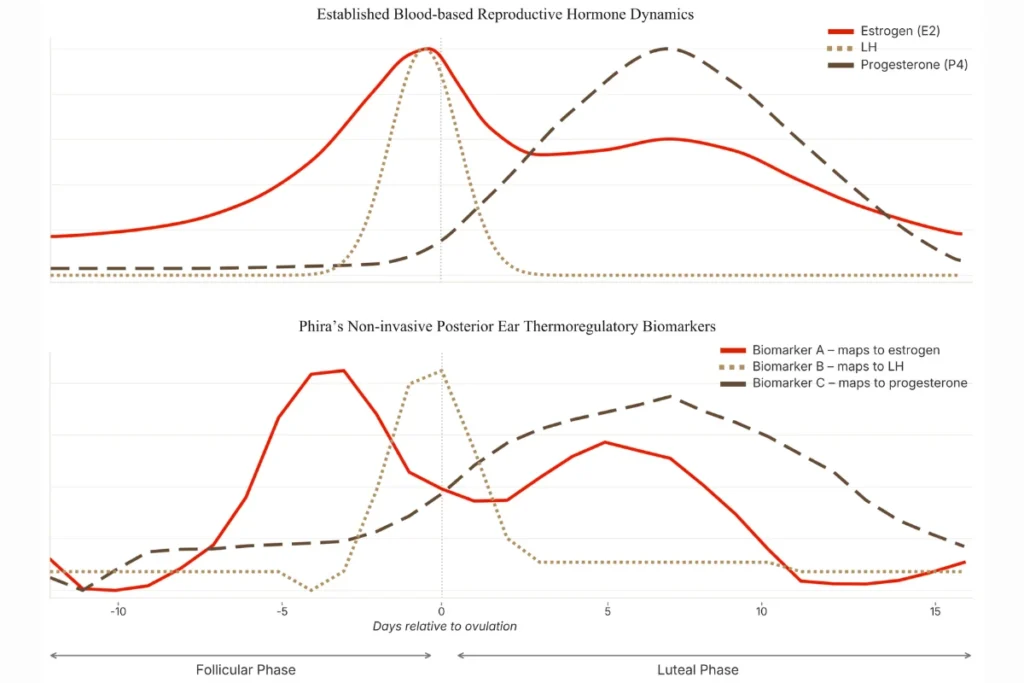
As the time for ovulation approaches, estrogen goes up and that comes with its own thermoregulatory signature. The LH surge happens just at the time of ovulation itself, which is the transition period that Phira is looking for. The increase in progesterone happens after ovulation and has a lot to do with the rise in body temperature that many of us know as the luteal phase.
Once again, the device is not supposed to measure hormone levels but their patterns in the body.
What Does Phira’s Early Research Actually Show?
© Phira
In a pilot study that was IRB approved and tested 31 menstrual cycles of 12 women whose menstrual cycles lasted between 27 and 36 days, Phira says their device worked well with their data being compared to daily urine hormone tests, clinically validated sleep wearables and an ovulation prediction app.
Specifically, the company claims that the thermal biomarkers captured behind the ear were in line with the hormonal levels of estrogen, LH and progesterone throughout the cycle. In another study that was done to understand the physiological sensing and not the hormone tracking claims, the research was peer reviewed and presented at the IEEE Engineering in Medicine and Biology Conference in July 2026.
I am not here to add to the criticism but it should be noted that the hormone tracking results have not been peer-reviewed yet. It is a 12 woman pilot study and an expanded study has been initiated to understand whether this result can be held across much larger and diverse population, including women with PCOS or PMOS and women going into perimenopause.
Here’s where I land on this. The science behind the idea is solid but the harder qustion is that can a wearable connect the dots outside of a controlled study? 12 women is not nothing but it is also not prood that this works the same across every cycle, every lifestyle, every body. Phira itself describes this as wellness technology, not a replacement for clinical hormone testing and I’d hold onto that framing.
But honestly, I would rather have companies take a shot at projects such as this than have this whole category go untested for another decade. No progress will come about overnight but it is going to come from a bunch of these early, messy attempts getting funded and picked apart one study at a time and Phira is one of those attempts.
What Could Phira Actually Be Used For?
Currently, the real world use cases will be cycle awareness, fertility prediction and personalization of how the cycle functions compared to population averages. This could also help shed some light on the interplay between sleep and training, as well as their impact on your hormones.
The future of this product seems to lie beyond the realm of what the product can do currently, with menopause, postpartum recovery and long-term hormonal health tracking being mentioned. This is the path Aurelia Vitals is heading in, but not something Phira can do right now, at least not in the way it is marketed.
Why Phira Is Different From Oura and Other Cycle Trackers
While Oura and almost all other cycle trackers available on the market today detect the cycle phase by measuring factors such as wrist temperature, heart rate variability and the cycle history, Phira wants to take this one step further by developing a sensing approach focused on hormone dynamics.
However, this is far from being a unique concept. As I mentioned earlier, another player in this space is Clair Health, which has over 25,000 waitlisted users before its expected launch in November 2026. Clair Health follows a similar inference approach with ten biosensors and it already has pricing set at $369 for the hardware plus $5.99 or $9.99 for a monthly subscription and is HSA/FSA eligible.
Phira has not revealed its pricing yet so Clair is currently winning the game of availability and pricing.
When Will Phira Be Available?
The product is waitlist only at this moment. There’s no information about any retail price or shipping schedule apart from commercial release plans scheduled for 2027 at best. But you can register and you will get the chance to be part of early access and the expanded study of the device itself.
Wrap Up
Today’s wearables have become excellent at measuring parameters such as heart rate, sleep and activity for a long time. Hormones have remained the area where consumer devices couldn’t go further than making people visit a lab. Phira believes that an earring, of all things, could make it work.
I am not sure that Phira has managed to crack the code on hormone tracking via wearable devices yet and even more so the company isn’t claiming that either. The point that makes the company interesting and worth paying attention is that the device can be considered one of the early and funded attempts to use a genuine physiological parameter in order to help people understand their body better without visiting labs and using apps that are just estimating average values. Whether the technology works well or not will be revealed during the expanded study.
FAQs
Decode the Decor
The Smart Jewelry Revolution
A practical guide to wearable tech's future — delivered straight to your inbox.
Author
