

WHOOP didn’t become popular because it counts steps. It became popular as it redefined fitness in the context of recovery: HRV, strain, sleep depth and daily readiness. It took away the distraction of the screen and focused people on a single question: “How ready is your body today?”

But in 2026, the conversation has shifted. Now, more users are questioning the subscription-only model, its long-term ownership cost and whether they need to “rent” access to their own health data. If you’re wondering if there are screen-free WHOOP alternatives without a recurring fee, the answer is yes.
This guide focuses only on screenless, subscription-free WHOOP alternatives. No smartwatches, no hybrid compromises and no “just install a recovery app.” Every device on this list focuses on recovery-style tracking, does not require a monthly subscription and is free of distractions. But first…
What Makes a Good WHOOP Alternative?
If we are being serious about this comparison, then the bar is set quite high. A true WHOOP alternative should include:
Decode the Decor
The Smart Jewelry Revolution — a practical guide to wearable tech.
- HRV tracking- Nightly HRV is required to make recovery scores accurate.
- Recovery or readiness scoring- The numbers are pointless without a means to interpret them.
- Deep sleep tracking- Stages, events, total time and trends.
- Comfort while in continuous wear- These devices are meant to be worn 24/7.
- A robust app environment- Being screenless means the app does all the heavy lifting.
- Economics- One-time purchase and no subscriptions.
Now, let’s take a look at your list of best WHOOP alternatives.
Garmin Cirqa Smart Band

© Garmin
With the first ever screenless band from Garmin coming out, the company has already built-in its trust in the brand along with targeting the core user base of WHOOP. The CIRQA combines the Garmin Elevate 4 sensor in a fabric loop which could be worn either on the wrist or on the upper arm for $199.99 globally without any recurring subscription charges. In contrast with the majority of the screenless fitness bands, it also features a small side button which enables interaction with it without taking out your phone.
What the Cirqa has to offer:
- Heart rate through wrist measurement, Body Battery Energy monitoring, Pulse Ox, stress and skin temperature
- Complete sleep tracking with stages, night score, HRV, breathing rate and naps
- Up to 10 days of battery life
- Optional Garmin Connect+ subscription at $6.99 monthly for nutrition tracking, real-time statistics, advanced coaching and breathing exercises
All core features remain accessible without any subscription and this is what makes it appealing. In other words, you won’t have to subscribe to the WHOOP-like tiers in order to get your recovery statistics and if you are already a Garmin watch user, the Cirqa would easily become a part of the ecosystem without any learning process.
It would be the best option for people who trust the accuracy of Garmin sensors and are interested in having a screenless band without paying anything monthly and having an ability to upgrade to advanced coaching at any moment in time.
Fitbit Air

If Cirqa is the response from Garmin to WHOOP, then Fitbit Air is the response from Google. It is priced at $99.99, it tracks your heart rate, SpO2, sleep stages, HRV and Afib rhythm alerts and lasts up to a week on a single charge. For less than $100, this could be the least expensive actual entry into screenless tracking from a top brand.
What sets it apart:
- Afib detection in a budget price bracket
- Sleep tracking with up to 15% more accuracy because of the latest ML models used by Google
- Up to seven days of data stored on-device without an always-connected phone
- All core features can be used without subscription and every purchase comes with three months of free Google Health Premium
The downside is the sensor design. An in-depth review mentions that the sensor array is non-circular, hence, it is already fighting against optical physics from the get-go and cannot achieve class leading heart rate accuracy, though this is a common problem faced by almost all band-style devices, and is not a deficiency of the Air alone. Support across platforms for Apple Watch, Garmin, WHOOP and Oura is also being planned for later in 2026, making it a useful tool even for users who do not plan to shift ecosystems.
This tracker works best for people who want to experiment with screenless tracking without putting down any actual money or for people within the Google/Pixel ecosystem who seek AFib detection and sleep insights for free.
Hume Band
© Hume Band
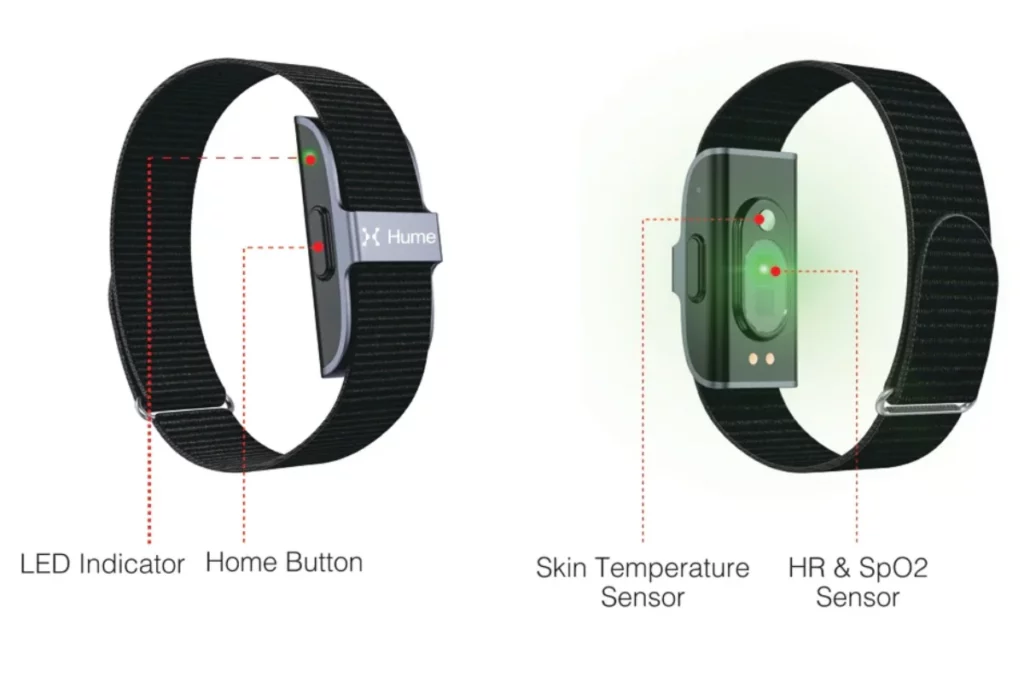
The Hume Health Band takes a different approach compared to most recovery tracking devices. While WHOOP focuses on athletic strain and performance optimization, Hume Health takes a more metabolic health focused approach.
Fundamentally, Hume tracks the expected metrics for a recovery focused wearable, such as HRV, sleep stages, heart rate and daily activity. However, Hume takes it a step further by relating these metrics to other components of the body composition and metabolism through its ecosystem. Another role of the Hume Health Band is emotion monitoring, which, as mentioned, is also based on artificial intelligence, but the focus of this role is the monitoring of the patterns of moods and emotions.
There are no subscription plans required to use the Hume Health Band to track the metrics, which makes the product more attractive to users as they need to have access to their health metrics without spending more money. Making it to our list of best WHOOP alternatives.
The app experience also feels more wellness focused compared to performance optimization. While this may not be for the high performance athlete looking to optimize peak output, it may be more appealing to those who are interested in long term health and recovery awareness.
While it may be a specialized product, it may be incredibly appealing to the right individual.
Price: $356 USD
Polar Loop 2

© Polar
Polar is a name that has been synonymous with sports science for decades, and the Polar Loop 2, which launched in 2025, is no exception. They’re known for their accuracy in heart rate monitoring as well as providing structured training data that’s invaluable for athletes.
The Polar Loop 2 offers:
- Nightly Recharge recovery scoring
- In depth sleep tracking
- Heart rate tracking
- Daily activity tracking
What’s more is that there are no subscription fees associated with the use of the device.
Polar’s strength lies in its structured training capabilities, providing users with the right metrics, recovery advice and long-term training tracking capabilities. While the device is screen-less, the overall platform is mature, rich in data and stable. What you’re essentially paying for is the training platform, not the UI animations.
In comparison to the WHOOP, the overall presentation is slightly old-school, almost as if they’re not as focused on the modern, ‘lifestyle’ branding approach that WHOOP is taking. However, the overall science behind the recovery metrics is still solid.
Luna Band

© Luna
The next newcomer to the screenless recovery wearables segment is the Luna Band. Similar to the WHOOP device, the Luna Band also operates on the same philosophy of being a screenless recovery tracker, but without the need to pay any recurring membership fee.
What does the Luna Band offer?
- Continuous biometric tracking
- Sleep tracking
- HRV-based recovery recovery tracking
- App-based coaching and insights
- No subscription model
The hardware looks simple and minimalist that doesn’t try to compete with your attention span. There’s no screen to fight against, no notifications to wade through. It leaves all the heavy lifting to the software side, which is where the real brainpower resides anyway.
One drawback to the Luna Band is that it’s a new entrant in the market and its software and data accuracy may not be as thoroughly tested and research-driven as the likes of Polar or Ultrahuman. However, the fact that it exists is a clear indication that the trend is moving towards screenless recovery wearables that don’t require a subscription model to use.
Ultrahuman Ring AIR

© Ultrahuman
The Ultrahuman Ring AIR takes a slightly different angle on recovery compared to most wrist-based trackers. Yes, it covers the core physiological metrics you’d expect like HRV, sleep stages, resting heart rate, activity trends and more. But outside of the basics, Ultrahuman is big on lifestyle optimization.
The platform is big on circadian rhythm optimization, caffeine windows and other metabolic health insights to help you optimize your energy levels throughout the day, not just your training sessions.
Physically, the Ring AIR is extremely lightweight, around 2–3 grams depending on size, making it far more comfortable for sleep tracking than bulkier wrist wearables. It’s discreet, durable and designed to be worn 24/7 without drawing attention. More importantly, it does not require a mandatory subscription for core features, which significantly lowers long-term ownership cost.
Where it really differs from WHOOP is in philosophy. WHOOP is strain-first, built around optimizing workouts, pushing performance and quantifying exertion. Ultrahuman is lifestyle-optimization-first, built around improving sleep timing, metabolic flexibility and daily rhythm alignment.
If you want recovery insights without the psychological pressure of daily strain targets and performance scoring, the Ring AIR offers a softer, more sustainable approach, while still delivering serious biometric depth.
RingConn Gen 3

© RingConn
RingConn has flown under the radar and has become one of the strongest no-subscription services in the smart ring market. The features of the Gen 3 include:
- Long battery life: 6-9 days
- Sleep tracking
- HRV trends
- Resting heart rate
- Lightweight titanium
- No subscription required
- No upsells within the app
While it’s similar to WHOOP in terms of features, it’s less coach-oriented and more data-oriented. You still get all of the data and trends, just maybe not as gamified.
If battery life and ease of use are important to you, RingConn is one of the most stable solutions on this list.
Amazfit Helio Ring

© Amazfit
If the appeal of WHOOP is “wear it and forget it,” smart rings are the next logical step. And the Amazfit Helio Ring is Amazfit’s entry into the smart ring market, with a focus on recovery.
While it offers a continuous heart rate, nightly HRV, sleep stages and quality, stress tracking, SpO₂ and readiness score, with a battery life of approximately 4-7 days, what makes this device interesting is the fact that it doesn’t scream “elites only” and instead offers useful information for readiness and recovery without the added cost.
If you’re already invested in the Amazfit and Zepp ecosystem, this is the cleanest transition away from the WHOOP.
What are the limitations? It doesn’t offer strain modeling to the same level as the WHOOP. However, for the average lifestyle athlete, this device offers the essentials.
WHOOP vs Alternatives: What Actually Changes?
Let’s make it real-world practical. From a surface level perspective, we can say that the difference between WHOOP and new screenless alternatives has closed somewhat. They all monitor the key metrics that are important. They all monitor heart rates, they all monitor heart rate variability, they all monitor sleep stages and recovery trends. Sensor quality in 2026 is no longer a significant difference maker.
So what actually changes?
So, first of all, WHOOP still dominates in terms of how it presents effort. It’s incredibly well-engineered and intuitive. You wake up and know how you’ve recovered and how hard you should train. It’s like having performance software, if you will, designed by athletes, not just another health and wellness platform.
Where the alternatives clearly excel is with the ownership and flexibility that comes with them. With these products, you own the hardware outright, and you own the data as well. There’s no tiering, no locked-in data and no stress about losing access to your metrics when your subscription runs out. This is not an insignificant difference, especially when you multiply it by three years.
Another difference is the form factor of the products themselves. WHOOP gives you a wrist band, while if you’re not a fan of sleeping with something on your wrist, a ring can be life-changing.
The biggest difference is no longer about the accuracy, it’s about the economics and philosophy.
Subscription Economics: The 3-Year Perspective
This is where the decision becomes less emotional and more mathematical.
With WHOOP, you’re not buying hardware in the traditional sense, instead, you’re committing to a membership model. The device is tied to the subscription. Stop paying and you lose access to the insights.
Let’s break it down.
WHOOP’s standard annual plan sits around $239 per year.
Over three years, the cost goes up to $717. So after three years, using WHOOP 4.0 effectively costs around $717. And that’s assuming you don’t upgrade tiers or add optional services. This is where WHOOP alternatives come into the picture.
Now compare that to a device like the Polar Loop 2. The Polar Loop 2 typically retails around $199 as a one-time purchase. Over three years, that’s still $199 total. That’s it. No recurring fees or locked recovery metrics.
That’s a difference of roughly $518 over the same period. And Polar isn’t the only one in that category. The same math applies to the Ultrahuman Ring AIR, RingConn Gen 3 or the Amazfit Helio Ring, all one-time purchases with no mandatory subscription.
The Garmin Cirqa Smart Band and the Fitbit Air take the equation even further in opposite directions. Cirqa has an initial cost of $199.99 and all core tracking services completely free of any charges, resulting in three years being worth $199.99 in costs as well, equal to Polar’s calculation, but from a more trusted name when it comes to sensor accuracy. The Fitbit Air takes things a step further with a cost of only $99.99, it is less than half the price of any other option on this list, while most of its health features, including AFib detection, are available for use without even requiring a subscription, meaning over three years it is less than $100 in cost altogether, which makes it $617 less than WHOOP over this period of time.
Yet it is not about finances alone, it is about ownership. With a subscription-free device, the initial payment is the maximum financial commitment you have to make. Over the three-year period of time, the choice becomes quite obvious.
WHOOP also introduced Meridian, but there are no hardware changes. It is only a new and fancy strap.
Who Should Still Choose WHOOP?
Despite all these WHOOP alternatives, WHOOP remains relevant to:
- Competitive athletes who enjoy the strain model
- Those seeking aggressive coaching
- Those comfortable with continuous payments
- Those who enjoy the tightly controlled ecosystem
Who Should Choose One of These Alternatives?
These WHOOP alternatives are best for:
- Those tired of subscriptions
- Those seeking data access without paying a fee
- Those focused on wellness
- Those preferring ring-based wearables
- Those preferring discreet 24/7 monitoring
Wrap Up
In 2026, it will no longer be required to subscribe to recovery tracking. The screen-less wearable space has come a long way. Smart rings have never been more accurate and the ecosystems are no longer experimental and subscription-based but competitive and stable.
While choosing between a smart ring such as the Amazfit Helio Ring or the RingConn Gen 3, a lifestyle optimization device such as the Ultrahuman Ring AIR or a smart band such as the Hume Health Tracker Band, Polar Loop 2 or Luna Band, one must understand that consistency is more important than complexity. What is important is to use it frequently and make intelligent decisions based on the trends and insights provided by the data.
The best WHOOP alternative is not necessarily the one that can provide strain scores and data with pixel to pixel precision, but the one that best suits one’s lifestyle and psychology. While some people can thrive in the pressure to perform optimally and compete with others, others might prefer a lifestyle optimization device that does not cause daily anxiety about being ready.
FAQS
Decode the Decor
The Smart Jewelry Revolution
A practical guide to wearable tech's future — delivered straight to your inbox.
Author
