

There was a time when gaming setups meant carrying a heavy laptop, a monitor, wires, chargers and maybe even a cooling pad just to enjoy a proper gaming session outside your room. But wearable tech is slowly changing that idea. Devices like the ROG XREAL R1 are trying to turn a simple pair of glasses into a massive virtual gaming screen you can carry anywhere.

That is what makes the ROG XREAL R1 so interesting. It is not trying to replace your eyes with a virtual world like a VR headset. Instead, it is trying to place a giant portable display in front of you while still letting you stay connected to the real world. I know it’s confusing, which is why I have put together a ROG XREAL R1 explained guide for you!
Decode the Decor
The Smart Jewelry Revolution — a practical guide to wearable tech.
The idea sounds futuristic, but ASUS and XREAL are betting that this could become the next big category in gaming wearables.
What Is the ROG XREAL R1?
The ROG XREAL R1 is a cutting-edge, gaming-focused AR wearable born from a strategic partnership between ASUS ROG (Republic of Gamers) and XREAL, a leading pioneer in the spatial computing space. Rather than forcing users into a closed ecosystem or demanding a monthly subscription fee to look at their own data, this pair of glasses is built on a platform-agnostic, plug-and-play philosophy.
At its core, the ROG XREAL R1 is an advanced display-glasses concept. It acts as a featherweight, high-performance face-worn monitor that projects a massive virtual screen directly into your field of vision. By combining the gaming hardware expertise of ASUS ROG with the optical engineering power of XREAL, the R1 aims to solve a classic problem: how to get a theater-sized, pro-grade gaming setup that fits right into your jacket pocket.
What the ROG XREAL R1 Actually Does
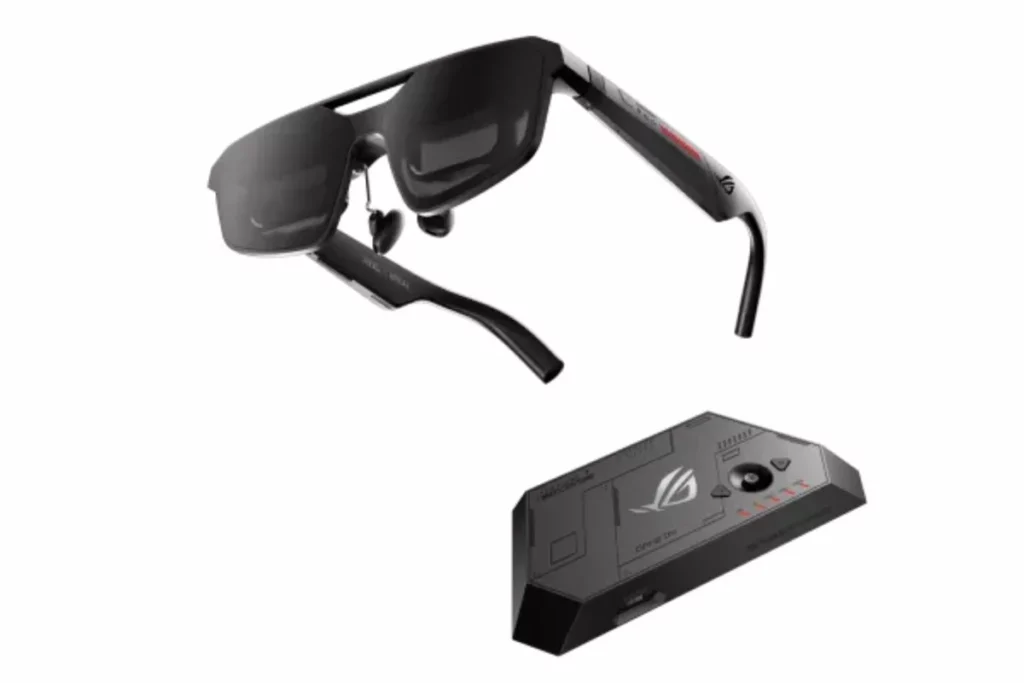
The ROG XREAL R1 is a high-performance, gaming-focused wearable display created through an exclusive partnership between ASUS ROG and XREAL.
At first glance, the device looks just like a regular pair of sleek sunglasses. However, inside the frames, there are tiny micro-OLED displays that project a massive virtual screen directly into your field of vision. Instead of forcing you to look down at a small physical monitor or a compact handheld screen, these glasses project a sharp, floating digital display that feels incredibly large and lifelike, right in front of your eyes.
The core engineering concept behind this hardware is straightforward, it focuses on four primary pillars:
- Create a Portable Gaming Display: It packs the visual real estate of a massive desktop display into a pocket-sized, travel-friendly form factor.
- Make Handheld Gaming More Immersive: It instantly upgrades small 7-inch handheld screens into a theater-sized view, pulling you deeper into your favorite games.
- Reduce the Need for Physical Monitors: It eliminates the hassle of carrying heavy portable screens, desktop stands and extra power bricks when traveling.
- Provide a Private Large-Screen Experience: The projected display is entirely invisible to the people around you, allowing you to game securely in public spaces like airplanes or coffee shops.
Unlike traditional, bulky VR headsets that completely cut you off from your environment, the ROG XREAL R1 does not fully block your surroundings. The lenses allow you to maintain a clear view of the physical world around you while simultaneously interacting with your digital content. Because it blends your actual environment with a floating screen, it is best described as an AR display wearable rather than a standard virtual reality headset.
This partnership brings together the best of both worlds: ASUS ROG contributes its legendary gaming hardware optimization, while XREAL supplies years of specialized optical engineering. By combining their strengths, both companies are successfully pushing gaming wearables into the mainstream.
Is the ROG XREAL R1 AR Glasses, VR or Just a Portable Display?
There is so much confusion as to where the ROG XREAL R1 falls in the spectrum of wearable devices. In order to address these uncertainties and foster some level of trust, we need to define what exactly this device is and what it is not.
First, the ROG XREAL R1 is absolutely not a Virtual Reality headset. Traditional VR goggles completely cover your eyes to isolate you inside a fully digital, computer-generated world. The R1 does the exact opposite by letting you look right through the lenses, ensuring you stay aware of your physical surroundings at all times.
Second, you should also avoid confusing the R1 with casual smart glasses. Devices like the Ray-Ban Meta are built primarily for taking quick photos, recording videos and listening to audio through built-in frames. They do not have visual display screens inside the glass. The R1, however, prioritizes top-tier display hardware over cameras or built-in AI assistants.
Instead, the R1 is best classified as an AR display wearable. It takes the high-end technology of a premium, 240Hz portable gaming monitor and shrinks it down into a lightweight, 91-gram pair of eyewear.
By utilizing advanced 3DoF tracking, the glasses allow you to anchor a massive, virtual 171-inch screen right into your real-world environment. This means you can choose to have the screen locked firmly in one physical spot while you look around or have it smoothly follow your gaze as you move your head.
Why ASUS ROG Is Entering Smart Glasses

The gaming industry is changing quickly and portable play is leading the charge. Thanks to devices like the Steam Deck and ROG Ally, we can finally play massive, console-quality games anywhere, whether we are traveling, commuting or just relaxing on the couch.
However, this portable revolution has a major bottleneck: tiny screens. It is hard to fully enjoy a beautiful, detailed game world on a compact 7-inch display. That is exactly why ASUS ROG decided to enter the wearable space with the ROG XREAL R1. They see these glasses as the ultimate solution to the small-screen problem.
By launching this hardware, ASUS is targeting three major opportunities:
- Handheld Gaming Growth: Capitalizing on the massive wave of players who now use portable gaming PCs as their primary systems.
- Minimal Gaming Setups: Helping gamers who want a clean, lightweight alternative to bulky desks and heavy monitors.
- The Next Essential Accessory: Turning gaming glasses into the next must-have upgrade, just like a high-end headset.
Partnering with XREAL was also a brilliant strategic move. Instead of trying to build complicated display optics from scratch, ASUS can focus on gaming software and hardware tuning while XREAL handles the wearable tech. It is just like the traditional monitor market, where gaming brands buy high-quality panels from suppliers and tune them specifically for players. By working together, they are making massive-screen gaming completely portable.
ROG XREAL R1 Features Explained
The internal specifications of the ROG XREAL R1 are meticulously tailored to meet the demanding standards of modern enthusiasts. Here is a breakdown of the core features, extra technical details and why they matter for intensive gaming:
Micro-OLED Displays
The R1 features dual Sony 0.55-inch micro-OLED displays pushing a crisp Full HD (1920×1080) resolution per eye. Because micro-OLED technology boasts an astonishing pixel density of roughly 4,000 PPI (Pixels Per Degree) and a sharpness rating of 40 PPD (Pixels Per Degree), it completely eliminates the visible “screen-door effect” common in older headsets.
More importantly, it delivers an industry-first 240Hz refresh rate (when Frame Rate Boost is enabled) and a near-instant 0.01ms panel response time. For high-speed racing games or first-person action RPGs, this ultra-high refresh rate ensures buttery-smooth motion with zero ghosting. The display also covers 107% of the sRGB color gamut and hits a peak brightness of 700 nits, ensuring your games look incredibly vibrant with deep, true blacks.
Field of View (FOV) and Low Latency
With a 57° field of view (FOV), using the R1 is visually equivalent to sitting in front of a staggering 171-inch virtual screen from a distance of 4 meters. The optics are finely calibrated to cover roughly 95% of the human-focused viewing area, striking a perfect balance between epic visual scale and edge-to-edge text sharpness.
To keep the experience feeling completely natural, the glasses achieve an ultra-low 3ms motion-to-photon latency. This near-instant communication between your head movements and the screen drastically minimizes the motion sickness and input lag often triggered by wearable displays.
Advanced Electrochromic Dimming and Auto Transparency
Ambient lighting can easily ruin a transparent display. To counter this, the R1 integrates intelligent Electrochromic Dimming lenses powered by the built-in XREAL X1 spatial computing chip. When using the native 3DoF (Three Degrees of Freedom) tracking in Anchor Mode, the glasses activate Auto Transparency.
This feature automatically tints the lenses down to isolate your vision when you look directly at your virtual game and instantly clears them up to full transparency when you turn your head away to look at your real-world surroundings or talk to a friend. The glasses also support three manual dimming levels so you can adjust them yourself to match bright daylight or dimly lit rooms.
Audio, Controls and Ergonomics
The R1 features spatial audio hardware explicitly tuned with Sound by Bose, alongside an integrated noise-canceling microphone array that uses phase cancellation to keep your voice chat clear of background noise.
When it is connected directly to an ROG Ally, the glasses unlock a unique synchronized dual-display functionality. This allows the Ally’s built-in screen to transform into a live touch-control panel. You can easily tweak brightness, screen size, aspect ratio, tint levels and spatial settings via the Armoury Crate SE app without pausing your game.
Structurally, the frames weigh just 91 grams and feature three levels of temple angle adjustment, digital IPD (interpupillary distance) calibration and a detachable prescription lens frame to guarantee long-term ergonomic comfort for all gamers.
Battery Life and Connectivity
The ROG XREAL R1 relies entirely on a tethered architecture, meaning the glasses themselves do not contain a heavy, heat-generating internal battery. Instead, they draw minimal power directly over a USB-C connection from the host device.
For mobile or on-the-go sessions, you simply plug the R1 directly into your laptop, phone or handheld console. While this does add minor power draw to your host device’s battery, it keeps the eyewear incredibly light and prevents them from overheating on your face.
The ROG Control Dock (GCD01)
For at-home desktop command centers, the glasses come bundled with the dedicated ROG Control Dock. This docking hub acts as an advanced hardware switcher and signal processing unit.
- Input Ports: Includes two HDMI 2.0 ports and one DisplayPort 1.4 port, letting you connect multiple systems (like a PS5, a PC and a console) simultaneously.
- One-Touch Switching: A physical button on the dock lets you instantly swap inputs without swapping cables.
- Software Control: Fully compatible with the ASUS DisplayWidget Center PC application, enabling quick layout templates, multi-screen configurations and easy firmware management using your mouse and keyboard.
ROG XREAL R1 vs XREAL Air: What’s the Difference?
| Feature | XREAL Air | ROG XREAL R1 |
|---|---|---|
| Max Refresh Rate | 120Hz | 240Hz (Industry First) |
| Response Time | Standard OLED latency | 0.01ms (Near-Instant) |
| Motion-to-Photon Latency | 4–6ms | 3ms |
| Accessories | Basic carrying case and cable | ROG Control Dock (GCD01) Included |
| Software Ecosystem | Nebula App | Armoury Crate SE |
| Design Language | Minimalist casual sunglasses | Aggressive ROG branding & gaming aesthetics |
| Peak Brightness | 500 nits | 700 nits (With Boost Mode Enabled) |
| Optical Lens Design | Curved inner lenses | Flatter, Anti-Glare Inner Lenses |
| Dual-Screen Interaction | Extinguishes phone screen | Synchronized Dual-Display |
| In-Game Overlay Tools | None | ASUS GamePlus (Dynamic AI Crosshairs & GameVisual presets) |
| Display Input Switching | Manual cable swapping | One-Touch Dock Switching (Toggle between PC and multiple consoles) |
Standard XREAL Air headsets are designed to be multi-purpose devices suitable for everyday media consumption by regular users. ROG XREAL R1 is a completely different story, being a professional gamer headset. 240Hz refresh rate with a 3ms latency in motion to photon helps to achieve a much faster reaction time compared to other products. Moreover, the ecosystem tuning allows the headset to work perfectly with ASUS software without requiring any additional tools.
ROG XREAL R1 vs Gaming Monitors
Can a 91 gram pair of gaming AR glasses truly replace a traditional desktop setup? Let’s look at the practical trade-offs.
- Immersion & Scale: The R1 easily wins on pure scale. Projecting a 171-inch virtual screen provides a level of theater-like visual immersion that a standard 27-inch or 32-inch desktop monitor simply cannot match.
- Portability: Traditional gaming monitors require a dedicated desk, a heavy stand and a constant wall outlet. The R1 packs flat into a travel case and turns an airplane tray table or a hotel bed into a pro-grade gaming zone.
- Latency & Precision: While the R1’s 3ms motion-to-photon latency and 0.01ms panel response time are phenomenal for a wearable display, a premium, hardwired gaming monitor still offers the absolute lowest input lag and pixel-perfect tracking required for tier-one esports.
- Practicality: Monitors are ideal for shared local multiplayer and long desktop work sessions. The R1 is an inherently private, isolated experience optimized for solo immersion.
Biggest Limitations of the ROG XREAL R1
Hardware is never perfect and maintaining total trust means highlighting the clear limitations of the ROG XREAL R1.
- Long-Term Comfort: Even though 91 grams is incredibly light for spatial hardware, it is still heavier than standard casual sunglasses. During multi-hour marathon sessions, users may experience minor nose-bridge fatigue or ear pressure.
- Power Dependency: Because it lacks an internal power cell, it acts as a constant parasite on your mobile device’s battery. Running a handheld console alongside a 240Hz dual-display output will noticeably shorten your portable playtime unless you are plugged into a power bank.
- Limited FOV Boundaries: A 57° field of view is expansive for a virtual monitor, but it is not full-world AR. If you look too far to the left or right without moving your head, the edges of the 171-inch virtual screen will clip out of your physical line of sight.
- Genre Limitations: While immersive ARPGs, racing simulators and cinematic single-player campaigns look absolutely stunning, fast-paced competitive esports titles that require constant, rapid map-checking can feel exhausting due to the sheer scale of the projected image.
Price and Availability
The ROG XREAL R1 officially opened for pre-orders on May 15, 2026, with a global launch price set at $849. It is currently available through major retail channels like the XREAL online store, Amazon and also from Best Buy.
Is the ROG XREAL R1 Worth Buying?
The ROG XREAL R1 makes the most sense for users who already enjoy portable gaming.
If you travel frequently or use handheld gaming devices daily, wearable displays can genuinely improve the experience. The glasses are worth buying for:
- Steam Deck users
- ROG Ally users
- Portable console gamers
- Travelers
- Early adopters
- Tech enthusiasts
However, users expecting revolutionary full AR experiences may feel disappointed.
The ROG XREAL R1 is better understood as a premium wearable monitor rather than futuristic holographic smart glasses.
Who Should Buy It?
You should buy it if you are:
- Handheld Power Users: If you spend hours playing on an ROG Ally or Steam Deck and want a massive screen without being anchored to a desk.
- Frequent Travelers: Frequent flyers, commuters or digital nomads who want a private, high-fidelity cinematic display that slips into a backpack pocket.
- Space-Constrained Gamers: Anyone living in a studio apartment or dorm room where fitting a large, physical television or monitor setup is structurally impossible.
Who Should Avoid It?
You should avoid this if you are:
- Casual Mobile Users: If you only want to check notifications or watch occasional short videos on your phone, standard, less expensive smart glasses are a better fit.
- Competitive Esports Athletes: Players who rely on absolute pixel-per-degree tracking at a fixed, physical desk layout for tournament play.
- Pure VR Enthusiasts: If you are looking for full room-scale tracking, interactive motion controllers and completely isolated virtual reality worlds, you should purchase a dedicated VR headset instead.
Final Verdict: One of the Most Interesting Gaming Wearables Yet?
The ROG XREAL R1 feels like a glimpse into where portable gaming may be heading next. Instead of carrying bigger screens, companies are now trying to place those screens directly in front of your eyes.
That idea still feels futuristic, but it is becoming increasingly practical. The ROG XREAL R1 will not replace gaming monitors or VR headsets for everyone. But it does create a new kind of gaming experience that sits somewhere between portability and immersion. For handheld gamers especially, these glasses make a lot more sense than they first appear.
Smart glasses are slowly moving beyond simple notifications and camera features. Devices like the ROG XREAL R1 show how wearable displays could eventually become a normal part of gaming setups. And even if this category is still evolving, ASUS and XREAL are clearly building something far more serious than a gimmick.
FAQs
Decode the Decor
The Smart Jewelry Revolution
A practical guide to wearable tech's future — delivered straight to your inbox.
Author
