

The race to dominate the wearable tech world has moved beyond smartwatches into the realm of everyday eyewear. Every year, smart glasses make a comeback and ask us to believe that this time will be different. And somehow, despite years of false starts and half-baked promises, many of us keep waiting. Because the idea itself is incredibly compelling: technology that blends into everyday life without forcing us deeper into a single ecosystem.

For anyone who prefers flexible, platform-agnostic hardware that doesn’t tie them to a single brand or lock data behind monthly subscriptions, watching tech giants fight over smart glasses is fascinating.
Decode the Decor
The Smart Jewelry Revolution — a practical guide to wearable tech.
I love watching how different companies solve the balance between weight and battery life. Recently, a brand-new contender stepped into the arena: the Huawei AI Glasses. The Huawei here is representing a major step forward for the brand, bringing built-in cameras, advanced AI integration and impressive specifications to the table. Let’s see what these smart glasses offer, how they work and even what they can do for your daily routine.
What Are Huawei AI Glasses?
The Huawei AI Glasses represent the tech giant’s latest attempt to conquer the smart eyewear industry. Rather than creating bulkier mixed-reality or augmented-reality headsets that cover your eyes, Huawei has introduced a pair of lightweight, display-less smart glasses. The primary objective is to deliver a hands-free personal assistant experience that integrates directly into your daily routine.
These glasses target a distinct audience: tech enthusiasts, productivity workers and mobile professionals who want quick access to tools without constantly pulling out a smartphone. By focusing heavily on voice commands, smart audio and first-person imaging, these frames position themselves as an everyday companion rather than a niche gaming or entertainment accessory.
Within the Huawei wearable ecosystem, these glasses hold a very important position. They are not meant to replace your smartphone or your smartwatch. Instead, they act as an extension of your existing devices, linking deeply with Huawei’s software ecosystem to offer a seamless, connected experience that makes accessing digital tools faster than ever before.
How Huawei AI Glasses Work
To understand how the Huawei AI Glasses work, we need to look at both the advanced software running inside them and the clever hardware packed into their lightweight frames.
AI Integration
At the heart of the Huawei AI Glasses is a self-developed AI chip that features a dual-engine distributed architecture. This fancy term means that the glasses can share the heavy processing work with your smartphone, making sure the AI acts quickly without draining your battery or overheating your face.
The primary way you interact with the software is through the Xiaoyi assistant. You can wake up this assistant using your voice or a simple physical shortcut on the frame. What makes this setup special is its continuous visual understanding. Because the glasses have a built-in camera, the Xiaoyi assistant can actually see what you are looking at.
For example, you can use the AI photo Q&A feature to look at a famous landmark and ask the assistant to tell you its history. If you are tracking your diet, you can look at a plate of food and the AI will try its best to detect the food items and estimate the calories and macros. The system is also highly sensitive, it supports low-volume interaction at just 47 dB. This means you can whisper to your glasses in a quiet library or office and the built-in noise filtering will ensure the assistant still understands you perfectly.
On top of that, the AI provides real-time translation and personal assistant functions. If someone speaks to you in a foreign language, the glasses can translate the speech and play it in your ear. They also handle your daily scheduling, reminding you of appointments and reading out your notifications so you never miss an update.
Sensors & Hardware

Packing cameras, microphones, speakers and batteries into an ordinary-looking frame is a massive engineering challenge, but Huawei has managed to fit a lot of impressive hardware into this device.
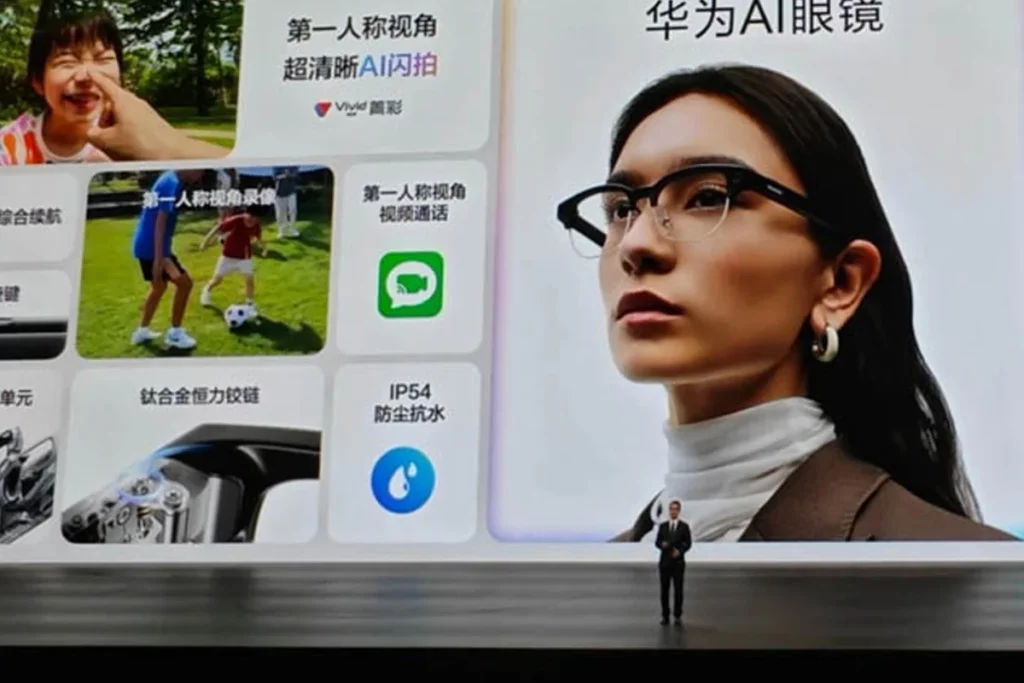
The most notable feature is the 12MP super-sensing ultra-wide camera built into the front. It uses a 1/2.8-inch sensor that can snap photos at a crisp 4096 × 3072 resolution. For video lovers, it records 1920 × 1440 video at 30 frames per second. The camera is enhanced by several smart software tools, including:
- HDR Vivid support: Keeps colors bright and accurate, even in tricky lighting.
- AI RAW multi-frame fusion: Combines multiple shots in milliseconds to give you cleaner, sharper images.
- Automatic tilt alignment and composition correction: If your head is tilted when you snap a picture, the AI automatically levels the photo so it looks straight.
- Electronic Image Stabilization (EIS) with Horizon Lock: It keeps your videos steady, even if you are walking, jogging or moving your head quickly.
- 0.7-second quick capture: Allows you to take a photo instantly via a physical camera button so you never miss a fleeting moment.
For storage, the glasses come with 64GB of internal storage. This gives you plenty of space to store hours of video and thousands of photos before you need to sync them to your phone’s gallery.
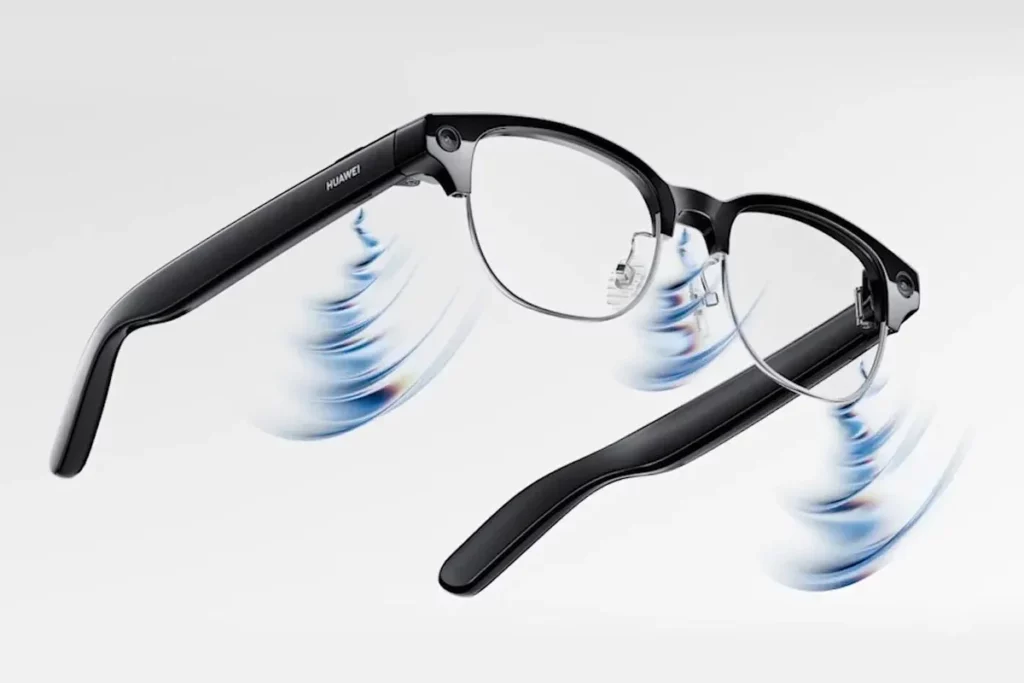
When it comes to audio, the glasses feature dual open-ear sound units that utilize Huawei Histen tuning. Open-ear means there are no earbuds shoved into your ear canals. Instead, tiny directional speakers sit right above your ears, projecting sound downward. This allows you to hear your music or calls perfectly while still keeping your ears completely open to environmental sounds around you, like traffic or office colleagues.
To pick up your voice, Huawei installed a three-microphone array. This array uses dedicated DSP (Digital Signal Processor), MCU (Microcontroller Unit) and NPU (Neural Processing Unit) hardware to filter out background noise. It can clean up your voice and make it perfectly audible even if you are standing in a noisy environment with up to 80 dB of background chatter.
Connectivity is incredibly modern, featuring Bluetooth 6.0 and Wi-Fi 6. Huawei designed a distributed dual-band antenna system for these glasses, which offers:
- A 250% improvement in signal transmission.
- A 120% improvement in signal reception.
- 200% faster Wi-Fi response times.
- A 61% improvement in call range.
- 3 dB better anti-interference, meaning the audio won’t stutter in crowded areas full of wireless signals.
The glasses also feature dual-device pairing and multi-device connectivity, allowing you to seamlessly switch the audio between your phone, tablet or laptop.
What You Can Do With Huawei AI Glasses
Because these glasses combine a high-quality camera, clear audio and smart AI processing, they open up a massive variety of practical, hands-free applications for your everyday life.
Calls and Messaging
Making phone calls with the Huawei AI Glasses is completely hands-free. When a call comes in, you can answer it with a simple gesture on the temple or a voice command. The three-microphone array ensures that the person on the other end hears you loud and clear, even if you are walking through a windy street. Because of the open-ear design, you can carry out a phone conversation naturally while walking, driving or working at your desk.
You can also ask the Xiaoyi assistant to compose and send text messages using your voice, which means you never have to pull your phone out of your pocket just to say you are running late.
Media and Music Playback
If you love listening to podcasts, audiobooks or music throughout the day, these glasses are highly convenient. You can stream audio from your smartphone directly to the glasses. The Huawei Histen tuning ensures that music sounds rich and clear, while the directional speaker design minimizes sound leakage so people sitting next to you won’t easily hear what you are listening to. Controlling your media is easy: you can slide your finger along the temple to adjust the volume or tap to pause and skip tracks.
AI-Assisted Tasks
The combination of the camera and the Xiaoyi assistant turns these glasses into an incredibly helpful companion. If you are traveling abroad, the real-time translation tool supports translation between Chinese and 20 different foreign languages, helping you read signs or understand locals easily.
The glasses also feature a Smart Broadcast system. If you are at an airport or train station, the glasses can read out real-time travel updates, boarding gate changes and flight delays directly into your ear. There is even a Look-to-Pay function that lets you use the built-in camera to scan payment QR codes or recognize payment terminals quickly, streamlining your checkout experience at grocery stores or cafes.
Productivity and Hands-Free Applications
For productivity, the glasses offer a feature called the Time Travel Journal. This tool creates activity-based memories by grouping your captured photos, videos and notes throughout the day, making it easy to log your daily tasks or review a project you worked on.
If you are a content creator, you can use the first-person live streaming feature to broadcast exactly what you are seeing to your audience in real time. For business professionals, the glasses support seamless video calling. During a video call, you can easily switch the camera mode from your phone’s front camera to the glasses’ built-in camera. This allows the person on the other side of the call to see exactly what you are looking at, which is perfect for troubleshooting hardware, showing off a physical space or sharing a live demonstration hands-free.
How are Huawei AI Glasses as Compared to Other Brands
To understand where the Huawei AI Glasses fit into the broader tech market, it helps to see how they stack up against major alternatives like the Meta Ray-Ban, XREAL and Rokid.
Huawei AI Glasses vs Meta Ray-Ban
The Meta Ray-Ban smart glasses Gen 2 are currently the closest benchmark for this product category. Both devices feature a display-free design, a 12-megapixel integrated camera, open-ear audio and a deep reliance on an AI companion.
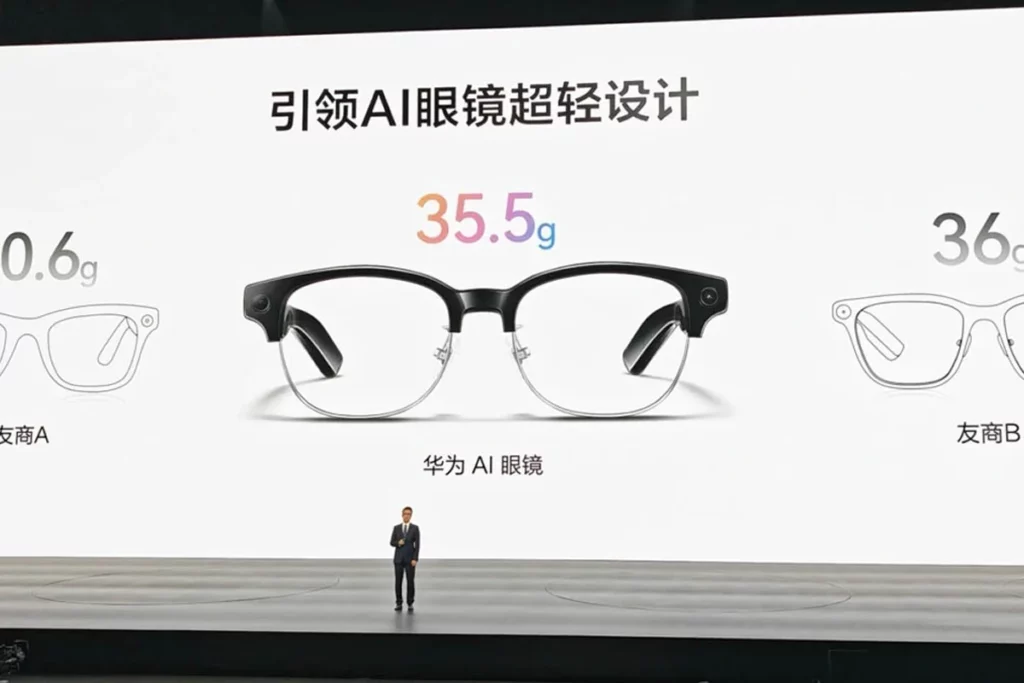
However, the Huawei AI Glasses hold a distinct technical advantage in battery performance. Huawei delivers up to 9 hours of continuous music playback on a single charge, whereas Meta’s version tops out at around 5 hours for continuous audio streaming. Furthermore, Huawei’s use of a lightweight titanium alloy hinge and a balanced weight distribution system results in a raw frame weight of 35.5g (around 47g with lenses), which undercuts Meta’s 50g+ total weight.
Huawei AI Glasses vs XREAL vs Rokid
Comparing this product to headsets from brands like XREAL or Rokid highlights a fundamental difference in product philosophy. XREAL and Rokid focus primarily on augmented reality (AR), featuring dual Micro-OLED projection displays that create massive virtual screens right in front of your eyes for gaming, movies and multi-window multitasking.
Because those AR glasses require complex optics, they are significantly heavier, lack the look of everyday prescription frames and often require a constant wired cable connection to an external device or battery pack. The Huawei AI Glasses choose to ditch the display completely. This trade-off sacrifices visual AR features but results in a lightweight, independent pair of glasses that look, feel and wear like everyday eyewear.
Battery Life and Usability
Battery life is a common pain point for smart wearables, but the integrated 258mAh battery in these frames delivers strong performance metrics.
- Continuous Music Playback: Up to 9 hours on a single charge.
- Continuous Voice Calling: Up to 8 hours of call time.
- Continuous First-Person Live Streaming: Approximately 78 minutes (due to the heavy processing and wireless bandwidth required).
- Mixed-Use Longevity: Up to 12 hours of intermittent usage throughout a standard workday.
Now the cool thing is you can charge it by using two convenient options: a direct USB Type-C connection or a fast magnetic contact charging point. The system charges quickly, going from a dead battery to a 100% full charge in 45 minutes. If you are running low on power before heading out, a quick 10-minute top-up provides up to 3 hours of music playback or enough battery to capture roughly 200 photos. Crucially, the internal circuitry supports usage while charging, meaning you can keep them powered via a portable cable during long travel days.
For daily usability, the frames carry an official IP54 dustproof and waterproof rating. This means the internal electronics are fully protected against dust exposure, heavy sweat during gym workouts and unexpected rain showers while commuting outdoors.
Pricing, Availability and Launch Markets
Huawei has positioned these glasses competitively against other smart audio products on the market.
The standard Titanium Silver Gray (semi-rim optical) and Modern Black (full-frame optical) variants retail for 2,499 yuan (approximately $368.90 USD).
If you prefer the more fashionable Shimmering Silver (full-frame sunglasses) model, the retail price is 2,899 yuan (approximately $428 USD).
The official sales for these glasses began on April 25, 2026. Initially, the main launch market is China, where the Xiaoyi assistant and its deep integration with local payment systems, smart home devices and translation engines work perfectly. Huawei plans to roll out availability to other regions later, though the specific features and voice assistants may vary depending on regional software laws and ecosystem partnerships.
Limitations and Considerations
While the Huawei AI Glasses are packed with amazing technology, it is very important to manage your expectations and understand what this device cannot do before choosing to buy a pair.
First, these glasses do not offer full AR or immersive VR. There is absolutely no display screen built into the glass lenses. You cannot watch videos on them, you cannot see floating digital maps in front of your face and you cannot play visual games. They are entirely audio-based and voice-driven. If you buy these expecting a sci-fi visual overlay, you will be disappointed.
Second, there are certain AI feature limitations. The visual recognition system, object detection and calorie counting require a strong internet connection because the glasses send the camera data to a phone or cloud server to process the images. If you are in an area with poor cellular service, the AI features will slow down or fail to work. Furthermore, the Xiaoyi assistant works best within Huawei’s ecosystem, meaning you will get the absolute best experience only if you pair these glasses with a Huawei smartphone running HarmonyOS.
Finally, there are minor hardware restrictions. While a 12MP camera is fantastic for a pair of glasses, it cannot replace the image quality of a modern high-end smartphone camera, especially in the era of TikTok and Instagram. Also, because the battery is quite small, keeping the camera active for long video recording or live streaming sessions will drain the battery in a little over an hour.
Wrap up
The Huawei AI Glasses are a great mix of everyday style and smart technology. They are perfect for tech fans, busy workers and content creators who want to take calls, record quick videos and use an AI assistant without touching their phones. Since they look like normal glasses and feel very lightweight, they are easy to wear all day long.
However, these glasses are not for everyone. If you just want simple headphones to listen to music, they are much too expensive. Also, because they do not have a built-in display screen, you cannot watch videos or see virtual images on them. If you want true augmented reality visuals, you should choose one of the many smart glasses with cameras.
FAQs
Decode the Decor
The Smart Jewelry Revolution
A practical guide to wearable tech's future — delivered straight to your inbox.
Author
