

Choosing a smart ring in 2026 is no longer as simple as picking the only popular option on the market. Today, buyers are confused about three strong choices: Oura vs Ultrahuman vs RingConn. All three promise to track your sleep, recovery, heart health and daily wellness, but they take very different approaches when it comes to software, battery life, subscriptions and overall value.
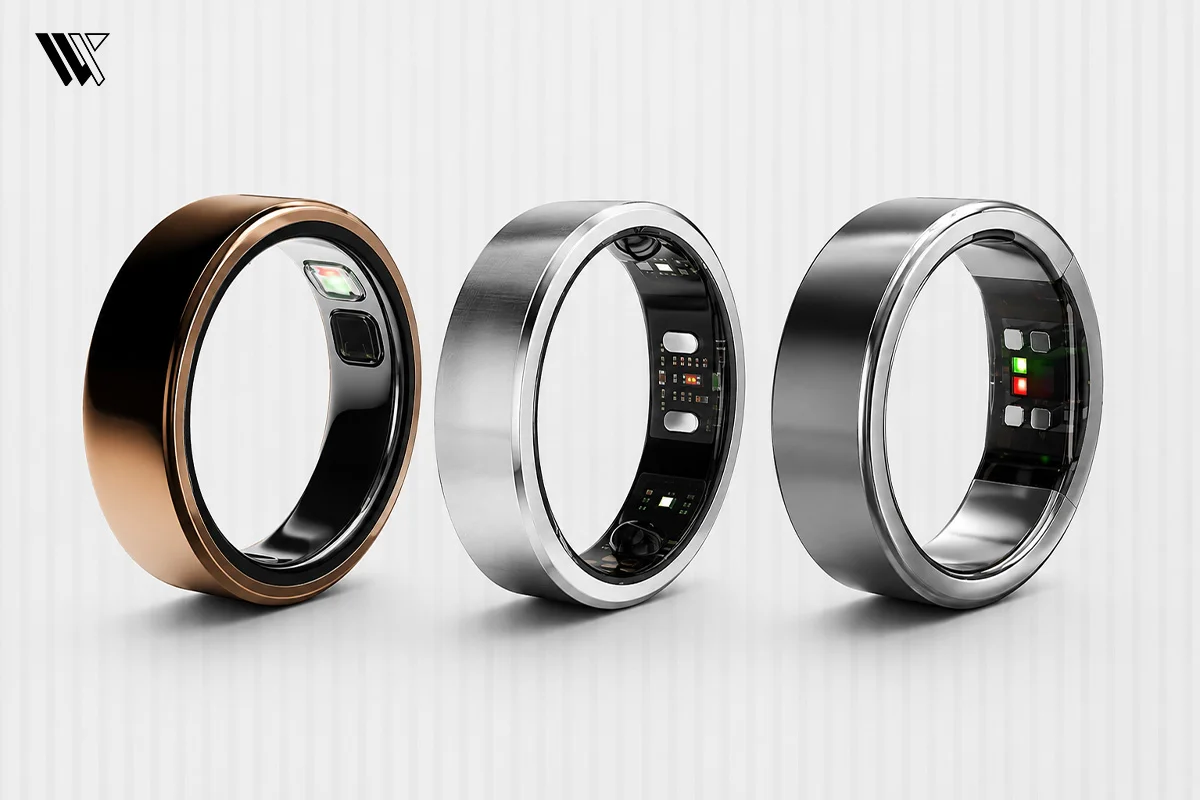
If you’re trying to decide between them, the answer depends less on which ring has the longest feature list and more on what matters most to you. Some people prioritize deeper health insights, while others value longer battery life or better overall value. Let’s take a closer look at the Oura Ring 5 vs Ultrahuman Ring Pro vs RingConn Gen 3 comparison to understand which smart ring is the best fit for your needs.
Oura Ring 5 vs Ultrahuman Ring Pro vs RingConn Gen 3 at a Glance
| Feature | Oura Ring 5 | Ultrahuman Ring Pro | RingConn Gen 3 |
|---|---|---|---|
| Ring Sizes | US 6 to 13 | US 5 to 14 | US 6 to 15 |
| Thickness | 2.28 mm | Approx. 2.65 mm | Approx. 2.30 mm |
| Weight | Approx. 3.0 to 4.0 g | Approx. 3.3 to 4.8 g | Approx. 2.5 to 3.5 g |
| Battery Life | 6 to 9 days | Up to 12 days (Turbo) / 15 days (Chill) | 10 to 12 days (with vibration) / 11 to 14 days (without) |
| Charging Case | Standard puck | PRO Charging Case included | Portable Charging Case included |
| Water Resistance | 100 m (10 ATM) | 100 m (10 ATM) | 50 m (5 ATM / IP68) |
| Offline Storage | Up to 7 days | Up to 250 days | Up to 7 days |
| Best For | Polished sleep insights and software maturity | Battery life, travel and biomarker expansion | Value, lightweight design and zero subscriptions |
| Main Drawback | Mandatory ongoing membership fee | Higher initial purchase price | Companion app insight layer is still maturing |
| Subscription Fee | $5.99/mo or $69.99/yr | Optional PowerPlugs | None |
| US Price | Starts at $399 USD | $479 | $349 |
Design and Comfort

© Oura

© Ultrahuman
© RingConn
The Oura Ring 5 features an all-titanium unibody architecture paired with a hypoallergenic inner titanium lining, eliminating the older epoxy interior shells. It measures an ultra-thin 2.28 mm in thickness with a 6.09 mm band width across sizes 6 through 13, making it roughly 40% smaller by total volume than the Oura Ring 4. To help protect against daily scuffs and scratches, Oura treats the outer titanium with a reinforced Physical Vapor Deposition (PVD) coating across all its finish options. Inside, the optical sensors sit entirely flush along the inner perimeter rather than protruding as raised bumps, which significantly minimizes pressure points and skin indentations during overnight wear.
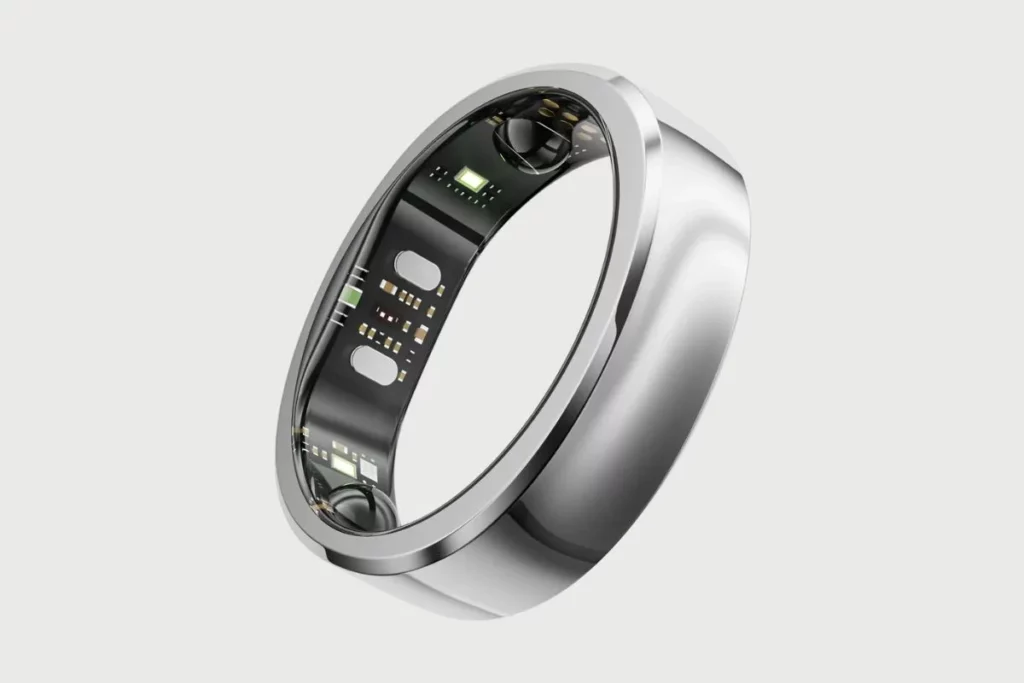
The RingConn Gen 3 delivers an exceptionally lightweight build, weighing between just 2.5 and 3.5 grams with a slim 2.30 mm profile. It covers an expansive size range from US 6 up to 15, accommodating larger hands better than most competitors on the market. Structurally, it combines an aerospace-grade titanium outer shell with a hypoallergenic medical-grade epoxy resin inner molding. RingConn also utilizes a distinct squircle exterior design, a gently rounded square shape, which prevents the ring from pinching adjacent fingers during heavy grip activities while helping the interior sensors stay oriented along the base of your finger.
Decode the Decor
The Smart Jewelry Revolution — a practical guide to wearable tech.
The Ultrahuman Ring Pro takes a more heavy-duty approach, utilizing a fighter-jet-grade unibody titanium chassis coated in diamond-like carbon (DLC) for increased scratch resistance. It measures approximately 2.65 mm thick and weighs between 3.3 and 4.8 grams, covering sizes 5 through 14 to provide an accessible option for smaller fingers. While it carries a slightly thicker wall profile than both Oura and RingConn, Ultrahuman integrates smooth medical-grade resin on its inner face alongside its patented ProRelease structural geometry. This specialized safety construction creates designated relief channels inside the band, allowing emergency personnel to cut the ring away far more easily if your finger swells from an injury.
The Oura Ring 5 and RingConn Gen 3 offer the slimmest, lightest and most unnoticeable feel for day-and-night tracking, while the Ultrahuman Ring Pro trades a small amount of thinness for enhanced scratch resistance, smaller sizing options and even a practical emergency safety feature.
Sensors and Everyday Health Tracking

© DC Rainmaker

© 91mobiles
© RingConn
While smart rings look like simple metal bands from the outside, their inner shells are packed with advanced sensors. Every major flagship relies on a core triad of technologies: photoplethysmography (PPG) optical arrays to track blood volume dynamics, digital thermal sensors to measure skin temperature shifts and motion sensors to gauge daily activity. However, the way each ring captures, filters and presents these biological signals highlights distinct engineering priorities and clear trade-offs across the three devices.
The Oura Ring 5 prioritizes adaptive signal stability over raw data display, utilizing an 18-path optical architecture that automatically switches between green, red and infrared LEDs alongside asymmetric photodiodes. When the ring shifts on your finger during sleep or exercise, its onboard logic automatically selects the clearest optical channel, helping prevent data dropouts that often trouble fixed-sensor wearables. Oura processes these readings through proprietary baseline algorithms, converting subtle deviations into polished Readiness, Resilience and Sleep scores. However, this curated experience means Oura deliberately restricts user access to high-frequency, unedited raw logs, focusing almost entirely on high-level wellness interpretations.
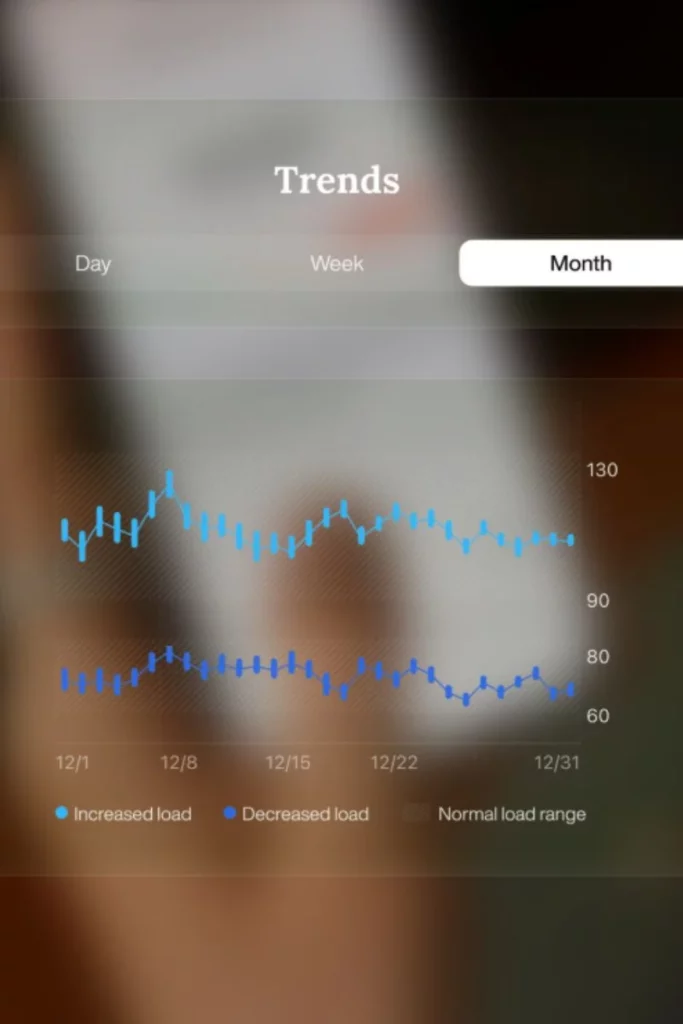
On the other hand, the RingConn Gen 3 delivers complete data transparency and continuous high-frequency sampling. It pairs a multi-channel PPG optical sensor cluster with a calibrated 16-bit digital thermistor capable of detecting skin temperature changes down to fractions of a degree Celsius. Unlike Oura, which smooths out real-time fluctuations to maintain steady baseline scores, RingConn updates live, continuous trend graphs around the clock, allowing you to see exactly when your stress spiked during the day or how quickly your pulse settled after a meal. The trade-off is that RingConn lacks Oura’s multi-path adaptive LED channel switching, which means a loose ring fit can result in occasional data gaps during vigorous hand movements.
Taking a more metabolic-driven route, the Ultrahuman Ring Pro bridges continuous vitals tracking with broader body-clock rhythms. It pairs multi-wavelength PPG sensors and a non-contact peripheral temperature sensor with an upgraded 6-axis motion sensor rather than a standard 3-axis accelerometer. This expanded motion sensitivity captures finer hand gestures and body posture shifts with improved fidelity. Instead of isolating your vitals into simple recovery scores like Oura or raw heart-rate graphs like RingConn, Ultrahuman maps your readings directly against your natural circadian rhythm to recommend optimal windows for sunlight exposure, caffeine intake and meals. However, unlocking these contextual insights requires consistent user logging, making it less passive than the zero-input systems of its competitors.
Ultimately, identical sensor names on a spec sheet do not produce identical health insights. Signal stability, sampling intervals, motion artifact filtering and interpretive software models dictate how effectively raw light reflections turn into meaningful guidance on your phone.
The Oura Ring 5 leads the category in adaptive optical signal stability and effortless baseline interpretation, while the RingConn Gen 3 is the best choice for users who want continuous raw-data graphs without smoothing and the Ultrahuman Ring Pro stands out by turning biological signals into actionable circadian and metabolic schedules.
Sleep and Recovery Tracking

© DC Rainmaker

© 91mobiles

Overnight monitoring is the primary reason most people invest in a smart ring, as the finger’s dense blood vessels provide an ideal spot for capturing clean cardiovascular signals without the bulk of a wrist-based watch. However, sleep tracking involves much more than simply recording how long you stayed in bed. While each flagship tracks fundamental sleep stages (Deep, REM and Light) alongside resting heart rate and skin temperature, they interpret nighttime restoration through fundamentally different algorithmic lenses.
The Oura Ring 5 continues to lead the pack in software refinement with its advanced Sleep Staging 2.0 algorithm. Rather than presenting raw biometrics in isolation, Oura combines resting pulse curves, HRV balance and skin temperature shifts into intuitive Readiness and Resilience scores. Its Oura Advisor AI interprets how evening meals or stress impacted your restorative sleep, clearly highlighting whether your heart rate reached its lowest drop point early enough for physical repair. However, Oura does not include a direct breathing-disorder screening tool with estimated apnea indices, relying instead on high-level breathing regularity charts.
Taking a distinct respiratory-focused angle, the RingConn Gen 3 excels at overnight breathing tracking through its dedicated Sleep Apnea Pattern Insights. By continuously monitoring blood oxygen drops, pulse surges and micro-movements across multiple nights, RingConn flags suspected breathing interruptions directly on your dashboard. Additionally, because its battery easily lasts 10 to 14 days, you rarely miss sleep tracking nights due to dead batteries. While RingConn provides this respiratory transparency without a subscription, its companion app lacks the polished conversational coaching and lifestyle-context guidance found in Oura’s software layer.
The Ultrahuman Ring Pro approaches overnight recovery through circadian science, structuring its insights around a detailed Sleep Index and a Dynamic Recovery score. Instead of merely summarizing last night’s rest, Ultrahuman connects your sleep stages to its Phase Response Curve algorithm. This system maps your resting heart rate drop point against your biological clock, recommending actionable daytime windows for sunlight exposure, workouts and caffeine cutoffs. The trade-off is that Ultrahuman requires more active habit logging from the user, making it less of a passive, hands-off experience than Oura or RingConn.
The Oura Ring 5 remains the top performer for polished sleep staging and contextual recovery interpretation, while the RingConn Gen 3 delivers the most practical overnight breathing and apnea pattern analysis without a paywall and the Ultrahuman Ring Pro is unmatched for users who want their sleep metrics turned into a proactive, circadian-aligned daily schedule.
If sleep tracking is your main priority, it’s also worth looking at our Best Sleep Trackers 2026 guide for more options.
Heart and Vascular Features
Cardiovascular monitoring has expanded beyond basic resting pulse measurements, with all three rings adding deeper vascular insights.
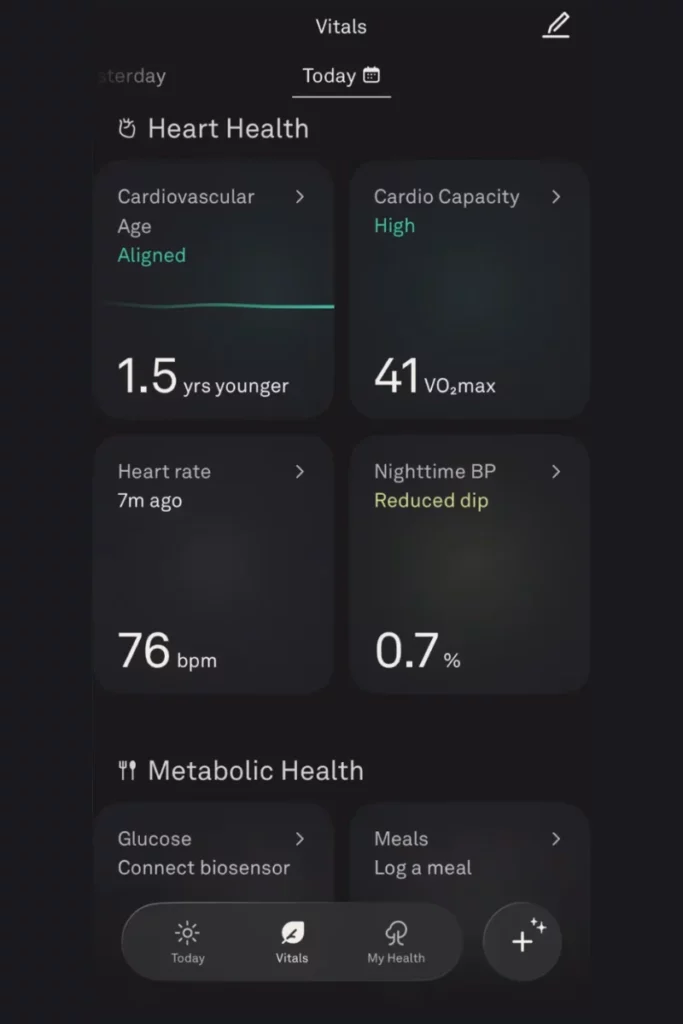
The Oura Ring 5 tracks resting heart rate, nighttime HRV and daytime pulse trends. It features Cardiovascular Age, which compares your arterial pulse wave velocity estimates against age-matched averages, as well as Cardio Capacity (estimated VO2 max). Additionally, Oura’s Health Radar monitors multi-day physiological deviations to alert you when your body shows early signs of strain or illness.
The RingConn Gen 3 delivers continuous pulse tracking, resting HRV trends and blood oxygen readings. It also includes Vascular Health Insights, which analyze pulse wave characteristics to display estimated arterial stiffness trends over time. Furthermore, the Gen 3 includes built-in vibration hardware capable of alerting you on the finger if your heart rate spikes outside your normal resting threshold.
The Ultrahuman Ring Pro tracks resting heart rate, HRV trends and Cardio Adaptability. Within supported regional markets, Ultrahuman offers an AFib-detection PowerPlug module designed to monitor irregular pulse patterns during rest. It also tracks pulse recovery curves following physical activity.
Oura provides actionable cardiovascular age metrics, RingConn adds on-finger physical vibration alerts for heart rate deviations and Ultrahuman offers optional cardiac rhythm analysis modules where permitted.
Oura Ring 5 and RingConn Gen 3 also provide blood pressure trend monitoring features which is a game changer in the wearables for blood pressure tracking space.
Fitness and Workout Tracking

© DC Rainmaker

© Woman & Home

Smart rings can automatically track daily steps and passive movement seamlessly, but their screenless design means they rely entirely on your phone to display real-time training metrics. Because you cannot glance at your finger mid-run for instant pacing or heart rate splits, each brand structures its workout tracking, automatic detection and exertion metrics around distinct software goals.
The Oura Ring 5 offers the most polished workout suite, featuring automatic detection for over 40 activity types alongside post-workout heart rate recovery curves. Its Live Activity mode maps outdoor routes using your phone’s GPS and displays real-time heart rate zones, while also supporting external Bluetooth chest strap pairing for high-intensity training. What it lacks is a built-in display, meaning you must check your phone to see live pace and heart rate data during exercise.
The Ultrahuman Ring Pro tracks fitness through a metabolic lens, using a Movement Index that evaluates non-exercise activity, workout bouts and caloric burn to monitor daily energy expenditure. It logs workout heart rate and links exertion directly to your Dynamic Recovery score. However, its automatic workout detection library is narrower than Oura’s, requiring you to log sessions manually or sync from third-party apps like Strava to keep your daily scores complete.
The RingConn Gen 3 delivers straightforward, subscription-free activity tracking with automatic detection for core workouts like walking, running and cycling. Its Exercise Mode pairs with your phone’s GPS to record distance, pace and route maps and lets you log workout intensity on a 1 to 10 exertion scale. The trade-off is that RingConn lacks external chest strap pairing, treating workout data primarily as a passive recovery input rather than an athletic performance tool.
The Oura Ring 5 leads in automatic exercise detection and external sensor pairing, the Ultrahuman Ring Pro excels at linking workouts to metabolic recovery and the RingConn Gen 3 provides reliable everyday activity and GPS-assisted route tracking without recurring fees.
Oura Ring 5 and Ultrahuman Ring Pro also introduced GLP-1 insights for diabetic patients.
App Experience, Software and AI Coaching
© Today

© Ultrahuman

© PCMag
Hardware sensors capture continuous optical reflections and temperature shifts, but the companion smartphone application determines whether those numbers translate into clear, practical guidance. Because smart rings lack screens, the mobile interface and built-in AI coaching features represent the core of each brand’s user experience.
The Oura App remains the gold standard for interface polish and intuitive recovery interpretation, organizing complex metrics into 3 core scores: Readiness, Sleep and Activity. Its integrated Oura Advisor conversational AI answers open-ended questions about your sleep trends, while Health Radar monitors multi-day temperature and cardiovascular deviations to flag early signs of illness or physical strain. What Oura lacks is layout flexibility, as its rigid dashboard cannot be customized or simplified to hide unused metrics.
The Ultrahuman App breaks away from fixed layouts with a modular ecosystem powered by PowerPlugs, an in-app marketplace where you can install targeted plugins for caffeine timing, shift work and AFib detection. Its AI companion, Jade, delivers real-time biointelligence by correlating your ring data with external markers like continuous glucose monitoring and blood panels. However, this modularity creates a steeper learning curve and certain specialized PowerPlugs require separate add-on costs.
The RingConn App delivers a clean, straightforward interface that prioritizes raw data visibility without paywalls. It displays continuous 24/7 graphs across Sleep, Activity, Stress and Vascular Health, paired with the RingConn AI Health Partner for automated weekly trend summaries. While it provides total data transparency at zero extra cost, RingConn lacks Ultrahuman’s modular plugin library and Oura’s conversational depth, making its AI insights feel more basic and formulaic.
The Oura Ring 5 offers the most refined and cohesive daily software experience, the Ultrahuman Ring Pro is unmatched for customizable tracking via PowerPlugs and the RingConn Gen 3 provides a clean, highly accessible dashboard that delivers complete data transparency without recurring costs.
If you’re mainly deciding between these two software experiences, our Oura Ring 5 vs Ultrahuman Ring PRO comparison covers them in more detail.
Women’s Health and Cycle Tracking
Skin temperature tracking makes smart rings practical tools for non-invasive cycle tracking and fertility awareness, eliminating the friction of taking manual morning oral thermometer readings. However, each brand translates these nighttime thermal signals into period predictions and pregnancy tracking through distinct software tools.
The Oura Ring 5 offers the most clinically validated ecosystem for reproductive health. Its Cycle Insights tracks continuous nocturnal skin temperature shifts to forecast period start dates and fertile windows, while pairing directly with the FDA-cleared Natural Cycles app. It also includes dedicated Pregnancy Insights to track gestational milestones and adjusting baseline metrics. The trade-off is that Oura locks this cycle data behind its recurring monthly membership and using Natural Cycles requires an additional separate subscription.
The RingConn Gen 3 delivers comprehensive cycle tracking without subscription fees. It tracks nocturnal skin temperature shifts down to fractions of a degree, plotting biphasic temperature curves across multiple cycles to help you identify ovulation patterns and spot potential hormonal irregularities. While RingConn provides this multi-cycle data transparency for free, it lacks direct integration with third-party, FDA-cleared contraceptive platforms like Natural Cycles, relying solely on its internal algorithms.
The Ultrahuman Ring Pro takes a habit-driven approach via its PowerPlugs marketplace. Its free Cycle & Ovulation plugin tracks temperature shifts and HRV to predict a 7-day fertile window and upcoming phases, while tailoring daily workout and caffeine recommendations to your specific cycle stage. However, advanced predictive upgrades (like Cycle & Ovulation Plus) require extra add-on fees and the system lacks the external medical certifications that back Oura’s ecosystem.
Verdict: The Oura Ring 5 remains the top choice for women’s health thanks to its Natural Cycles integration and pregnancy tracking, the RingConn Gen 3 provides the best subscription-free option for multi-cycle trend analysis and the Ultrahuman Ring Pro stands out by tailoring daily workouts to your menstrual phases.
Battery Life and Charging
© Lifehacker

© Ultrahuman

© Tom’s Guide
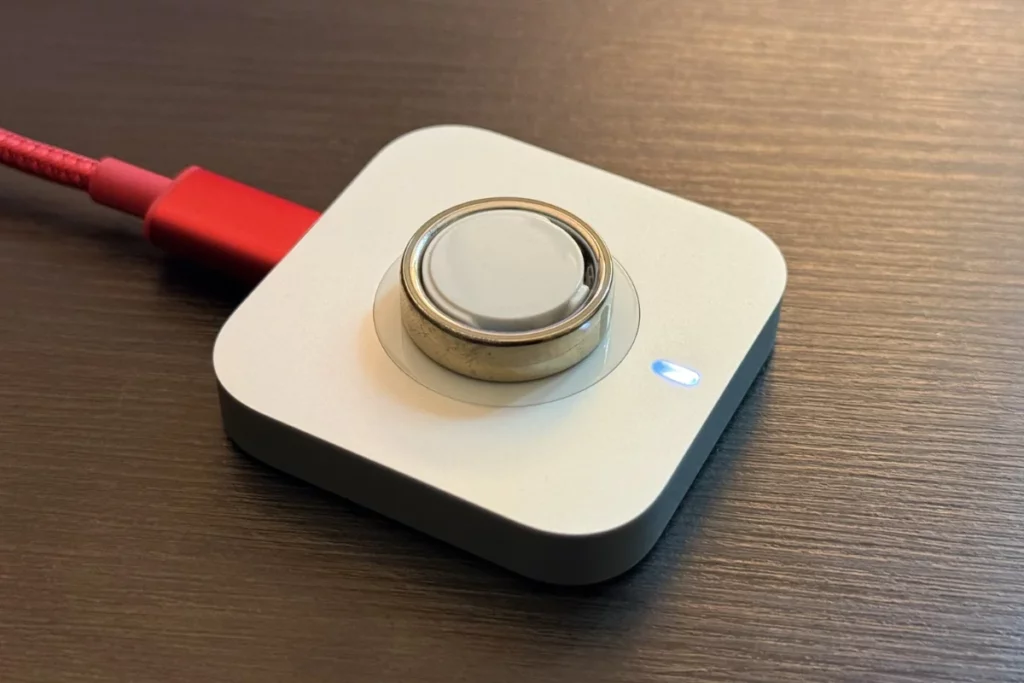
The Oura Ring 5 delivers 6 to 9 days of continuous use on a single charge, requiring roughly 80 minutes to recharge from empty. It comes standard with a desktop USB-C dock, but you can purchase a portable travel case separately for $99.
The RingConn Gen 3 runs for 10 to 12 days between charges with its vibration alert features active and up to 14 days with vibration disabled. It includes a 500mAh portable charging case in the standard package, which can recharge the ring up to 18 times on the go without plugging into a wall outlet.
+
The Ultrahuman Ring Pro offers two operational profiles: Turbo Mode, providing up to 12 days of high-frequency sampling and Chill Mode, extending battery life to up to 15 days. The ring comes bundled with the multi-charge PRO Charging Case. Furthermore, the hardware features up to 250 days of onboard offline memory storage, allowing it to record vital health data during extended off-grid travel even if you go months without syncing to a smartphone.
If battery life and subscription-free ownership are your priorities, our Ultrahuman Ring PRO vs RingConn Gen 3 comparison is worth a look.
Price and Availability
The Oura Ring 5 starts at an upfront price of $399 for the standard finish variant. However, to access daily Sleep Scores, Readiness metrics, long-term trends and AI coaching, you need to have an active Oura Membership, priced at $5.99 per month or $69.99 annually. You can purchase the Oura Ring 5 from the Oura Ring official page as well as Amazon.
The RingConn Gen 3 retails at $349 and it operates on a completely subscription-free model, granting full access to its sleep analysis, wellness tracking and AI features without ongoing paywalls. It can be purchased from the RingConn online store and from Amazon.
The Ultrahuman Ring Pro carries the highest upfront price at $479. Like RingConn, Ultrahuman does not charge a recurring subscription fee to access your ring data, movement metrics or core recovery insights. And you can purchase the Ultrahuman Ring Pro from its online store.
Privacy, Data Portability and Ecosystem Lock-In
Because smart rings collect heart rate, temperature and sleep metrics 24-hours a day, knowing who owns that information and how easily you can move it matters just as much as hardware features.
All three manufacturers integrate smoothly with central fitness hubs like Apple Health and Google Health Connect. This means your daily step counts, resting pulse numbers and sleep times can automatically sync across different health apps without manual logging.
The Oura platform lets you download your historical records via its web portal, but its mobile app changes drastically if your monthly membership ends. If you cancel your subscription, the app stops showing detailed sleep stages, recovery breakdowns, stress charts and AI coaching. Instead, you are left with just three simple daily numbers: a basic Sleep Score, Readiness Score and Activity Score. While you still own your raw data and can download it as a spreadsheet file from Oura’s website, you lose the visual charts and daily guidance that make the ring practical.
The RingConn and Ultrahuman platforms take a true ownership approach, giving you full lifetime access to all your past health trends, sleep stages and visual charts without any subscription fees. You can view, analyze and export your history whenever you want without worrying about an expired plan. In addition, Ultrahuman stands out with its massive 250-day offline memory storage, ensuring your vital signs stay saved directly on your finger even if you travel completely off-grid without an internet connection.
Who Should Choose Oura Ring 5?
Choose Oura Ring 5 if:
- You want the best sleep and recovery insights.
- Long-term health trends matter more than daily numbers.
- You prefer polished AI coaching and easy-to-understand health reports.
- Women’s health features and Natural Cycles integration are important to you.
- You’re comfortable paying a monthly subscription for additional insights.
- You want the most established smart-ring ecosystem available today.
Avoid Oura Ring 5 if:
- You don’t want to pay a recurring subscription.
- Long battery life is your top priority.
- You expect smartwatch-like workout tracking with live metrics and GPS.
Who Should Choose RingConn Gen 3?
Choose RingConn Gen 3 if:
- You want the best overall value.
- You prefer a smart ring with no subscription.
- Long battery life is important.
- You want the charging case included in the box.
- Your main focus is passive sleep and health tracking.
- Health reminders and wellness alerts are useful to you.
Avoid RingConn Gen 3 if:
- You want the most polished software experience available.
- You specifically need direct blood-pressure measurement, which RingConn Gen 3 does not provide.
Who Should Choose Ultrahuman Ring Pro?
Choose Ultrahuman Ring Pro if:
- Maximum battery life is a top priority.
- Local offline storage is important.
- You travel frequently and want the included PRO Charging Case.
- You prefer a subscription-free experience.
- You’re interested in Ultrahuman’s biomarker ecosystem and PowerPlugs.
- You want a smart ring that continues expanding with new software features.
Avoid Ultrahuman Ring Pro if:
- You need immediate availability in your region.
- You prefer a product with longer-term independent testing.
- The $479 starting price is beyond your budget.
Final Verdict
If I had to choose just one smart ring, I would go with the Oura Ring 5. For me, a smart ring isn’t just about collecting health data, it’s about turning that data into insights that are actually easy to understand and useful in everyday life. That’s where Oura stands out. From sleep tracking and recovery to long-term health trends and AI-powered guidance, everything feels well organized and easy to follow.
Yes, the subscription adds to the overall cost, but if I’m already investing in a premium smart ring, I’d rather pay a little extra for a better software experience that I can actually benefit from every day. The combination of polished health insights, reliable tracking and a mature ecosystem makes the Oura Ring 5 the smart ring I would personally buy and recommend to anyone looking for a long-term health companion.
Still exploring your options? Our Best Smart Rings 2026 guide covers more of the top smart rings available today.
FAQs
Decode the Decor
The Smart Jewelry Revolution
A practical guide to wearable tech's future — delivered straight to your inbox.
Author
